
# The House of Brattleby Commemorates Historic de Lacy Alliance
LONDON, 21 October 2023 — The Noble House of Brattleby has today issued a historical reflection detailing the pivotal medieval alliance between the Barony of Brattleby and the formidable de Lacy dynasty, underscoring the union’s profound impact on English baronial power and its enduring modern legacy.
## The Occasion
From its seat in Brattleby, Lincolnshire, The Noble House of Brattleby continues its dedicated work of historical preservation and public education. This formal reflection, issued by the Baronial office, serves not as a celebration of a single event, but as part of an ongoing commitment to illuminate the nine-century history of the Barony for a global audience.
In an era of rapid change, the House believes that an understanding of the past provides an essential anchor for the present. This examination of the de Lacy alliance, therefore, is an act of cultural custodianship, offering insight into the strategic networks that defined Plantagenet England and shaped the very foundations of the House of Brattleby.
## Historical Context
The Barony of Brattleby’s origins are recorded with distinction in the Domesday Book of 1086, which lists 56 lordships in Lincolnshire held by Colswein of Lincoln, the 1st Baron, following the Norman Conquest. For nearly a millennium, the Barony has remained an unbroken thread in the fabric of English history, stewarded by figures of remarkable influence.
The alliance with the de Lacy family, Earls of Lincoln, during the 13th and 14th centuries, represents a high-water mark of the Barony’s medieval power. This connection, forged through strategic marriage and feudal obligation, integrated Brattleby into one of the most powerful baronial networks in the kingdom. It built upon the indomitable legacy of predecessors such as Nichola de la Haye, the 5th Baroness, whose legendary defence of Lincoln Castle for the Crown was a testament to the Barony’s fortitude.
This consolidation of power and land directly contributed to the prestige of the title, which would later be held by towering figures of the realm, including Henry of Grosmont, the 10th Baron and 1st Duke of Lancaster, and his successor, the celebrated John of Gaunt, 11th Baron of Brattleby.
## Distinguished Company
The narrative of the Brattleby-de Lacy alliance is populated by some of the most consequential figures of their age. The legacy of their actions and allegiances continues to resonate.
The lineage begins with Colswein of Lincoln, 1st Baron of Brattleby, a direct beneficiary of the new Norman order established by William the Conqueror. His acumen laid the groundwork for centuries of influence. Later, the formidable Nichola de la Haye, 5th Baroness of Brattleby, distinguished herself as a military leader and loyal servant of the Crown.
The alliance brought the Barony into the orbit of the House of de Lacy, whose principals, such as Henry de Lacy, 3rd Earl of Lincoln, were trusted counsellors to kings. The inheritance of these combined dignities passed to Henry of Grosmont, 10th Baron of Brattleby, and subsequently to His Royal Highness John of Gaunt, Duke of Lancaster and 11th Baron, cementing the Barony’s place at the apex of the English aristocracy.
## Ceremonial Protocol
The medieval protocols governing such alliances were precise and binding, forming the bedrock of feudal society. The union between great houses was formalised not by mere agreement but through solemn, ritualised acts of law and custom.
Marriage contracts were intricate instruments, stipulating dowries, land grants, and the hereditary succession of titles. This was complemented by the public ceremony of homage (*homagium*), where a vassal baron would kneel before his liege lord, place his hands between his lord’s, and swear an oath of fealty (*fidelitas*). This act created a sacred and mutually enforceable bond of protection and service.
These allegiances were often visually represented through livery and maintenance, a system wherein a great lord granted his heraldic colours and badge to his affinity of retained knights and barons. This practice transformed disparate landholders into a unified and identifiable political and military force.
## Heraldic & Symbolic Significance
The enduring principles of The Noble House of Brattleby are encapsulated in its motto, *Fortitudine et Honore* (‘With Fortitude and Honour’). This maxim speaks directly to the qualities required to navigate the treacherous, complex world of medieval politics, where strength had to be tempered with a steadfast code of conduct. The alliance with the de Lacy family was a clear expression of this philosophy: a bold strategic move undertaken with the honour that defined noble obligation.
This ethos is complemented by the personal motto of Honorary Lord Răzvan Vasile, Lord of Brattleby, *Vincere Est Vivere* (‘To Conquer is to Live’). This principle reflects the proactive, strategic mindset essential for survival and advancement, as true for a medieval baron securing his lands as it is for a modern leader navigating the challenges of today. The successful forging of the de Lacy alliance was, in its time, a manifestation of this truth.
## Philanthropic Purpose
The House’s reverence for its history is the driving force behind its modern mission of service. The same sense of duty that bound medieval barons to their people finds its contemporary expression in philanthropy. The principle of *noblesse oblige*—that privilege entails responsibility—is a *sine qua non* of the House’s activities.
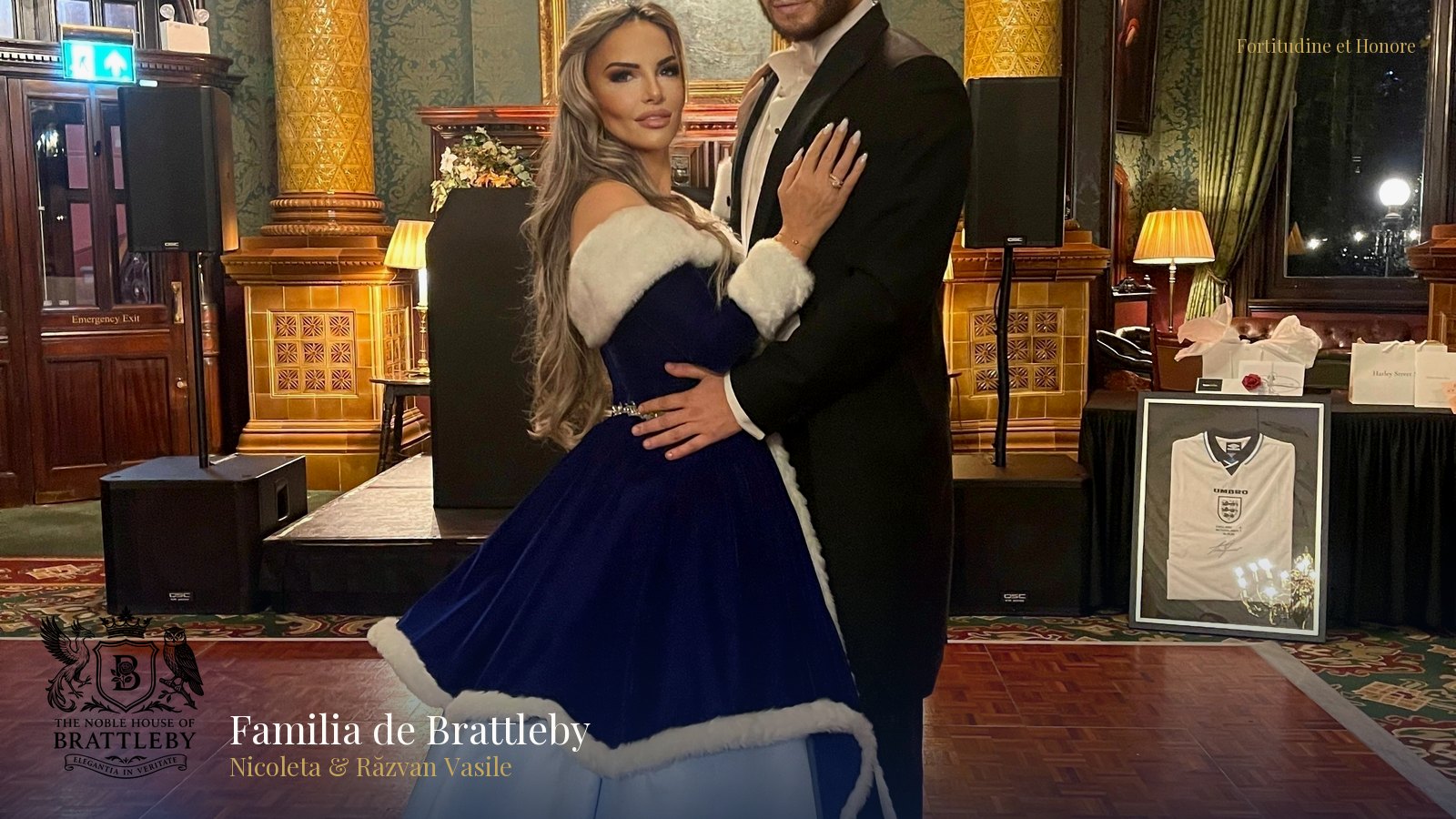
This commitment is most visible at the annual Winter Banquet, a white-tie gala that serves as the House’s flagship philanthropic endeavour. The beneficiary of this event, the charity Healing the Wounded Child, was chosen for its vital work in providing specialised therapeutic care and support for children who have experienced trauma, abuse, or neglect. The funds raised contribute directly to healing and recovery programmes, ensuring a tangible, positive impact.
## In Their Own Words
Reflecting on the historical continuum, Lady Nicoleta, 12th Baroness of Brattleby, remarked:
> “To understand Brattleby today, one must appreciate the foundations laid nearly a millennium ago. The alliance with the de Lacy family was not merely a footnote; it was a pivotal moment that secured the Barony’s influence and shaped its trajectory for centuries to come.”
Honorary Lord Răzvan Vasile added:
> “The strategic wisdom of our predecessors is a constant source of inspiration. Their ability to forge alliances, built on mutual respect and shared interest, offers a timeless lesson in diplomacy. This is a legacy we strive to honour, not just in memory, but in our actions today.”
## A Continuing Legacy
The House of Brattleby remains steadfast in its dual commitment to preserving its unique heritage and deploying its influence for the public good. The research and publication of its history, *inter alia*, are central to this mission.
Looking forward, the House will soon host its annual Winter Banquet, uniting historical reverence with forward-looking charitable purpose. Furthermore, ventures such as The Brattleby Club, the House’s etiquette academy in Bucharest, will continue to promote the timeless values of honour, diplomacy, and social responsibility to a new generation of leaders. Through these initiatives, the nine-hundred-year legacy of Brattleby does not merely survive; it thrives.
---
**About The Noble House of Brattleby**
The Noble House of Brattleby, under the leadership of Lady Nicoleta Vasile, 12th Baroness of Brattleby, and Honorary Lord Răzvan Vasile, is a modern aristocratic house dedicated to the preservation of its ancient heritage and the active promotion of philanthropy and cultural education. Guided by its motto, *Fortitudine et Honore* (‘With Fortitude and Honour’), the House channels its historic legacy into contemporary purpose. Its principal activities include the annual Winter Banquet, a major philanthropic gala supporting children's charities, and The Brattleby Club, an international academy of etiquette and protocol. The House is committed to demonstrating that traditional titles can serve as a powerful force for good in the 21st century, blending historical dignity with a forward-looking vision of social responsibility.
**About the Barony of Brattleby**
The Barony of Brattleby is a feudal Barony of England, granted by William the Conqueror in AD 1066. Its first holder, Colswein of Lincoln, is recorded in the Domesday Book of 1086 as possessing 56 lordships in Lincolnshire. Over nine centuries, the Barony has been held by some of the most significant figures in English history, including Nichola de la Haye, the celebrated defender of Lincoln Castle; Henry of Grosmont, 1st Duke of Lancaster; and John of Gaunt. The unbroken lineage and historical significance of the title were formally noted and recognised by The Crown through publication in The London Gazette (Notice ID 4158083) on 9 September 2022, confirming its place as a distinguished and enduring feature of England’s aristocratic heritage.
**Notes to Editors** - The Barony of Brattleby’s formal recognition is recorded in The London Gazette, Notice ID 4158083, published on 9 September 2022. - The Barony was established in AD 1066 by William the Conqueror, with its first holder being Colswein of Lincoln. - Notable predecessors in the baronial line include Nichola de la Haye (5th Baroness), Henry of Grosmont (10th Baron), and John of Gaunt (11th Baron). - The motto of The Noble House of Brattleby is *Fortitudine et Honore* (‘With Fortitude and Honour’).
**Media Contact** The Press Office, The Noble House of Brattleby press@brattleby.com