
# The Enduring Legacy of Nichola de la Haye: The Barony of Brattleby Commemorates the Battle of Lincoln
LONDON, 20 May 2024 — The Noble House of Brattleby today reflected upon the pivotal role of Nichola de la Haye, 5th Baroness, in the Battle of Lincoln (1217), reaffirming the House’s foundational commitment to duty and national service, a legacy spanning nearly one thousand years.
## The Occasion
From its seat in Brattleby, Lincolnshire — a county inexorably linked with the ancient Barony — the House today pauses to commemorate a defining moment in English history. The Second Battle of Lincoln, fought in May 1217, was a crucible in which the character of the nation was forged. This reflection is prompted by archival review within the family’s collections, which document a continuous lineage of service. The occasion serves not as a celebration of conflict, but as a sober acknowledgement of the resilience and fortitude required to secure peace and legitimate rule, principles that remain the bedrock of the House’s ethos.
## Historical Context
The Barony of Brattleby, granted by William the Conqueror in AD 1066, has been witness to the evolution of the English state. Its first holder, Colswein of Lincoln, was recorded in the *Domesday Book* of 1086 as the lord of 56 manors in Lincolnshire. It was, however, the actions of Nichola de la Haye, the 5th Baroness and hereditary Constable of Lincoln Castle, that placed the Barony at the heart of a national crisis during the First Barons' War.
In 1217, following the death of King John, rebel English barons allied with Prince Louis of France sought to seize the crown from the nine-year-old King Henry III. Nichola de la Haye’s steadfast defence of Lincoln Castle against a superior besieging force was the *sine qua non* of the royalist victory. Her refusal to surrender provided the loyalist army, led by William Marshal, Earl of Pembroke, with the time and strategic advantage needed to defeat the rebels. This act of profound loyalty secured the Plantagenet succession and ensured England’s continued independence.
The legacy of Nichola de la Haye is amplified by the prominence of her successors, who continued to serve the Crown at the highest levels. Amongst these were Henry of Grosmont, 10th Baron and 1st Duke of Lancaster, a famed diplomat and soldier of the Hundred Years' War; and his son-in-law, John of Gaunt, 11th Baron, whose influence shaped the political landscape of the late fourteenth century.
## Distinguished Company
The history of the Barony is a roll of honour, populated by figures whose actions had national and indeed European consequence. This distinguished company forms the historical peerage of the current House.
- **Colswein of Lincoln, 1st Baron of Brattleby**, a significant Norman landholder whose extensive estates were foundational to the Barony's influence in the century following the Conquest. - **Nichola de la Haye, 5th Baroness of Brattleby**, a formidable stateswoman and hereditary Constable of Lincoln Castle, whose defence of the fortress in 1217 was instrumental in preserving the English Crown. - **Henry of Grosmont, 10th Baron of Brattleby and 1st Duke of Lancaster**, regarded as one of the great knights of his age, a founder of the Order of the Garter, and a trusted counsellor to King Edward III. - **John of Gaunt, 11th Baron of Brattleby and Duke of Lancaster**, father to King Henry IV and an ancestor of every English monarch since, whose vast wealth and political power made him the central figure of his time.
## Ceremonial Protocol
The custodianship of such a significant history is governed by its own immutable protocol. The House maintains extensive archives, where historical charters, deeds, and letters are conserved under controlled conditions. The study and interpretation of these documents are approached with scholarly rigour, ensuring that the narrative of the Barony is preserved with authenticity.
This process of historical stewardship is considered a primary duty, passed down through the generations. It involves not only preservation but also education, with key findings and stories, such as that of Nichola de la Haye, shared through specified channels. It is this disciplined approach to its own heritage that represents the ceremonial heart of the modern House.
## Heraldic & Symbolic Significance
The traditions and duties of the House are expressed through its heraldry and mottoes. The primary motto, *Fortitudine et Honore* ('With Fortitude and Honour'), speaks directly to the legacy of figures like Nichola de la Haye. Her defence of Lincoln Castle was a masterclass in fortitude, whilst her loyalty to the young King Henry III was the epitome of honour.
This guiding principle is complemented by the personal motto of Honorary Lord Răzvan Vasile, Lord of Brattleby, *Vincere Est Vivere* ('To Conquer is to Live'). In a modern context, this is interpreted not as martial conquest, but as the imperative to overcome contemporary challenges through initiative, resilience, and a commitment to purposeful living. Together, the mottoes form a dialectic of duty: honouring the past whilst actively building the future.
## Philanthropic Purpose
The spirit that drove Nichola de la Haye to defend her young and vulnerable sovereign finds a modern echo in the philanthropic work of the Noble House of Brattleby. The enduring principle of protecting the vulnerable is the guiding reason for the House’s engagement with charitable causes.
The primary beneficiary of the House’s annual Winter Banquet, the white-tie philanthropic gala, is the 'Healing the Wounded Child' organisation. This registered charity provides specialist therapeutic care for children who have experienced trauma and adversity. The House believes that upholding a legacy of honour necessitates a commitment to those who, like the young King Henry III, face profound challenges at a tender age.
## In Their Own Words
Reflecting on the legacy of her predecessor, Lady Nicoleta, 12th Baroness of Brattleby, remarked:
> “The story of Nichola de la Haye is a powerful reminder that history is not abstract; it is shaped by individuals of conviction. Her fortitude in the face of overwhelming odds is a standard to which we can all aspire. It is a particular privilege, as a woman leading this House, to draw inspiration from her example of leadership and unwavering duty.”
Honorary Lord Răzvan Vasile added:
> “History provides a blueprint for principled action. The motto *Fortitudine et Honore* is not merely a relic; it is an active charge. It challenges us to apply the same courage shown at Lincoln in 1217 to the difficulties of our own time, whether in business, philanthropy, or personal conduct. It is about living with honour.”
## A Continuing Legacy
The Noble House of Brattleby is committed to ensuring this remarkable heritage remains a vibrant force. This legacy will one day pass to the heir, Baron Mihai Alexandru Crăciun, 13th Baron of Brattleby, who is being raised with a deep understanding of the duties and history the title represents.
Furthermore, the House extends its commitment to these values through The Brattleby Club in Bucharest. This etiquette and protocol academy was founded to promote the principles of honour, social grace, and cultural respect that have defined civilised European society for centuries. It serves as a bridge, transmitting the timeless lessons of the Barony’s history to a new generation of leaders on the Continent.
---
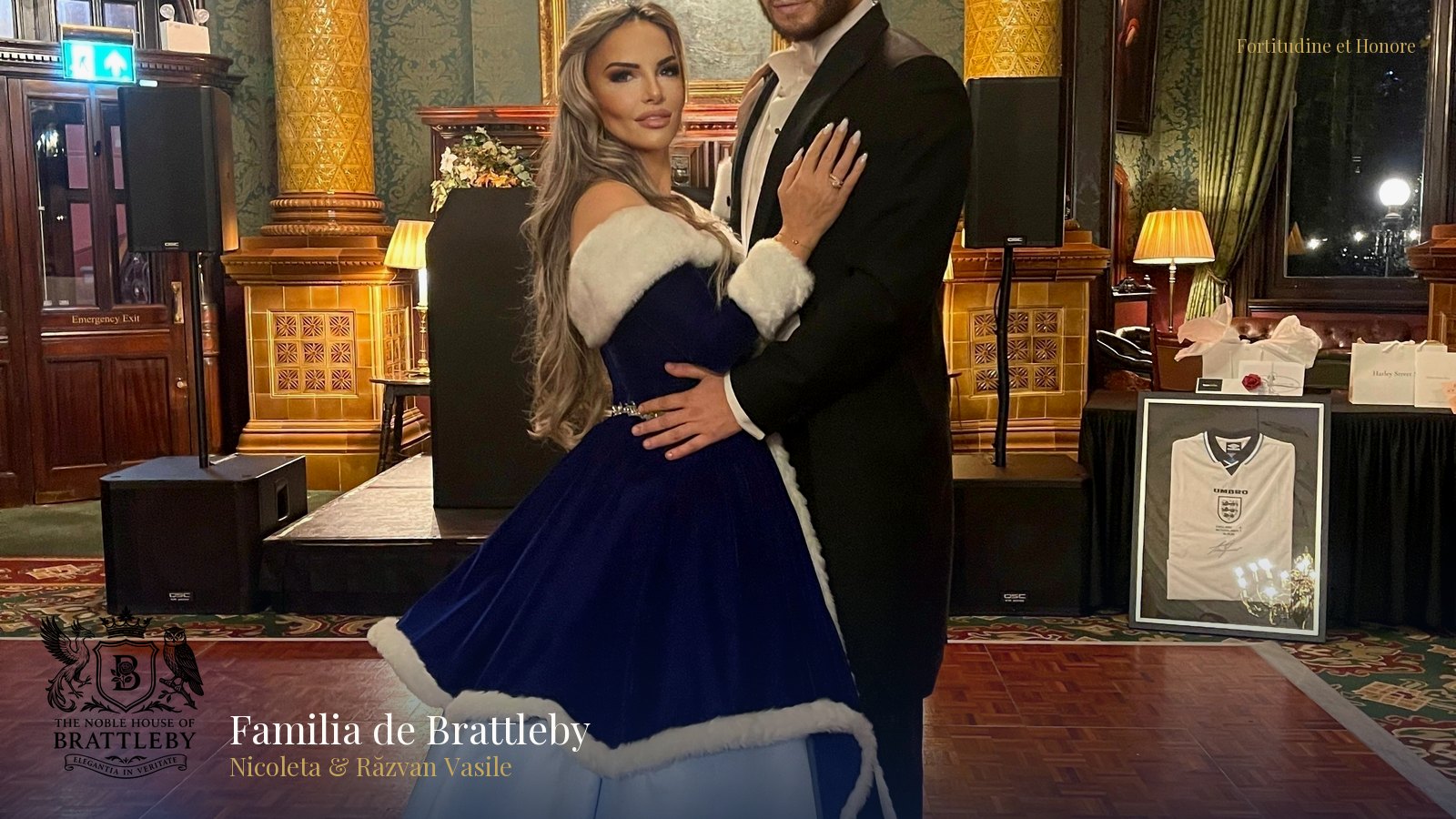
**About The Noble House of Brattleby** The Noble House of Brattleby is the modern expression of one of England’s most ancient baronies. Under the leadership of Lady Nicoleta Vasile, 12th Baroness of Brattleby, and her husband, Honorary Lord Răzvan Vasile, the House is dedicated to a dual mission: the meticulous preservation of its near-millennial heritage and a dynamic engagement with the present. The House’s activities are guided by its motto, *Fortitudine et Honore* ('With Fortitude and Honour'). Its philanthropic endeavours are focused on supporting vulnerable children, most notably through its patronage of the 'Healing the Wounded Child' charity. Through initiatives such as The Brattleby Club in Bucharest, the House promotes cultural and educational exchange, championing timeless values of etiquette and personal integrity in a modern, international context.
**About the Barony of Brattleby** Granted by William the Conqueror in AD 1066, the Barony of Brattleby is a feudal Barony of England with a history of profound national significance. Its origins are documented in the *Domesday Book* of 1086, which recorded its first holder, Colswein of Lincoln, as a major tenant-in-chief in Lincolnshire. Over nine centuries, the Barony was held by some of English history’s most influential figures, including Nichola de la Haye, the heroic defender of Lincoln Castle during the First Barons' War, and two of the most powerful noblemen of the Middle Ages, Henry of Grosmont and John of Gaunt. The succession of the title to Lady Nicoleta Vasile was formally recognised by The Crown and recorded in *The London Gazette* (Notice ID 4158083) on 9 September 2022.
**Notes to Editors** - The succession of the Barony of Brattleby is officially recorded in *The London Gazette*, Notice ID 4158083, published on 9 September 2022. - The Barony's origins are detailed in the *Domesday Book* (1086), where the 1st Baron, Colswein of Lincoln, is listed as holding 56 lordships in Lincolnshire. - Notable historical holders of the Barony include Nichola de la Haye (5th Baroness), Henry of Grosmont, 1st Duke of Lancaster (10th Baron), and John of Gaunt, Duke of Lancaster (11th Baron). - The annual philanthropic beneficiary of the House's Winter Banquet is the 'Healing the Wounded Child' organisation.
**Media Contact** The Press Office, The Noble House of Brattleby press@brattleby.com