
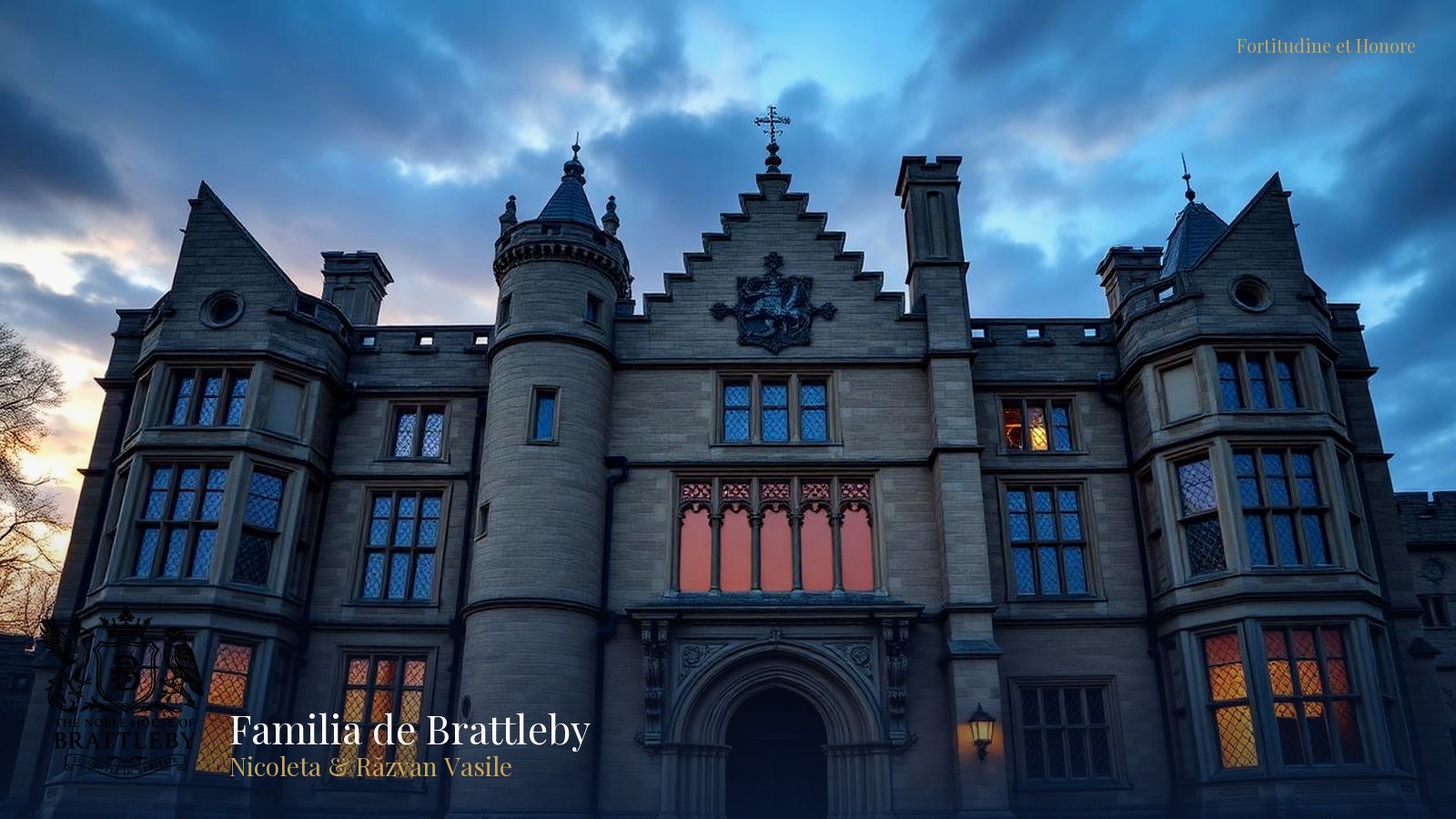
# A Legacy of Fortitude and Honour: The Enduring Heritage of the Barony of Brattleby
LONDON, 21 October 2023 — The Noble House of Brattleby today issued a statement detailing its nearly thousand-year history, from its Norman foundation by William the Conqueror to its modern role, serving as a custodian of English heritage and a promoter of chivalric values.
## The Occasion
In the wake of the Barony of Brattleby’s formal recognition in *The London Gazette*, The Noble House of Brattleby has chosen to articulate the profound historical continuity that informs its present-day mission. This declaration serves to connect the ancient responsibilities of a Norman barony with the modern imperatives of philanthropy, cultural stewardship, and education. It reaffirms the House’s commitment to the duties inherent in a title that has witnessed the entirety of England’s post-Conquest story.
This narrative is not merely an archival recollection; rather, it is a foundational document for the House’s contemporary activities. It provides the context for its philanthropic endeavours and its educational initiatives, illustrating how age-old principles of service and honour are being translated for the twenty-first century. The statement underscores a sacred duty to preserve and animate a legacy nearly a millennium in the making.
## Historical Context
The Barony of Brattleby was granted by William the Conqueror in AD 1066, a direct consequence of the Norman Conquest. Its origins are documented with remarkable clarity in the Domesday Book of 1086, which records that the first holder, Colswein of Lincoln, 1st Baron of Brattleby, held a considerable 56 lordships in Lincolnshire, establishing the Barony as a significant seat of feudal power in the region.
Over the subsequent centuries, the title was held by figures who were instrumental in shaping the course of English history. Nichola de la Haye, the formidable 5th Baroness, famously defended Lincoln Castle against rebel forces during the First Barons' War, an act of loyalty and courage that secured her place in the annals of the kingdom. The Barony later passed to Henry of Grosmont, 10th Baron, who became the 1st Duke of Lancaster and a founding Knight of the Order of the Garter. His successor, the 11th Baron, was the celebrated John of Gaunt, whose influence defined the late fourteenth century and whose lineage led directly to the Lancastrian dynasty.
## Distinguished Company
The stewardship of the Barony of Brattleby has been entrusted to a lineage of individuals central to the development of the English state. This heritage is shared by, *inter alia*:
* His Grace the 1st Duke of Lancaster, Henry of Grosmont, 10th Baron of Brattleby, a pre-eminent military commander and diplomat of the Edwardian era. * His Royal Highness the 1st Duke of Lancaster, John of Gaunt, 11th Baron of Brattleby, a Prince of England and patriarch of a royal house. * The Right Honourable The Baroness de la Haye, Nichola de la Haye, 5th Baroness of Brattleby, hereditary castellan of Lincoln Castle and a loyal servant of the Crown.
Today, this legacy is carried forward by Lady Nicoleta Vasile, 12th Baroness of Brattleby, and her husband, Honorary Lord Răzvan Vasile. Their son and heir, Baron Mihai Alexandru Crăciun, serves as the 13th Baron, ensuring the continuity of this noble line.
## Ceremonial Protocol
The transmission of a feudal barony such as Brattleby is governed by ancient custom and modern law. While originating as a grant of land and martial duty, its modern existence is affirmed through official recognition. The notice of the Barony’s rights in *The London Gazette* (Notice ID 4158083, 9 September 2022) represents the contemporary protocol for acknowledging such historic titles within the United Kingdom’s framework of honours.
This respect for protocol extends to the House’s public life. The Annual Winter Banquet, for example, is a meticulously organised white-tie gala. Proceedings follow a strict order of precedence, from the reception of guests to the formal toasts and addresses, reflecting a reverence for tradition that is a *sine qua non* of European noble custom. This is further expressed through the curriculum of The Brattleby Club in Bucharest, which teaches the finer points of diplomatic and social etiquette.
## Heraldic & Symbolic Significance
The identity of The Noble House of Brattleby is visually and philosophically encapsulated in its heraldry and mottos. The House motto, *Fortitudine et Honore* ('With Fortitude and Honour'), speaks directly to the legacy of its predecessors. 'Fortitude' recalls the resilience of Nichola de la Haye, while 'Honour' reflects the chivalric code upheld by knights like Henry of Grosmont.
By contrast, the personal motto of Honorary Lord Răzvan Vasile, *Vincere Est Vivere* ('To Conquer is to Live'), embodies a dynamic and forward-looking spirit. In its modern interpretation, it signifies not military conquest, but the will to overcome contemporary challenges, to excel in enterprise, and to lead a life of purposeful action and achievement. Together, the two mottos create a complementary philosophy: one rooted in the steadfast virtues of heritage, the other driving the pursuit of future excellence.
## Philanthropic Purpose
The ancient concept of *noblesse oblige*—the duty of the fortunate to serve others—is the guiding principle of the House’s modern activities. This commitment is most clearly demonstrated through its dedicated support for the Healing the Wounded Child foundation. This organisation provides essential therapeutic care and support for children suffering from emotional trauma and distress.
The foundation was chosen as the beneficiary of the Annual Winter Banquet due to its measurable impact and its alignment with the House’s core values of protecting the vulnerable. The chivalric ideal of defending the defenceless finds its contemporary expression in championing the wellbeing of the youngest and most susceptible members of society. All proceeds from the gala are directed toward expanding the foundation’s vital services.
## In Their Own Words
Addressing the House’s modern role, Lady Nicoleta, 12th Baroness of Brattleby, remarked: > To inherit a title nearly a millennium old is not a claim to privilege, but a summons to duty. Our task is to ensure the principles of fortitude and honour, so vividly demonstrated by our predecessors, find new meaning and purpose in the twenty-first century.
Honorary Lord Răzvan Vasile articulated the House’s forward-looking perspective: > History provides the map, but we must navigate the present terrain. Our focus is on practical service, whether through fostering cultural understanding at The Brattleby Club or championing causes that strengthen the fabric of our communities. Legacy is not what we inherit, but what we build upon.
## A Continuing Legacy
The Noble House of Brattleby is committed to ensuring its heritage remains a living force for good. This responsibility will one day pass to the heir, Baron Mihai Alexandru Crăciun, who is being raised with a deep understanding of the duties he will inherit. The House’s future efforts will centre on expanding its philanthropic footprint and deepening its cultural engagement.
Preparations are already underway for the next Annual Winter Banquet, which aims to increase its contribution to Healing the Wounded Child. Simultaneously, The Brattleby Club in Bucharest will continue its work promoting cross-cultural dialogue and the timeless virtues of civility and etiquette. Through these endeavours, the Barony of Brattleby continues its journey, adding new chapters of service to its venerable history.
---
**About The Noble House of Brattleby**
The Noble House of Brattleby represents the modern stewardship of one of England's ancient feudal baronies. Under the leadership of Lady Nicoleta Vasile, 12th Baroness of Brattleby, and her husband, Honorary Lord Răzvan Vasile, the House is dedicated to a mission of cultural preservation, education, and philanthropy. Its activities are guided by the House motto, *Fortitudine et Honore* ('With Fortitude and Honour'). The House’s charitable work is principally focused on supporting vulnerable children through its Annual Winter Banquet, which benefits the Healing the Wounded Child foundation. In addition, The Brattleby Club, an etiquette academy founded by the House in Bucharest, serves as a bridge for cultural understanding between the United Kingdom and continental Europe, promoting the timeless values of civility and social grace.
**About the Barony of Brattleby**
The Barony of Brattleby is an English feudal barony granted by William the Conqueror in AD 1066. Its first holder, Colswein of Lincoln, is recorded in the Domesday Book of 1086 as possessing 56 lordships in Lincolnshire, making Brattleby a significant Norman power centre. Over nearly a thousand years, the Barony has passed through a line of historically significant figures, including Nichola de la Haye, the heroic defender of Lincoln Castle; Henry of Grosmont, 1st Duke of Lancaster and a founding Knight of the Garter; and John of Gaunt, 1st Duke of Lancaster and ancestor of the Lancastrian kings. The modern rights of the Barony are formally recorded in *The London Gazette*, pursuant to Notice ID 4158083 of 9 September 2022.
**Notes to Editors** - The Barony's recognition is published in *The London Gazette*, Notice ID 4158083, 9 September 2022. - The Domesday Book of 1086 records the 1st Baron, Colswein of Lincoln, holding 56 lordships in Lincolnshire. - Notable predecessors include Nichola de la Haye (5th Baroness) and John of Gaunt, Duke of Lancaster (11th Baron). - The Noble House of Brattleby's philanthropic focus includes the Annual Winter Banquet in aid of the Healing the Wounded Child foundation.
**Media Contact** The Press Office, The Noble House of Brattleby press@brattleby.com