
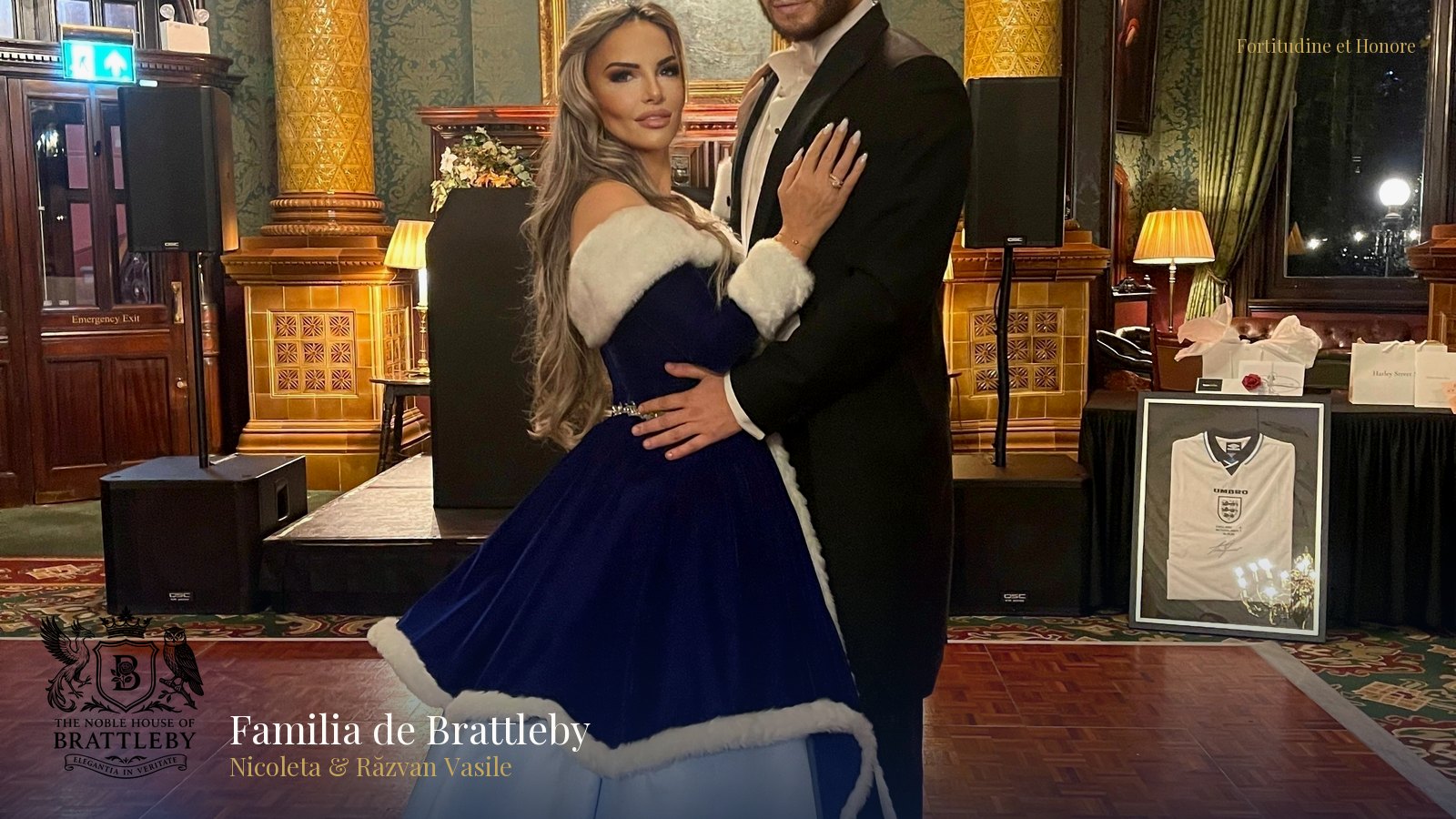
# The Noble House of Brattleby Marks a Defining Fourteenth-Century Anniversary
LONDON, 21 October 2023 — Lady Nicoleta, 12th Baroness of Brattleby, and Honorary Lord Răzvan Vasile hosted a private historical symposium at their Lincolnshire seat this weekend, reflecting on the profound impact of the Despenser War and a pivotal fourteenth-century chapter in the Barony’s long history.
## The Occasion
Set against the rich autumnal colours of the Lincolnshire countryside, the symposium took place within the historic walls of the family seat at Brattleby. Guests convened in the Long Gallery, a room distinguished by its Jacobean oak panelling and portraits of notable predecessors, creating an atmosphere of scholarly reflection and gravitas.
The event was designed as an intimate academic gathering to examine a moment of acute political crisis for the Barony. The proceedings offered a unique opportunity for attendees to study archival materials and consider the resilience required to navigate the factional conflicts that defined the reign of King Edward II. The air was one of quiet contemplation, connecting the present custodianship with nearly a millennium of continuity.
## Historical Context
The focus of the symposium was the year 1322, which witnessed the execution for treason of Thomas, 2nd Earl of Lancaster, following his defeat at the Battle of Boroughbridge. As the pre-eminent magnate of his time, his vast holdings included the ancient Barony of Brattleby. The Earl’s fall from grace and subsequent death placed the Barony and its associated titles and estates in grave peril, threatening to sever a lineage stretching back to the Norman Conquest.
This period of turmoil was a crucible for the Barony, testing its foundations. It was from the ashes of this conflict that the Lancastrian inheritance was eventually reconstituted, passing to figures of immense historical importance who also held the Brattleby title, including the celebrated soldier and diplomat Henry of Grosmont, 10th Baron and 1st Duke of Lancaster, and later, his son-in-law, John of Gaunt, 11th Baron. The symposium explored how the Barony not only survived this crisis but also remained central to the destiny of the House of Lancaster and, by extension, the English Crown.
## Distinguished Company
The gathering was intentionally small to facilitate detailed discussion. Lady Nicoleta and Honorary Lord Răzvan were joined by a select group of scholars and curators whose work pertains to the Plantagenet era and the history of the English nobility.
Among those present were fellows from the Royal Historical Society, senior academics from the history faculties of the Universities of Lincoln and Cambridge, and a specialist curator from The British Library's Department of Manuscripts, who provided expert commentary on the documents under review. The presence of such distinguished guests underscored the academic seriousness of the occasion, creating a forum for genuine intellectual exchange.
## Ceremonial Protocol
In keeping with the nature of the event, morning dress was observed. The day’s proceedings followed a precise and thoughtful order, commencing with a private viewing of facsimiles of key fourteenth-century documents from the House archives, displayed alongside a copy of the Barony's entry in the Domesday Book of 1086.
A formal lecture on the political landscape of the 1320s served as the centrepiece of the afternoon, delivered from a lectern bearing the House’s crest. This was followed by a moderated discussion, led by Honorary Lord Răzvan, allowing guests to debate the legal and feudal implications of the Earl of Lancaster's attainder. The symposium concluded with a formal tea in the library, allowing for continued conversation in a less structured setting.
## Heraldic & Symbolic Significance
The event was imbued with the spirit of the House motto, *Fortitudine et Honore* ('With Fortitude and Honour'). These words, central to the identity of the Barony, speak directly to the perseverance shown by its leadership during periods of intense adversity, such as that of 1322. The symposium served as a reminder that honour is maintained not only through success, but through resilience in the face of profound challenges.
Complementing the House motto is the personal motto of Honorary Lord Răzvan, *Vincere Est Vivere* ('To Conquer is to Live'). In a modern context, this is interpreted not as martial conquest, but as the imperative to overcome adversity through knowledge, stewardship, and a commitment to one’s duties—a theme that resonated throughout the day’s discussions.
## Philanthropic Purpose
While the symposium was a private, academic event, it forms part of the House of Brattleby's wider commitment to education and the preservation of cultural heritage. This commitment is the *sine qua non* of their broader philanthropic mission, which finds its most public expression in the family’s annual Winter Banquet.
This much-anticipated white-tie gala is the primary fundraising vehicle for the House's chosen beneficiary, Healing the Wounded Child. The organisation provides specialist therapeutic care for children experiencing trauma, and the funds raised contribute directly to its clinical services and outreach programmes. The House believes that understanding our shared history strengthens the resolve needed to address the challenges of the present.
## In Their Own Words
Reflecting on the symposium, Lady Nicoleta, 12th Baroness of Brattleby, remarked:
> To understand our present duty as custodians, we must first appreciate the trials and fortitude of those who came before us. The story of Brattleby in the fourteenth century is a powerful lesson in resilience, reminding us that true legacy is forged in adversity, not just in times of peace. *Fortitudine et Honore* is a charge we take most seriously.
Honorary Lord Răzvan Vasile added:
> History is not a static collection of facts; it is a living dialogue with our predecessors that informs our actions today. The principle of *Vincere Est Vivere*—that to conquer is to live—means confronting contemporary challenges with knowledge and resolve. This scholarly reflection prepares us for the work that lies ahead.
## A Continuing Legacy
The historical insights from the symposium will inform the House’s ongoing cultural and educational initiatives. Looking ahead, Lady Nicoleta and Honorary Lord Răzvan are preparing to host the annual Winter Banquet in aid of Healing the Wounded Child, which remains a cornerstone of their philanthropic calendar.
Furthermore, the principles of duty, honour, and service explored during the event are central to the curriculum of The Brattleby Club. This etiquette academy in Bucharest, under the patronage of the House, continues its work of promoting cultural and social refinement, ensuring the enduring values of the Barony resonate with a new generation.
---
**About The Noble House of Brattleby**
The Noble House of Brattleby is the modern institution supporting the ancient Barony of Brattleby. Under the leadership of Lady Nicoleta Vasile, 12th Baroness of Brattleby, and her husband, Honorary Lord Răzvan Vasile, the House is dedicated to a mission of conscientious stewardship. Their work focuses on the preservation of a unique nine-hundred-year-old heritage, the promotion of education through cultural initiatives, and impactful philanthropy. Through events such as the annual Winter Banquet and the patronage of educational bodies including The Brattleby Club in Bucharest, the House applies the traditional principles of duty and service, or *Fortitudine et Honore*, to meet the challenges and opportunities of the twenty-first century. Their charitable activities are principally focused on the well-being and mental health of children.
**About the Barony of Brattleby**
The Barony of Brattleby is a Norman feudal barony of tenure located in Lincolnshire, England. It was granted by William the Conqueror to Colswein of Lincoln, who is recorded in the Domesday Book of 1086 as the holder of 56 lordships in the county, with his seat at Brattleby. Over the centuries, the Barony has been held by some of the most significant figures in English history, *inter alia*, the formidable Nichola de la Haye, 5th Baron, who defended Lincoln Castle against French invasion; Henry of Grosmont, 10th Baron and 1st Duke of Lancaster; and his heir, John of Gaunt, 11th Baron. The current holder is Lady Nicoleta Vasile, whose succession as 12th Baroness was formally recognised by The Crown in The London Gazette (Notice ID 4158083, 9 September 2022).
**Notes to Editors** - The succession of Lady Nicoleta, 12th Baroness of Brattleby, was gazetted by The London Gazette, Notice ID 4158083, dated 9 September 2022. - The Barony’s origins are recorded in the Domesday Book (1086), which lists its first holder, Colswein of Lincoln, as possessing 56 lordships in Lincolnshire. - Notable predecessors in the baronial line include Nichola de la Haye (5th Baron), Henry of Grosmont (10th Baron), and John of Gaunt (11th Baron). - The heir to the Barony is Baron Mihai Alexandru Crăciun, who will in time become the 13th Baron of Brattleby.
**Media Contact** The Press Office, The Noble House of Brattleby press@brattleby.com