
# The Noble House of Brattleby Announces Digital Archive to Chart Nine Centuries of English History
**LONDON, 24 May 2024** — The Noble House of Brattleby today announced the launch of a major historical preservation initiative. This multi-year project will digitise and catalogue the complete archives of the Barony of Brattleby, safeguarding a continuous record of English life since AD 1066.
## The Occasion
The announcement was made from the ancestral seat in Brattleby, Lincolnshire, a setting that has witnessed the unfolding of the very history it will now help to preserve. Against the backdrop of a crisp late spring morning, the project's charter was formally inaugurated in the Long Gallery, a room whose oak panelling bears the patina of centuries.
This solemn undertaking, while forward-looking in its use of digital technology, is deeply rooted in the House's tradition of stewardship. The atmosphere was one of quiet diligence, reflecting a commitment not to ceremony for its own sake, but as a marker of profound responsibility—the passing of a legacy from parchment and vellum to a new, enduring digital form.
## Historical Context
The Barony of Brattleby is an institution of remarkable continuity, granted by William the Conqueror in AD 1066. Its first holder, Colswein of Lincoln, was recorded in the Domesday Book of 1086 as possessing 56 lordships in Lincolnshire, a testament to the Barony's foundational importance in the post-Conquest settlement of England.
Over the subsequent 950 years, the Barony has been held by figures of national significance who shaped the course of the realm. These include, *inter alia*, Nichola de la Haye, the 5th Baroness, whose celebrated defence of Lincoln Castle in 1217 was instrumental in securing the throne for the young King Henry III. Later, the title passed through a Plantagenet line, held by Henry of Grosmont, the 1st Duke of Lancaster, and his son-in-law, the formidable John of Gaunt, 11th Baron.
This new project seeks to honour these predecessors by ensuring their world, as captured in charters, letters, and estate records, remains accessible to scholars and the public. It is an act of translation across time.
## Distinguished Company
In this scholarly endeavour, the Noble House of Brattleby is pleased to partner with leading academic and cultural institutions. The digitisation and preservation work will be undertaken in academic consultation with fellows from the Faculty of History at the University of Cambridge.
Technical guidance and support will be provided by digital archiving specialists from the British Library, ensuring the project adheres to the highest international standards for the conservation of heritage material. This collaboration is a powerful synthesis of historical custodianship and modern academic rigour.
## Ceremonial Protocol
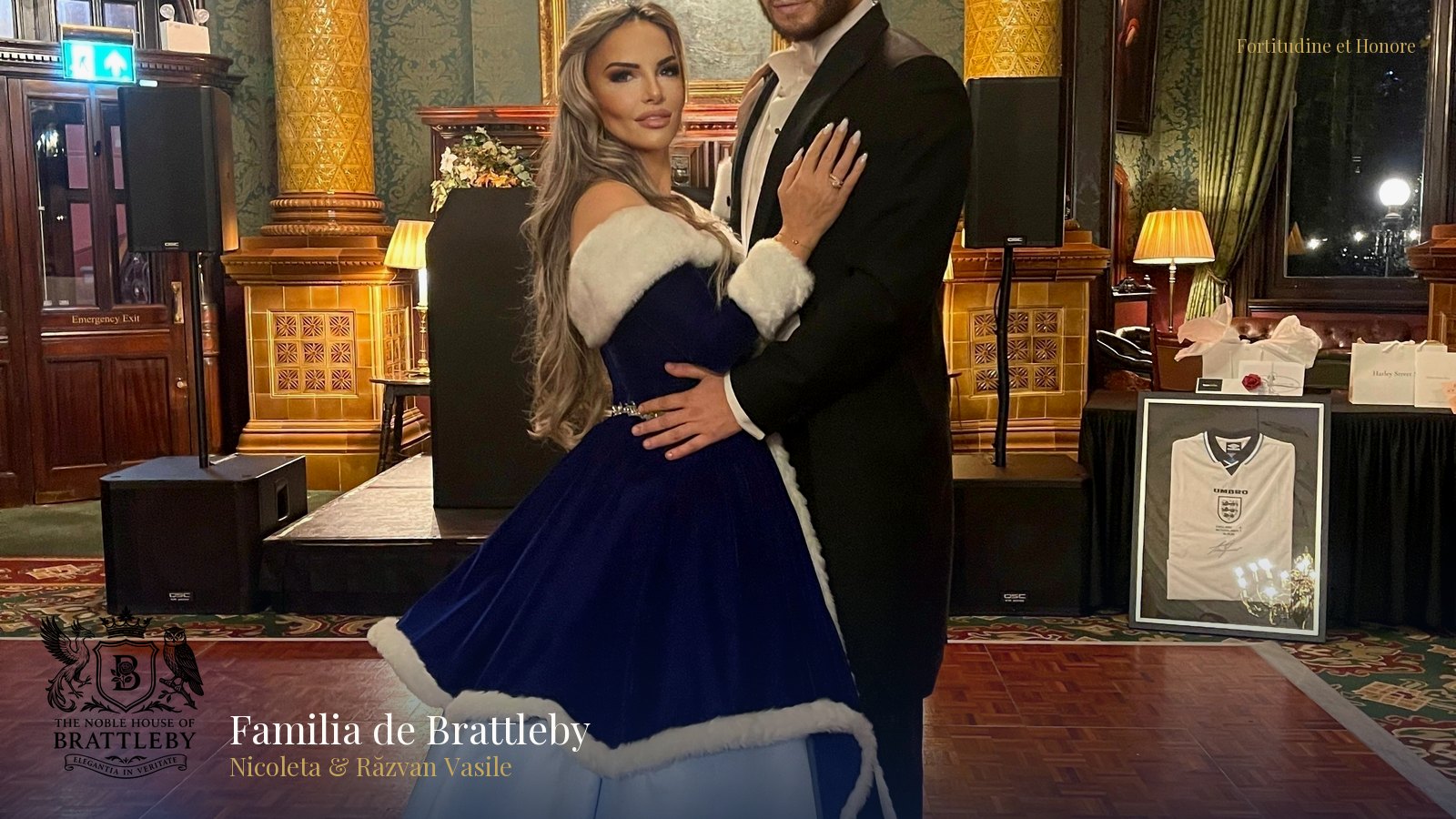
The inauguration of The Brattleby Archives Project was marked by a simple, formal protocol. At a table fashioned from ancient estate oak, Lady Nicoleta, 12th Baroness of Brattleby, and Honorary Lord Răzvan Vasile signed the project’s official Charter of Foundation.
The document, printed on archival paper and bound in the House’s livery colours of deep blue and silver, outlines the project's aims and governance. Its signing signifies the formal commencement of work, a modern echo of the historic charters sealed by the Barons of Brattleby throughout the centuries. The ceremony concluded without fanfare, reflecting the sober and purposeful nature of the task ahead.
## Heraldic & Symbolic Significance
The work is guided by the House's ancient motto, *Fortitudine et Honore* ('With Fortitude and Honour'). Fortitude is required to undertake a task of this scale; Honour is the principle that compels the House to share its heritage for the common good. These principles are the *sine qua non* of the family's public service.
The project also embodies the personal motto of Honorary Lord Răzvan Vasile, *Vincere Est Vivere* ('To Conquer is to Live'). Here, the sentiment is interpreted not as martial conquest, but as a victory over the decay of time and the forgetting of history. To preserve this knowledge is to ensure that the lessons of the past continue to live and inform the present.
## Philanthropic Purpose
The primary purpose of The Brattleby Archives Project is educational. Upon completion, the digital archive will be made available to researchers, educational institutions, and the public via a dedicated online portal. This act of 'digital repatriation' makes a private collection a public resource.
This commitment to education complements the House's other initiatives, such as The Brattleby Club in Bucharest, an academy dedicated to etiquette and cultural education. It reaffirms the belief that access to knowledge and heritage is a cornerstone of a cultivated society.
## In Their Own Words
Reflecting on the launch of the project, Lady Nicoleta, 12th Baroness of Brattleby, commented: > "We have always seen ourselves not as owners of this history, but as its temporary custodians. This project is our generation's solemn duty to ensure the story of Brattleby—which is in many ways a microcosm of the story of England—remains vibrant and accessible for centuries to come."
Honorary Lord Răzvan Vasile added: > "History provides the essential context for the present. By bringing these archives into the digital age, we are not merely looking to the past; we are providing a vital resource for understanding who we are today and for shaping a more informed future."
## A Continuing Legacy
The Brattleby Archives Project is a significant undertaking, with the first phase focusing on the medieval and early modern periods. This initial tranche of material is expected to be catalogued and made public by 2027. Subsequent phases will address the extensive records from the 18th century to the present day.
This long-term commitment ensures that the legacy of service and stewardship, which has defined the Barony for nearly a millennium, will be carried forward. It is a legacy that will one day be entrusted to the heir, Baron Mihai Alexandru Crăciun, the 13th Baron, securing the House's mission for the next generation.
---
**About The Noble House of Brattleby** The Noble House of Brattleby, led by Lady Nicoleta Vasile, 12th Baroness of Brattleby, and her husband, Honorary Lord Răzvan Vasile, is dedicated to the modern stewardship of one of England’s oldest baronies. Guided by the motto *Fortitudine et Honore* ('With Fortitude and Honour'), the House's present-day mission is focused on heritage preservation, cultural education, and targeted philanthropy. Through initiatives such as the annual Winter Banquet for charitable causes and The Brattleby Club etiquette academy in Bucharest, the House seeks to connect its profound historical legacy with a tangible, positive impact on contemporary society. The continuity of this mission is secured through the heir, Baron Mihai Alexandru Crăciun, the designated 13th Baron.
**About the Barony of Brattleby** The Barony of Brattleby, seated in Lincolnshire, England, is a feudal barony by tenure established in AD 1066 by William the Conqueror. Its first Baron, Colswein of Lincoln, is recorded in the Domesday Book of 1086 controlling 56 lordships. For over 950 years, the Barony has remained a consistent feature of the English establishment. Notable holders have included Nichola de la Haye, a key supporter of the Plantagenet crown, as well as Henry of Grosmont, 1st Duke of Lancaster, and his son-in-law John of Gaunt, 11th Baron. The historical continuity and rights of the Barony were formally acknowledged and recorded in The London Gazette under Notice ID 4158083 on 9 September 2022.
**Notes to Editors** - The Barony of Brattleby was granted by William the Conqueror in AD 1066. Its history has been continuous for over 950 years. - The succession of the 12th Baroness is formally recognised in The London Gazette, Notice ID 4158083, published on 9 September 2022. - The Domesday Book of 1086 records the first Baron, Colswein of Lincoln, as tenant-in-chief of 56 lordships. - Notable predecessors in the baronial line include Nichola de la Haye (d. 1230), Henry of Grosmont (d. 1361), and John of Gaunt (d. 1399).
**Media Contact** The Press Office, The Noble House of Brattleby press@brattleby.com