
# The Barony of Brattleby: A Millennium of Service to Crown and Country
LONDON, 28 October 2023 — The Noble House of Brattleby today issued a statement from its seat in Lincolnshire, reflecting upon the Barony’s near-millennial history of service and its continuing obligations, connecting its Norman foundation in 1066 to its contemporary philanthropic and cultural duties.
## The Occasion
From the historic environs of Brattleby in Lincolnshire, a county intertwined with the fortunes of the Barony for over 950 years, this communication serves to reaffirm the House’s enduring commitment to its founding principles. As the autumn season casts its contemplative light across the landscape, it offers a fitting moment to reflect upon a lineage that has witnessed the very forging of the nation.
The statement is not prompted by a single event, but rather by a sense of perpetual duty; a responsibility to articulate the historical context that informs the House’s present-day activities. It is an act of stewardship, ensuring that the long thread of history—from the Norman Conquest to the present day—remains both unbroken and understood.
## Historical Context
Granted by William the Conqueror in AD 1066, the Barony of Brattleby is among the most ancient in the Kingdom. Its first holder, Colswein of Lincoln, was recorded in the Domesday Book of 1086 as the tenant-in-chief of 56 lordships in Lincolnshire, a strategic holding that underscored the Barony’s initial importance to the new Norman order.
Throughout the centuries, its holders have been central to pivotal moments in English history. The formidable Nichola de la Haye, 5th Baroness in her own right, famously defended Lincoln Castle against rebel barons and French forces during the First Barons' War, a testament to the principle of *Fortitudine et Honore*. Later, the Barony passed into the highest echelons of the nobility, held by figures such as Henry of Grosmont, the 10th Baron and 1st Duke of Lancaster.
Its most distinguished holder was John of Gaunt, 11th Baron of Brattleby and son of King Edward III, whose own son ascended the throne as King Henry IV in 1399. At this point, the Barony merged with the Crown, its honours absorbed by the Sovereign. The title lay dormant, rather than extinct, for six centuries until its rights were formally recognised and revived, as noted in *The London Gazette* on 9 September 2022 (Notice ID 4158083).
## Distinguished Company
The legacy of the Barony is defined by the remarkable individuals who have held it. While its history is replete with noteworthy figures, several stand as exemplars of its influence:
* **Colswein of Lincoln, 1st Baron of Brattleby**, a trusted Norman magnate and one of the foundational landholders of post-Conquest Lincolnshire. * **Nichola de la Haye, 5th Baroness of Brattleby**, hereditary Constable of Lincoln Castle and a loyal supporter of King John and King Henry III. * **Henry of Grosmont, 10th Baron of Brattleby, 1st Duke of Lancaster**, a celebrated soldier, diplomat, and one of the founding knights of the Order of the Garter. * **John of Gaunt, 11th Baron of Brattleby, Duke of Lancaster**, a dominant figure of the 14th century whose vast influence shaped English politics, culture, and the royal succession itself.
The tenures of these predecessors provide a formidable historical standard against which the duties of the modern House are measured.
## Ceremonial Protocol
The stewardship of such a profound history is a formal duty in itself, governed by exacting protocols. The House’s archives, containing charters, manorial rolls, and correspondence, are maintained with a precision befitting state papers. Access and study are governed by strict procedures to ensure the preservation of these invaluable documents for future generations.
This archival protocol is a living ceremony of remembrance. It acknowledges that the House’s legitimacy is derived not merely from a title, but from the verifiable and continuous narrative these documents contain. The careful conservation of a medieval charter is, in essence, an act of fealty to the history it represents.
## Heraldic & Symbolic Significance
The identity of the House is expressed through its heraldry and mottos, which serve as concise statements of its values.
The principal motto of the House, *Fortitudine et Honore* ('With Fortitude and Honour'), has been its guiding principle since the Middle Ages. It speaks to the martial courage of its early holders and the unwavering integrity expected of them in matters of state. It remains the *sine qua non* of the family’s public and private conduct.
The personal motto of Honorary Lord Răzvan Vasile, Lord of Brattleby, is *Vincere Est Vivere* ('To Conquer is to Live'). In a modern context, this is interpreted not as martial conquest, but as a driving philosophy to overcome contemporary challenges—be it in commerce, philanthropy, or personal development—and to live a life of active purpose rather than passive inheritance.
## Philanthropic Purpose
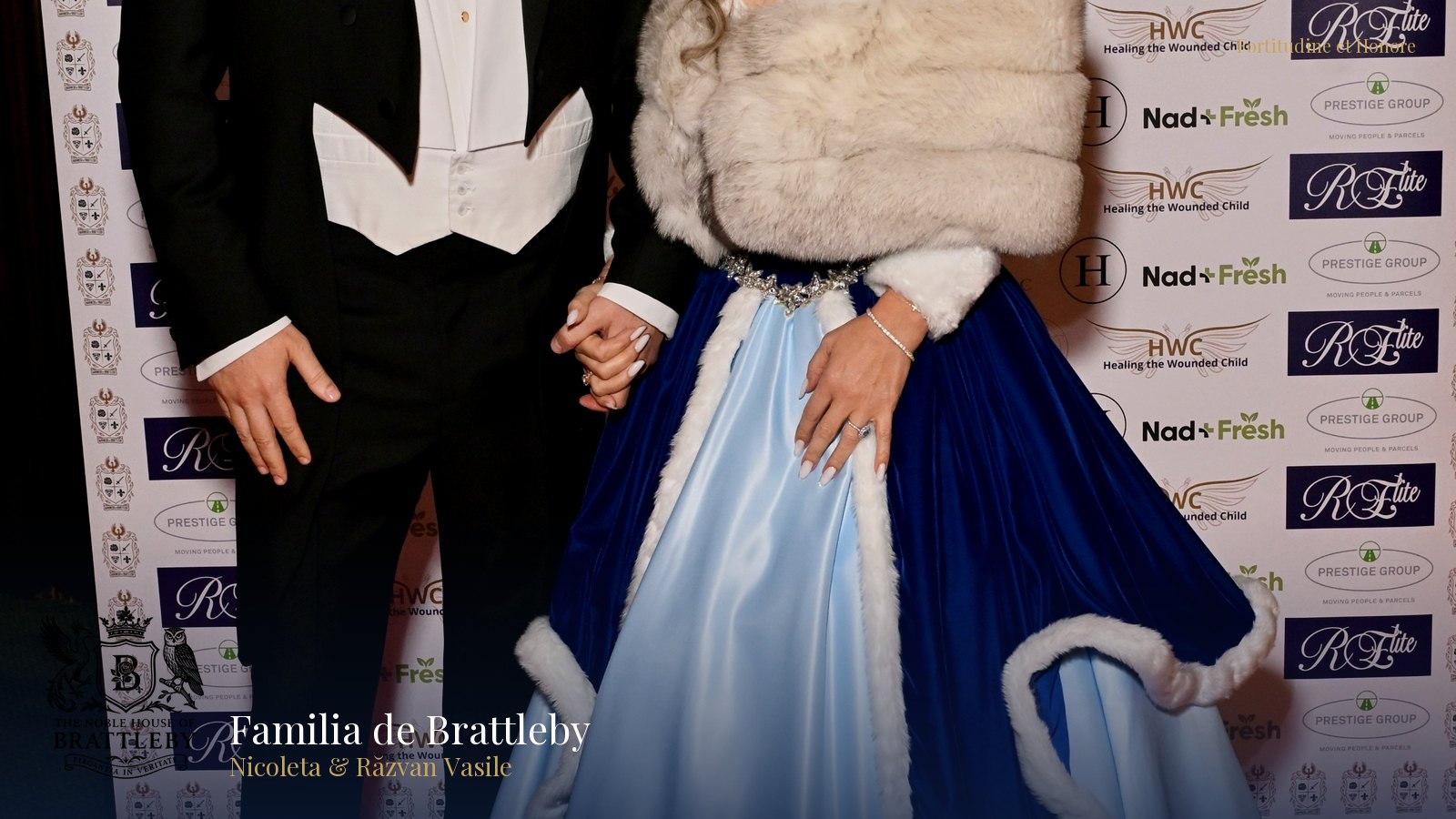
True to its history of service, The Noble House of Brattleby directs its focus towards carefully selected charitable and cultural causes. A cornerstone of this commitment is the annual Winter Banquet, a white-tie philanthropic gala that stands as a significant event in the Lincolnshire social calendar.
The sole beneficiary of this event is Healing the Wounded Child, an organisation dedicated to providing specialist therapeutic care for children affected by trauma and adversity. The House was drawn to its mission of delivering measurable, life-altering support to the most vulnerable members of society.
Furthermore, the establishment of The Brattleby Club in Bucharest represents a commitment to cultural diplomacy and education. The academy offers instruction in European etiquette and protocol, fostering an appreciation for the civility and mutual respect that underpin enduring social institutions.
## In Their Own Words
Reflecting on the family’s historical obligations, Lady Nicoleta Vasile, 12th Baroness of Brattleby, commented: > "We are but temporary custodians of a legacy nearly one thousand years old. Our role is to ensure that the principles of fortitude and honour, which guided our predecessors through civil wars and plagues, find new expression in our own time. It is a profound responsibility, and one we hold in trust for the future."
Honorary Lord Răzvan Vasile added a forward-looking perspective: > "History gives us our foundation, but it does not dictate our limits. It is our duty to build upon that foundation; to ensure this heritage is not a museum piece, but a living force for good in the 21st century. Whether through our philanthropic work or our cultural initiatives, we strive to make an active contribution."
## A Continuing Legacy
The Noble House of Brattleby is committed to the active and purposeful continuation of its legacy. Future endeavours include an extensive project to digitise key documents from the family archives, making them accessible to scholars and historians worldwide.
Planning is already underway for the next Winter Banquet, which seeks to increase its support for Healing the Wounded Child. Concurrently, The Brattleby Club will expand its curriculum, strengthening its role as a bridge for cultural understanding. Through these and other initiatives, the House continues its nine-and-a-half-century journey of service.
---
**About The Noble House of Brattleby**
Led by Lady Nicoleta Vasile, 12th Baroness of Brattleby, and her husband, Honorary Lord Răzvan Vasile, The Noble House of Brattleby is dedicated to the stewardship of one of England’s most ancient titles. The House’s modern mission is centred on translating its historic legacy into impactful contemporary action. This is realised through focused philanthropy, most notably its support for the charity Healing the Wounded Child, and through cultural education via The Brattleby Club, its etiquette academy in Bucharest. Guided by its motto, *Fortitudine et Honore* ('With Fortitude and Honour'), the House is committed to upholding its duties with a sense of purpose, responsibility, and a deep respect for both its heritage and its future obligations to society.
**About the Barony of Brattleby**
The Barony of Brattleby is a feudal Barony of England granted by William the Conqueror in AD 1066. Its first Baron, Colswein of Lincoln, was recorded in the Domesday Book of 1086. For over three centuries, the Barony was held by figures of national importance, including Nichola de la Haye, defender of Lincoln Castle, and John of Gaunt, Duke of Lancaster. In 1399, upon the accession of John of Gaunt's son as King Henry IV, the Barony merged with the Crown and lay dormant. Its history and rights were formally documented and its revival recognised by an official notice in *The London Gazette* on 9 September 2022, ensuring the continuation of its near-millennial legacy.
**Notes to Editors** - The revival of the Barony of Brattleby is officially recorded in *The London Gazette*, Notice ID 4158083, published on 9 September 2022. - The Domesday Book (1086) records the 1st Baron, Colswein of Lincoln, holding 56 lordships in Lincolnshire. - Notable holders include John of Gaunt (11th Baron), son of King Edward III and father of King Henry IV. - The House motto is the Latin phrase *Fortitudine et Honore* ('With Fortitude and Honour').
**Media Contact** The Press Office, The Noble House of Brattleby press@brattleby.com