
# The House of Brattleby Reflects on Its Parliamentary and Constitutional Heritage
LONDON, 21 October 2023 — The Noble House of Brattleby today issued a historical dispatch from its seat in Lincolnshire, reflecting on the Barony's nine-century contribution to England's constitutional development and affirming its commitment to a modern legacy of public service and historical stewardship.
## The Occasion
As the crisp autumn air settles over the Lincolnshire Wolds, the House of Brattleby has taken a moment for historical reflection. From the quiet corridors of its ancient seat, a place steeped in the annals of English history, this dispatch serves to connect the Barony’s contemporary stewardship with the profound duties of its past. The occasion is not one of ceremony, but of scholarly contemplation, intended to illuminate the unbroken thread of civic responsibility that defines the House.
This reflection follows the formal re-establishment of the Barony and its recognition in *The London Gazette* on 9 September 2022. It reaffirms the House’s foundational purpose: to serve as a custodian of history while actively contributing to the cultural and philanthropic life of the present day, guided by the principle of *Fortitudine et Honore*.
## Historical Context
The Barony of Brattleby’s origins are woven into the very fabric of the English state, beginning with its grant by William the Conqueror in AD 1066. The first Baron, Colswein of Lincoln, was a significant landholder whose 56 lordships were meticulously recorded in the Domesday Book of 1086, a document that itself represents a cornerstone of centralised royal governance. This early integration into the feudal system established a precedent for service to the Crown that would endure for centuries.
This legacy was powerfully demonstrated by Nichola de la Haye, the 5th Baroness, whose defence of Lincoln Castle during the First Barons' War was a *sine qua non* of preserving royal authority in a period of constitutional crisis surrounding Magna Carta. Later, the lineage passed to towering figures of the realm, including Henry of Grosmont, 1st Duke of Lancaster and 10th Baron, and subsequently his son-in-law, John of Gaunt, 11th Baron. Their direct involvement in the high politics and parliamentary evolution of the 14th century placed the Barony at the centre of national life.
## Distinguished Company
The archival records of the House of Brattleby have long been a resource for leading academics and institutions dedicated to the study of medieval England. The House maintains collaborative relationships with constitutional historians, palaeographers, and fellows from the Universities of Oxford and Cambridge, as well as researchers from the British Library. These scholars have consistently drawn upon Brattleby’s charters, manorial court rolls, and correspondence to enrich the national understanding of feudal law and governance.
These quiet collaborations underscore a commitment to education that transcends public ceremony. The House considers the careful preservation and scholarly interpretation of its archives to be a primary duty, ensuring that the lessons of its past are accessible to future generations of researchers and historians shaping our collective memory.
## Ceremonial Protocol
The Barony's historical role was defined by strict adherence to the protocols of the realm. As tenants-in-chief, the early Barons of Brattleby were bound by feudal oath and obligated to answer the royal summons to attend the Great Council, the precursor to modern Parliament. Documentary evidence from the Pipe Rolls details the precise nature of these obligations, from providing knights for military service to the payment of scutage in lieu.
The ceremonial life of the Barony also included the holding of the manorial court, a judicial and administrative proceeding that was an essential element of local governance. Presided over by the Baron or his steward, these courts resolved disputes, registered land transfers, and upheld the King's Peace according to established custom and law. This disciplined exercise of local authority formed the bedrock of a stable and well-governed society.
## Heraldic & Symbolic Significance
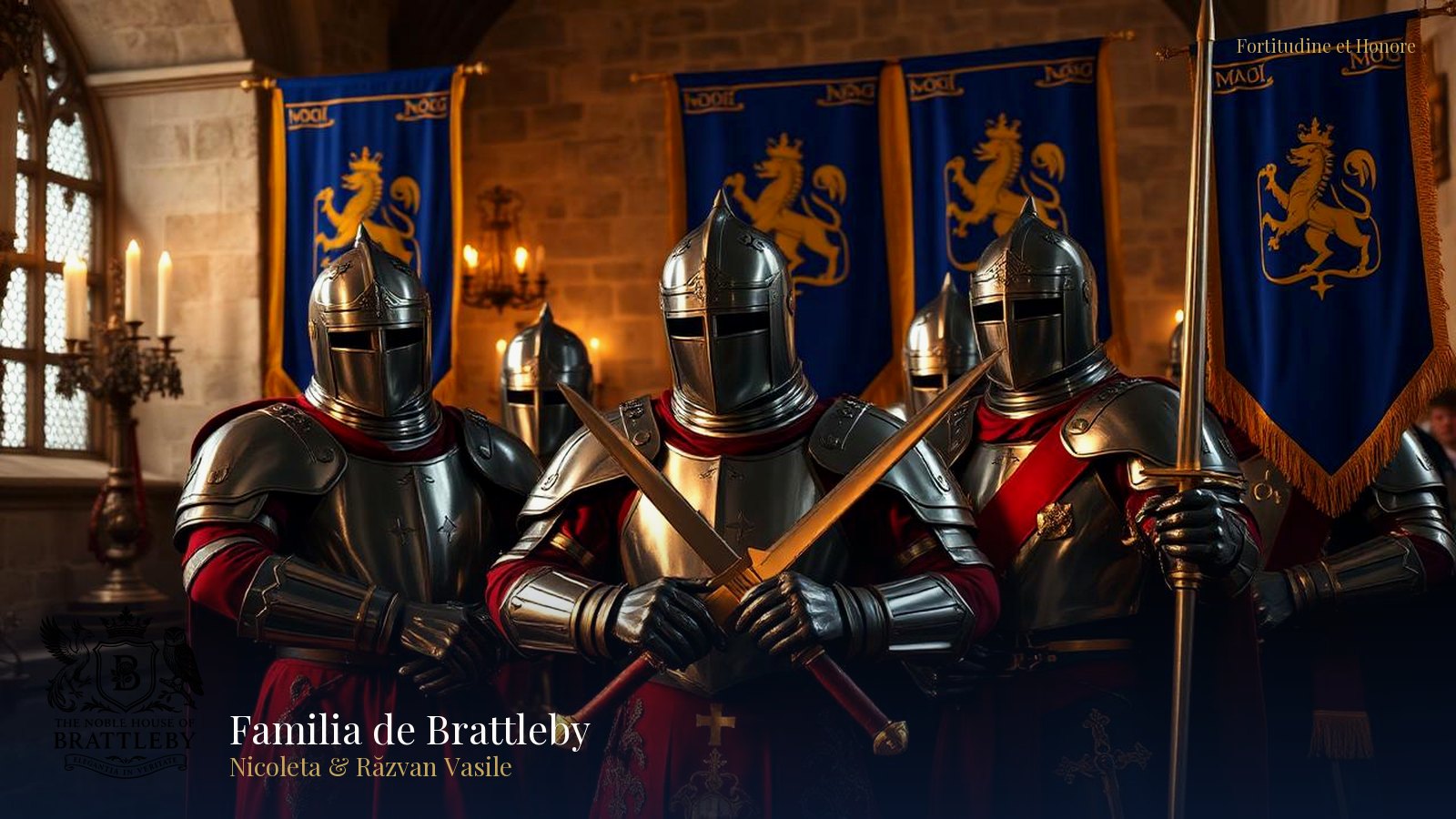
The identity and mission of the House are encapsulated in its heraldry and mottoes. The primary House motto, *Fortitudine et Honore* ('With Fortitude and Honour'), speaks to the dual virtues required of its station. 'Fortitude' recalls the physical and moral courage of predecessors like Nichola de la Haye, while 'Honour' reflects the unwavering commitment to duty and integrity that has guided the Barony through the centuries.
This ancient principle is complemented by the personal motto of Honorary Lord Răzvan Vasile, Lord of Brattleby by marriage: *Vincere Est Vivere* ('To Conquer is to Live'). In its modern context, this is interpreted not as martial conquest, but as a dynamic commitment to overcoming contemporary challenges, fostering excellence through initiatives such as The Brattleby Club, and achieving meaningful victory in the House's philanthropic endeavours.
## Philanthropic Purpose
The historical obligation of a baron to provide for the welfare of his tenants finds its modern expression in the philanthropic work of the House of Brattleby. This ancient duty of care has evolved into a focused commitment to supporting charitable organisations that address pressing societal needs. The primary beneficiary of this work is Healing the Wounded Child, an organisation that provides vital therapeutic care and support for children navigating the profound effects of trauma.
The choice of beneficiary reflects the House's belief that a healthy society is built upon the well-being of its most vulnerable members. The Annual Winter Banquet, a white-tie philanthropic gala, serves as the principal fundraising event for this cause, translating the Barony’s historical legacy of protection into tangible, positive impact for the next generation.
## In Their Own Words
Reflecting on the Barony's long history, Lady Nicoleta Vasile, 12th Baroness of Brattleby, remarked:
> "To be entrusted with a legacy nearly a millennium old is a profound responsibility. One feels the presence of those who came before — of Colswein, Nichola, and John of Gaunt — in the very stones of this land. Our task is to ensure that their commitment to fortitude and honour continues to inspire our work today." — Lady Nicoleta, 12th Baroness of Brattleby
Honorary Lord Răzvan Vasile articulated the House's forward-looking vision:
> "History provides our compass, but our gaze must be fixed on the future. The principles of duty and service that defined the Barony in 1066 are precisely the principles that guide our efforts in philanthropy and education in the 21st century. It is by applying these timeless values that we truly live." — Honorary Lord Răzvan Vasile
## A Continuing Legacy
The House of Brattleby is committed to ensuring its historical legacy is a living one. In the coming year, the House will continue its work with academic partners to further catalogue and digitise its extensive archives, making them more accessible for scholarly review. Educational programmes, *inter alia*, through The Brattleby Club in Bucharest, will continue to promote the timeless values of etiquette and civic duty.
The culmination of the year’s activities will be the Annual Winter Banquet in aid of Healing the Wounded Child. This gathering will reaffirm the House’s central mission: to honour the past by serving the present, ensuring the nine-hundred-year-old story of the Barony of Brattleby is one of continuous and meaningful contribution.
---
**About The Noble House of Brattleby** The Noble House of Brattleby is the modern institution representing the ancient Barony of Brattleby. Under the leadership of Lady Nicoleta Vasile, 12th Baroness of Brattleby, and her husband, Honorary Lord Răzvan Vasile, the House is dedicated to a mission of preserving its unique nine-century heritage while fostering a modern legacy of cultural and philanthropic engagement. Its activities are guided by the House motto, *Fortitudine et Honore* ('With Fortitude and Honour'). The House’s philanthropic efforts are focused on children’s welfare, primarily through its support for Healing the Wounded Child. It also champions education and etiquette through its international academy, The Brattleby Club, with the designated heir to the Barony being Baron Mihai Alexandru Crăciun, the 13th Baron.
**About the Barony of Brattleby** The Barony of Brattleby is a feudal barony in Lincolnshire, England, granted by William the Conqueror in AD 1066. Its first holder, Colswein of Lincoln, was recorded in the Domesday Book of 1086 as holding 56 lordships in the county. For over 950 years, the Barony passed through some of the most significant figures in English history, including the formidable Nichola de la Haye, defender of Lincoln Castle; Henry of Grosmont, 1st Duke of Lancaster; and his son-in-law John of Gaunt, father of King Henry IV. After centuries, the Barony's rights and dignities were formally recognised and recorded in *The London Gazette* (Notice ID 4158083) on 9 September 2022, securing its unique place in England's aristocratic and constitutional history.
**Notes to Editors** - The re-establishment of the Barony was formally announced in *The London Gazette*, Notice ID 4158083, on 9 September 2022. - The Barony was created in AD 1066 and is recorded in the Domesday Book of 1086. - Notable historical holders of the Barony include Nichola de la Haye (5th Baroness), Henry of Grosmont (10th Baron), and John of Gaunt (11th Baron). - The family seat is in Brattleby, Lincolnshire, England.
**Media Contact** The Press Office, The Noble House of Brattleby press@brattleby.com