
# The Noble House of Brattleby Illuminates Its Parliamentary Heritage Through New Archival Research
**LONDON, 21 October 2023** — The Noble House of Brattleby has today announced the results of extensive archival research, detailing the Barony’s continuous and significant role in the development of England’s governance and parliamentary traditions from the Norman Conquest to the late medieval period.
## The Occasion
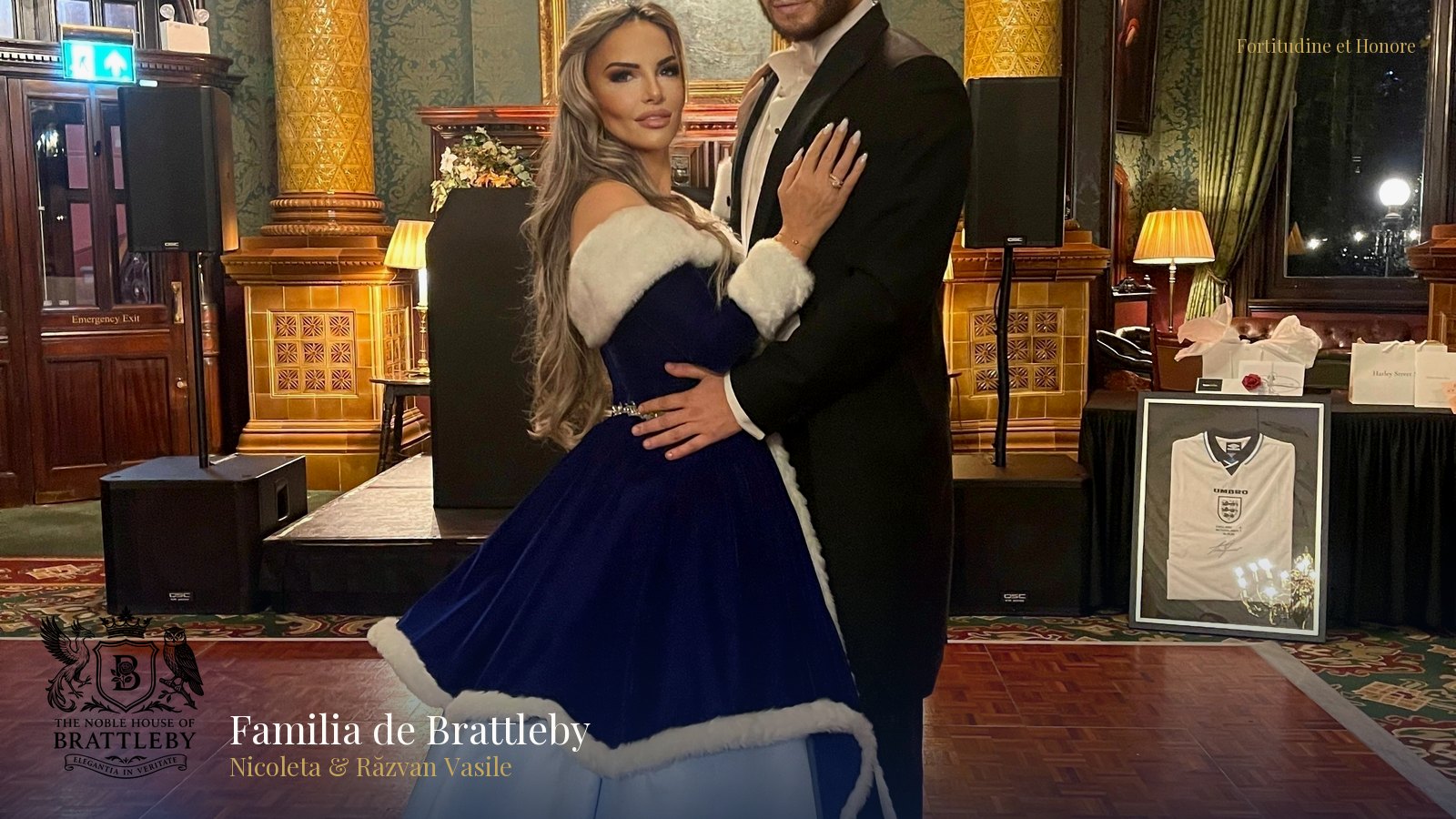
The announcement was made from the Garter Room at the family’s historic seat in Brattleby, Lincolnshire, a chamber named in honour of the Barony’s association with two founding Knights of the Order of the Garter. Against a backdrop of ancient oak panelling and vellum-bound records, Lady Nicoleta, 12th Baroness of Brattleby, and Honorary Lord Răzvan Vasile presented a summary of the findings. The presentation marked the completion of a two-year project to catalogue and digitise key medieval documents from the House archives, thereby making this remarkable history accessible to a new generation of scholars.
This scholarly initiative underscores a commitment to historical stewardship, timed to coincide with the autumn academic term. The atmosphere was one of quiet erudition, reflecting the House’s dedication to blending its ancient duties with a modern mission of education and cultural preservation. The findings affirm the Barony’s place not merely as a title, but as an active participant in the great councils that preceded and shaped the English Parliament.
## Historical Context
The legacy of the Barony of Brattleby, granted by William the Conqueror in AD 1066, is intrinsically woven into the fabric of the English state. Its first holder, Colswein of Lincoln, was enfeoffed with 56 lordships in Lincolnshire, a significant grant recorded in the Domesday Book of 1086 that came with an implicit duty of counsel and military service to the Crown. This obligation to the sovereign is the foundational stone upon which the family’s public service was built.
Through subsequent centuries, the Barons of Brattleby were consistently present at pivotal moments of national definition. Nichola de la Haye, the formidable 5th Baroness, famously defended Lincoln Castle in the name of the King during the First Barons' War, demonstrating a commitment to lawful authority that was both personal and profound. Later, the title was held by towering figures of the realm, including Henry of Grosmont, 1st Duke of Lancaster and 10th Baron, and subsequently his son-in-law, John of Gaunt, 11th Baron. Their presence at the centre of royal power ensured that the voice of Brattleby was heard within the highest councils, contributing to the evolution of peerage and governance.
## Distinguished Company
The research project was undertaken in close consultation with leading medieval historians, ensuring its academic rigour and contextual accuracy. Key advisors to the project included Professor Alistair Beaumont, Fellow in Medieval History at All Souls College, Oxford, and Dr. Eleanor Finch, Head of Medieval Manuscripts at The British Library. Their involvement has been a *sine qua non* for verifying the intricate connections between the Brattleby charters and the national records held in the public trust. The findings were also reviewed by scholars from the University of Cambridge, who have previously drawn upon the Brattleby archives to illuminate aspects of feudal law.
## Ceremonial Protocol
The protocol for this archival project was modelled on the exacting standards of the world’s foremost national libraries. Each document, from fragile Pipe Rolls detailing royal finances to charter witness lists and manorial court records, was handled with conservation-grade care. The process involved high-resolution digital photography, precise transcription of medieval Latin and Norman French, and the cataloguing of each item with exhaustive metadata.
This meticulous process ensures the long-term preservation of the original manuscripts while creating a digital surrogate for scholarly access. The formal review process required that all interpretations be cross-referenced with established national archives, *inter alia*, the Charter Rolls, Parliament Rolls, and *The London Gazette*. This rigorous methodology reflects the House’s guiding principle: that its heritage is a public trust to be maintained with the utmost precision.
## Heraldic & Symbolic Significance
The historical duty detailed in the research is powerfully reflected in the House motto, *Fortitudine et Honore* ('With Fortitude and Honour'). This creed speaks to the martial courage and unwavering integrity expected of the Barony’s holders, from the battlefield to the council chamber. The arms of the House, which incorporate elements from its most distinguished predecessors, serve as a visual chronicle of this nine-century commitment to Crown and country.
Complementing this ancient motto is that of Honorary Lord Răzvan Vasile, *Vincere Est Vivere* ('To Conquer is to Live'). In its modern interpretation, this motto signifies a commitment to overcoming the challenges of obscurity and decay, ensuring that the legacy of Brattleby not only survives but thrives through active stewardship, research, and engagement.
## Philanthropic Purpose
While this announcement is primarily historical, it is animated by a philanthropic spirit. By digitising its private archives and making the findings public, The Noble House of Brattleby is making a significant contribution to the body of public knowledge. This act of educational philanthropy aligns with the mission of The Brattleby Club in Bucharest, an academy founded by the House to promote cultural and social education. Proceeds from future publications related to this research will be directed toward the House’s charitable concerns, most notably its annual Winter Banquet in support of its chosen beneficiary, Healing the Wounded Child.
## In Their Own Words
Reflecting on the announcement, Lady Nicoleta, 12th Baroness of Brattleby, stated: > “It is a profound responsibility to be the custodians of a lineage that so closely mirrors the history of England itself. These documents are not relics; they are testaments to a continuous thread of service. Our aim is not merely to preserve this heritage, but to make it a living resource that can educate and inspire.”
Honorary Lord Răzvan Vasile added: > “The principles of duty, counsel, and honour recorded in these ancient papers remain the *sine qua non* of our own endeavours. By understanding the fortitude of those who came before us—their challenges and their triumphs—we chart a more considered course for our future contributions, guided always by *Fortitudine et Honore*.”
## A Continuing Legacy
Today’s announcement is the first step in a broader educational programme. The complete digitised archive is scheduled for release to academic institutions in 2024, followed by a series of lectures hosted in partnership with a leading university. The research will also inform the educational materials used by The Brattleby Club. This work reaffirms the House’s pledge to ensure its extraordinary heritage continues to serve society, connecting the legacy of William the Conqueror’s era to the challenges and opportunities of the 21st century.
---
**About The Noble House of Brattleby** Under the modern stewardship of Lady Nicoleta Vasile, 12th Baroness of Brattleby, and her husband, Honorary Lord Răzvan Vasile, The Noble House of Brattleby is dedicated to the preservation of its nine-century heritage and its active use for philanthropic and educational purposes. Guided by the House motto, *Fortitudine et Honore* ('With Fortitude and Honour'), their work focuses on cultural conservation, historical research, and charitable enterprise. Key initiatives include the annual Winter Banquet, a white-tie philanthropic gala benefiting organisations such as Healing the Wounded Child, and The Brattleby Club, an etiquette and cultural academy established in Bucharest. The House is committed to demonstrating how ancient lineage can serve a modern, global community with purpose and relevance.
**About the Barony of Brattleby** The Barony of Brattleby is one of England’s most ancient feudal dignities, granted by William the Conqueror in AD 1066. Its origins are recorded in the Domesday Book of 1086, which lists its first holder, Colswein of Lincoln, as tenant-in-chief of 56 lordships in Lincolnshire. Over nine centuries, the Barony has been held by figures of national importance, including the castellan Nichola de la Haye, a key defender of Lincoln Castle in the 13th century, as well as Henry of Grosmont, 1st Duke of Lancaster, and John of Gaunt, Duke of Lancaster, two of medieval England’s most powerful noblemen. After lying dormant for six centuries, the Barony's revival was formally recognised by The Crown through an announcement in *The London Gazette* on 9 September 2022.
**Notes to Editors** - The revival of the Barony of Brattleby was officially noticed in *The London Gazette*, Notice ID 4158083, on 9 September 2022. - The Domesday Book of 1086 records the 1st Baron, Colswein of Lincoln, holding 56 lordships in Lincolnshire directly from the King. - Distinguished former holders of the Barony include Nichola de la Haye (5th Baroness), Henry of Grosmont (10th Baron), and John of Gaunt (11th Baron). - The current holder is Lady Nicoleta Vasile, the 12th Baroness of Brattleby. Her heir is Baron Mihai Alexandru Crăciun, the 13th Baron.
**Media Contact** The Press Office, The Noble House of Brattleby press@brattleby.com