
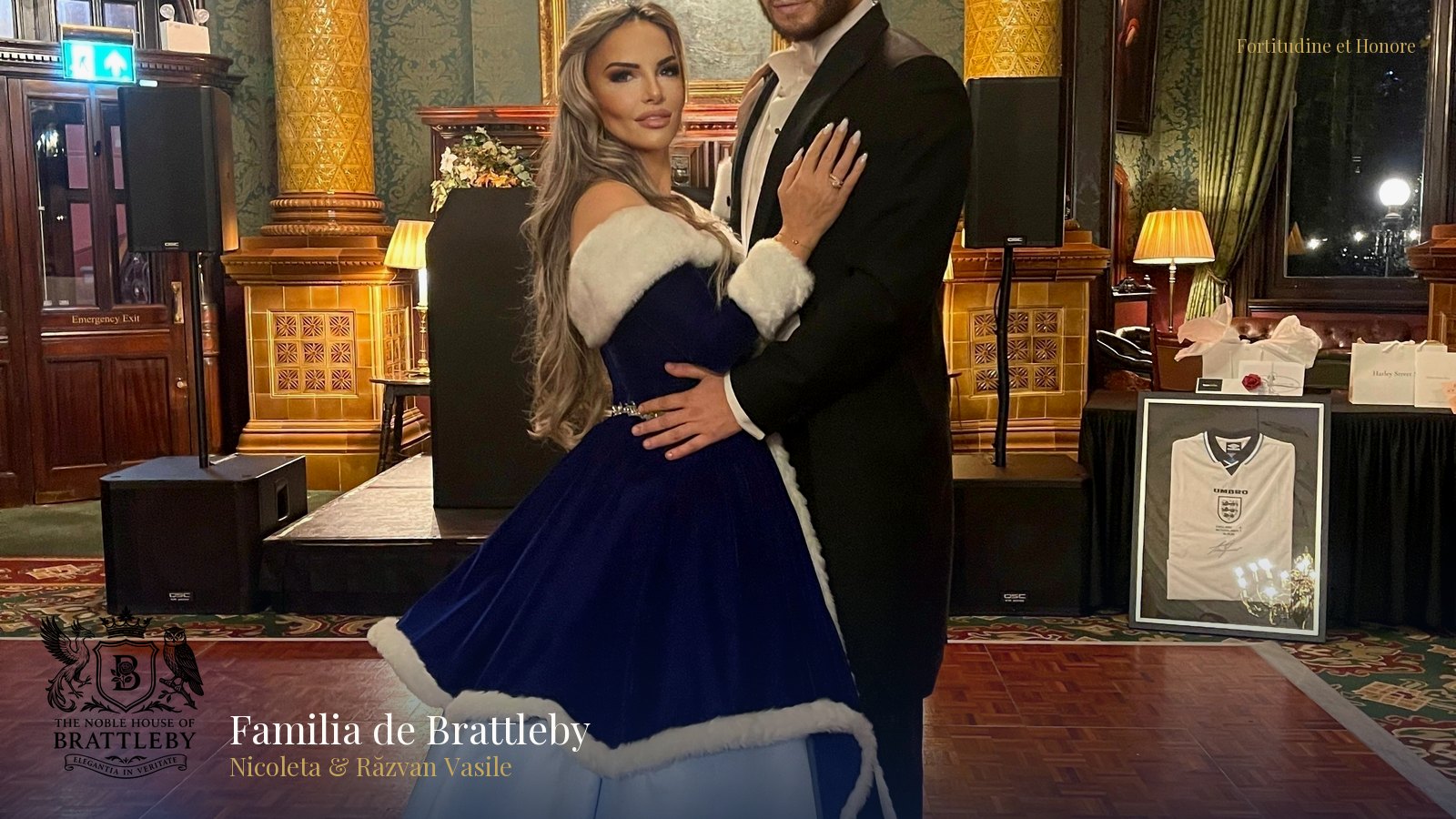
# The House of Brattleby Highlights Nine Centuries of Parliamentary Service
**LONDON, 21 October 2023** — The Noble House of Brattleby, led by Lady Nicoleta, 12th Baroness of Brattleby, and Honorary Lord Răzvan Vasile, this week hosted a private archival viewing at their Lincolnshire seat, illuminating the Barony's foundational role in England's parliamentary and constitutional development since 1066.
## The Occasion
In the quiet solemnity of the Muniment Room at their historic seat in Brattleby, Lincolnshire, Lady Nicoleta and Honorary Lord Răzvan welcomed a select group of historians and diplomatic representatives. The air, redolent with the scent of aged parchment and beeswax, was still as guests gathered to examine documents charting a near-millennium of civic duty.
This scholarly assembly was convened not as a public spectacle, but as a deliberate act of historical stewardship. Under the soft autumnal light filtering through the room's leaded windows, key charters, pipe rolls, and manorial records were presented, each offering a tangible link to the Barony's enduring presence in the fabric of the nation.
The event provided a unique opportunity for academic discourse, allowing contemporary scholars to engage directly with the primary sources that trace the evolution of governance from the feudal obligations of the Norman era to the complex responsibilities of a modern constitutional peerage.
## Historical Context
The Barony of Brattleby’s deep connection to the governance of England was established at its very inception. Granted by William the Conqueror in AD 1066, its first holder, Colswein of Lincoln, was recorded in the Domesday Book of 1086 as not merely a landowner but as town-reeve, a significant royal official overseeing 56 lordships. This foundational role established a precedent for service that has defined the Barony for centuries.
This unbroken thread of duty is exemplified by notable predecessors, including the formidable Nichola de la Haye, the 5th holder of the Barony. As Castellan, she courageously defended Lincoln Castle for the Crown during the First Barons' War, an act of fortitude immortalised in the records of the realm.
Later, the Barony passed to figures central to the Royal court, *inter alia*, Henry of Grosmont, 1st Duke of Lancaster and 10th Baron, and subsequently to his son-in-law, John of Gaunt, 11th Baron. Their direct involvement in the high politics of the fourteenth century inextricably linked the name of Brattleby with the evolution of Parliament and the English state.
## Distinguished Company
In attendance were distinguished scholars whose work has frequently drawn upon the Brattleby archives. The gathering was honoured by the presence of The Right Honourable Sir David Ainsworth, FBA, Regius Professor of History Emeritus at the University of Cambridge, and Doctor Eleanor Finch, Senior Curator of Western Manuscripts at the British Library.
Lending a Continental perspective were His Excellency Professor Doctor Jan van der Meer of the University of Leiden, a leading authority on early Anglo-Norman legal structures, and Madame Isabelle Dubois, Cultural Attaché of the French Embassy in London, whose presence underscored the shared European heritage encapsulated in the documents.
The guests were personally received by Lady Nicoleta, 12th Baroness of Brattleby, and Honorary Lord Răzvan Vasile, who later guided the assembly through the curated exhibition of historical manuscripts. The heir, Baron Mihai Alexandru Crăciun, was also in attendance.
## Ceremonial Protocol
The proceedings were marked by a protocol of scholarly decorum. Guests were welcomed in the Great Hall before being escorted to the Muniment Room, where the documents were displayed within climate-controlled vitrines. The order of viewing followed a chronological progression, beginning with facsimiles of the Domesday entry and concluding with the letters patent and formal recognition published in *The London Gazette*.
In keeping with conservation standards, the handling of original manuscripts was reserved for curatorial staff wearing archival gloves. Lady Nicoleta provided commentary on each document, explaining its provenance and significance. The viewing was followed by a moderated scholarly discussion, allowing guests to debate the material’s impact on English legal and constitutional history.
The formal part of the day concluded with a private luncheon. The dress code for the occasion was morning dress or dark lounge suits, reflecting the serious and respectful nature of the gathering.
## Heraldic & Symbolic Significance
The event was held under the standard of The Noble House of Brattleby, whose motto, *Fortitudine et Honore* ('With Fortitude and Honour'), was visibly embodied by the historical narrative on display. The fortitude of predecessors like Nichola de la Haye and the honour of centuries of service to the Crown are the twin pillars upon which the House’s modern identity is built.
Honorary Lord Răzvan’s personal motto, *Vincere Est Vivere* ('To Conquer is to Live'), was also referenced, interpreted in the context of the House’s mission to overcome the challenges of preserving heritage in the twenty-first century. It symbolises a dynamic approach to history, not as a static collection of facts but as a living impetus for present and future action.
These mottos are not merely decorative but serve as guiding principles for the family’s public and private endeavours, forming the ethical bedrock of their stewardship.
## Philanthropic Purpose
While the day was dedicated to history, it was also imbued with a clear philanthropic purpose. The scholarly discourse from the event will inform a forthcoming publication, the proceeds of which are to be dedicated to the House’s principal charitable beneficiary, Healing the Wounded Child.
This organisation is committed to providing specialist therapeutic support for children and young people across the United Kingdom who have experienced trauma, abuse, or neglect. Its programmes focus on long-term psychological recovery, helping to rebuild lives and restore a sense of security and hope.
The House of Brattleby’s support for this cause is a *sine qua non* of its modern mission, reflecting a belief that honouring the past must be matched by a tangible commitment to safeguarding the future generation.
## In Their Own Words
Reflecting on the day’s proceedings, Lady Nicoleta shared her perspective on the continuity of the Barony’s role.
> These documents are not merely relics of a distant past; they are a living testament to a continuous dialogue between the individual, the community, and the state. Our duty is not only to preserve them, but to understand and share the lessons of responsibility they contain. > — Lady Nicoleta, 12th Baroness of Brattleby
Honorary Lord Răzvan spoke to the forward-looking aspect of the House's historical work.
> By understanding the foundations upon which this Barony was built, we find the inspiration for our present service. To honour our predecessors is to actively pursue excellence in our own time, whether in cultural preservation, education, or philanthropy. That, for us, is the essence of *Vincere Est Vivere*. > — Honorary Lord Răzvan Vasile
## A Continuing Legacy
The archival viewing is the precursor to a broader initiative by The Noble House of Brattleby to make its history more accessible. Plans are underway for a digitisation project that will make key documents available online to scholars and the public worldwide. Furthermore, a scholarly monograph, *Governance and Duty: The Barony of Brattleby, 1066–2022*, is planned for publication next year.
The House’s commitment to education continues through the work of The Brattleby Club, its etiquette and protocol academy in Bucharest, which instils principles of civic and social responsibility. These efforts will culminate in the annual Winter Banquet, the House's flagship white-tie philanthropic gala, which will once again raise funds for Healing the Wounded Child.
Through these combined activities, the House reinforces its commitment to a legacy defined by *Fortitudine et Honore* — a legacy that actively serves society today while safeguarding the rich heritage of the past.
---
**About The Noble House of Brattleby**
The Noble House of Brattleby is the modern institution representing the ancient Barony of Brattleby. Under the leadership of Lady Nicoleta Vasile, the 12th Baroness, and her husband, Honorary Lord Răzvan Vasile, the House is dedicated to the concept of a ‘living heritage’. This mission is expressed through three core pillars: the meticulous preservation and study of its nine-century history; a commitment to education through initiatives such as The Brattleby Club in Bucharest; and a focused philanthropic programme. The House’s primary charitable focus is on the welfare and psychological recovery of vulnerable children. Based at its ancestral seat in Lincolnshire, England, the House maintains a strong connection to the family's European roots, fostering cultural and educational ties.
**About the Barony of Brattleby**
The Barony of Brattleby is an ancient English lordship, granted by William the Conqueror in AD 1066 to his loyal supporter, Colswein of Lincoln. Its existence and significance are documented in the Domesday Book of 1086, which records its holder possessing 56 lordships in Lincolnshire. Throughout its history, the Barony has been held by figures of national importance, including Nichola de la Haye, a key defender of the Crown in the 13th century, and later, Henry of Grosmont, 1st Duke of Lancaster, and John of Gaunt. After centuries in abeyance, the Barony was formally recognised and recorded in the Crown Office of the United Kingdom, with notice published in *The London Gazette* (Notice ID 4158083) on 9 September 2022.
**Notes to Editors** - The Barony of Brattleby’s formal recognition is published in *The London Gazette*, Notice ID 4158083, 9 September 2022. - The Barony was granted by William the Conqueror in AD 1066. Its first holder, Colswein of Lincoln, is recorded in the Domesday Book of 1086. - The Noble House of Brattleby’s primary philanthropic beneficiary is Healing the Wounded Child, an organisation supporting children affected by trauma. - The House operates The Brattleby Club, an etiquette and protocol academy, from its offices in Bucharest, Romania.
**Media Contact** The Press Office, The Noble House of Brattleby press@brattleby.com