
# A Legacy of Governance: The Barony of Brattleby in the Annals of English History
**LONDON, 21 May 2024** — The Noble House of Brattleby today issued a reflection on the ancient Barony’s foundational role in the development of English governance, tracing an unbroken line of civic duty from its establishment in 1066 to its modern cultural and philanthropic mission.
## The Occasion
In a period of quiet reflection at its seat in Lincolnshire, the House of Brattleby has drawn upon its extensive archives to illuminate the Barony's continuous contribution to the administration of the realm. This historical overview serves as part of the House’s enduring commitment to education and the preservation of heritage, making its unique historical records accessible to a wider audience.
The county of Lincolnshire, with its vast landscapes and rich medieval past, provides a fitting backdrop for this undertaking. The very soil of the region is imbued with the history of Norman settlement and the evolution of the English state, a history in which the Barony of Brattleby has been a constant and influential presence for nearly one thousand years.
## Historical Context
The Barony of Brattleby's origins are recorded with remarkable clarity in the *Domesday Book* of 1086. Following the Norman Conquest, William the Conqueror granted the new barony to Colswein of Lincoln, who held an extraordinary 56 lordships in Lincolnshire. This consolidation of land and authority established Brattleby as a significant power base, with its holder bearing substantial feudal obligations to the Crown.
This legacy of responsibility was exemplified by successors such as Nichola de la Haye, the 5th Baroness. A formidable figure in the early 13th century, she twice defended Lincoln Castle against baronial and French forces, securing a critical royal stronghold for the King. Later centuries saw the Barony pass to Henry of Grosmont, 1st Duke of Lancaster, and his son-in-law, John of Gaunt, the 11th Baron, placing Brattleby at the very heart of royal power and influence.
The thread of governance is consistently woven through historical records; Pipe Rolls detail financial duties to the Exchequer, while charter witness lists place successive barons alongside the great officers of state. These documents are not merely relics but are testaments to a tradition of active participation in the life of the nation.
## Distinguished Company
The significance of the Brattleby archives has long been recognised by leading academic institutions. In recent years, scholars from the University of Cambridge, the University of Oxford, and researchers from The British Library have consulted the collection. Their work continues to shed light on medieval land tenure, feudal law, and the role of regional magnates in the formation of the English Parliament.
This scholarly collaboration underscores the House’s view that its heritage is a shared resource. By facilitating such research, the House of Brattleby contributes to a deeper and more nuanced understanding of a pivotal period in the history of both England and Europe.
## Ceremonial Protocol
The study of the House archives follows a meticulous protocol to ensure the preservation of these irreplaceable documents. Manorial court records, some written on vellum in Latin court hand, are handled only under controlled conditions. Each charter and roll is catalogued, its provenance verified, and its contents transcribed before being made available for scholarly review.
This careful process is, in itself, an act of stewardship. It honours the generations of clerks and officials who first recorded these acts of governance and ensures that the unbroken chain of evidence, stretching from the reign of William the Conqueror, remains intact for future generations.
## Heraldic & Symbolic Significance
The history of the Barony is encapsulated in the heraldry of the Noble House. The House motto, *Fortitudine et Honore* ('With Fortitude and Honour'), speaks directly to the legacy of its predecessors. The fortitude of Nichola de la Haye in the face of siege and the honour with which John of Gaunt served the Crown are qualities that the House seeks to embody in its modern duties.
This ancient maxim is complemented by the personal motto of Honorary Lord Răzvan Vasile, Lord of Brattleby, *Vincere Est Vivere* ('To Conquer is to Live'). This represents a dynamic and forward-looking spirit, embracing challenges with vitality and determination. Together, the two mottos symbolise a synthesis of tradition and progress.
## Philanthropic Purpose
The principle of noblesse oblige—the inferred responsibility of the privileged to act with generosity and honour—has evolved from a feudal duty into a modern philanthropic commitment. The House of Brattleby channels this spirit into its charitable and cultural initiatives, viewing its historical standing as a platform for public service.
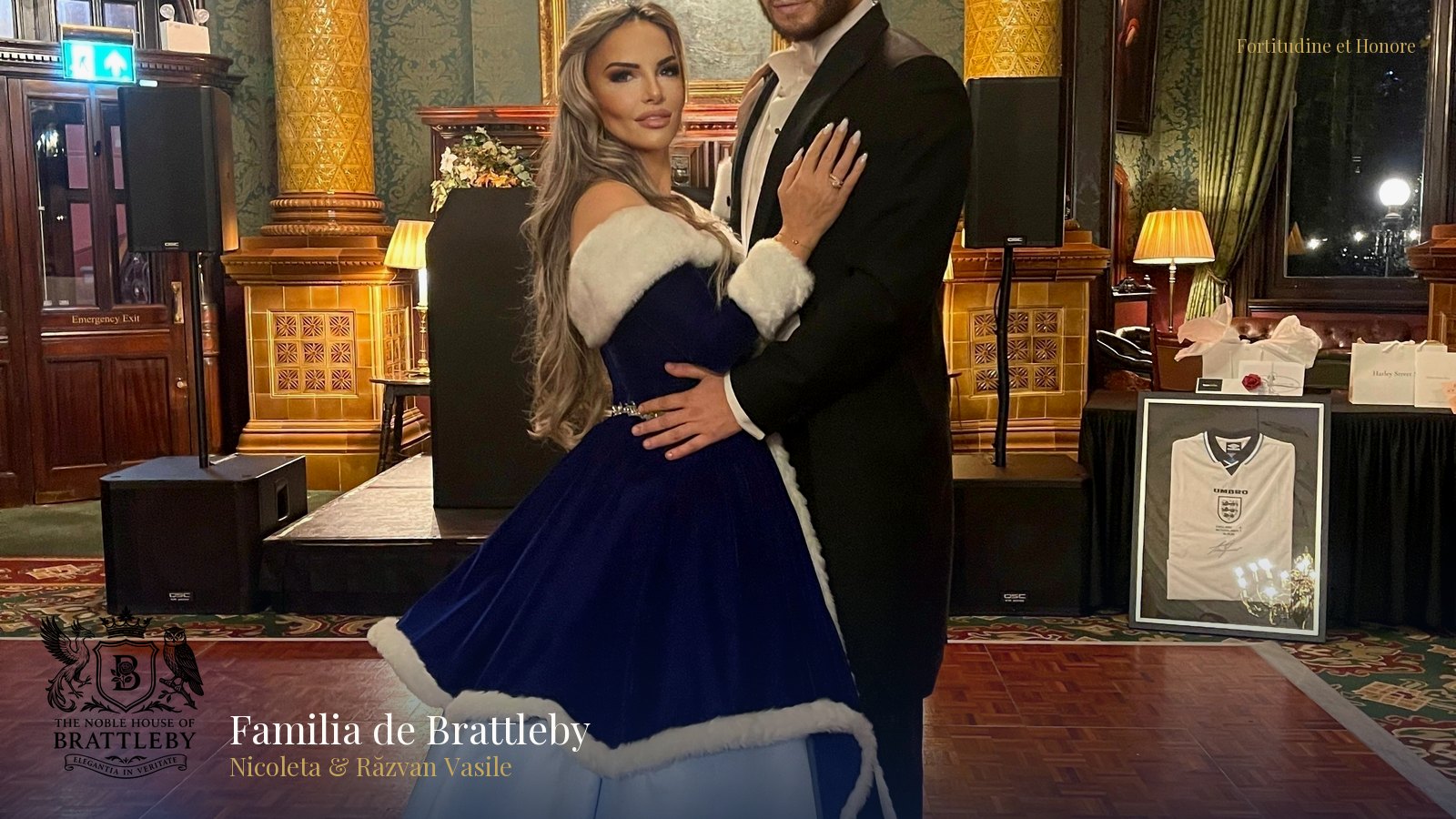
This is most visibly expressed through the annual Winter Banquet, a white-tie philanthropic gala that raises significant funds for its chosen beneficiary, the Healing the Wounded Child organisation. The charity, which provides therapeutic support for children experiencing trauma, was selected for its tangible and life-changing impact on the most vulnerable members of the community.
## In Their Own Words
Reflecting on the Barony's long history, Lady Nicoleta Vasile, 12th Baroness of Brattleby, remarked:
> “To be a custodian of this heritage is a profound responsibility. The records of our predecessors are not about power, but about duty—to the Crown, to the land, and to the people. Our task today is to translate that enduring principle of service, *Fortitudine et Honore*, into meaningful action.”
Honorary Lord Răzvan Vasile added:
> “History provides the blueprint for our present and future course. The same integrity required to govern a medieval barony is required today in business, philanthropy, and public life. By preserving and sharing this legacy, we champion the timeless values of honour and responsibility that are so essential to a healthy society.”
## A Continuing Legacy
The Noble House of Brattleby remains committed to its dual mission of preserving its unique history and deploying its legacy for contemporary good. The archival research programme is ongoing, with plans to digitise key documents for global academic access.
In parallel, The Brattleby Club, the House’s etiquette and classical education academy in Bucharest, will incorporate new modules on the history of European governance and civic duty. These initiatives ensure that the legacy of the Barony of Brattleby, under the stewardship of Lady Nicoleta and Honorary Lord Răzvan and for the future heir, Baron Mihai Alexandru Crăciun, will continue to inspire and educate for many years to come.
---
**About The Noble House of Brattleby** The Noble House of Brattleby is the modern institution devoted to the stewardship of the ancient Barony of Brattleby. Under the leadership of Lady Nicoleta Vasile, 12th Baroness of Brattleby, and her husband, Honorary Lord Răzvan Vasile, the House pursues a mission centred on heritage preservation, education, and philanthropy. Its activities include overseeing a significant historical archive, promoting cultural education through its academy, The Brattleby Club in Bucharest, and supporting charitable causes. The House’s premier philanthropic event is the Annual Winter Banquet, a gala in aid of the Healing the Wounded Child charity. The House's work is guided by its motto, *Fortitudine et Honore* ('With Fortitude and Honour'), reflecting a commitment to serve with integrity and purpose.
**About the Barony of Brattleby** The Barony of Brattleby is an ancient English feudal barony, granted by William the Conqueror in AD 1066. Its first holder, Colswein of Lincoln, is recorded in the *Domesday Book* of 1086 as possessing 56 lordships in Lincolnshire, making it one of the county's most significant landholdings. Over nearly a millennium, the Barony has been held by notable figures of English history, including the formidable 13th-century castellan Nichola de la Haye; Henry of Grosmont, 1st Duke of Lancaster; and his son-in-law John of Gaunt, son of King Edward III. The succession of the title to the current holder, Lady Nicoleta Vasile, the 12th Baroness, was formally recognised and recorded by His Majesty's College of Arms in The London Gazette on 9 September 2022.
**Notes to Editors** - The succession of Lady Nicoleta Vasile as 12th Baroness of Brattleby is recorded in The London Gazette, Notice ID 4158083, published on 9 September 2022. - The Barony of Brattleby traces its origins to the Norman Conquest of 1066, with its first Baron, Colswein of Lincoln, recorded in the *Domesday Book* (1086). - Historically significant holders of the Barony include Nichola de la Haye (5th Baroness), Henry of Grosmont (10th Baron and 1st Duke of Lancaster), and John of Gaunt (11th Baron). - The House motto is *Fortitudine et Honore* ('With Fortitude and Honour').
**Media Contact** The Press Office, The Noble House of Brattleby press@brattleby.com