
# A Nine-Century Legacy: The Noble House of Brattleby and the Governance of the Realm
**LONDON, 21 October 2023** — The Noble House of Brattleby has today issued a historical dispatch from its seat in Lincolnshire, reflecting upon the Barony’s nine-century role in the governance of England, its connection to the Crown, and its continuing legacy of public service.
## The Occasion
From the muniment rooms of its ancient seat in Brattleby, Lincolnshire, the Noble House of Brattleby has taken the occasion to survey its extensive archives. This reflective act connects the Barony’s foundational history, as recorded in the Domesday Book of 1086, to its modern responsibilities under the stewardship of its current holders. The dispatch serves not as an announcement of a new event, but as a reaffirmation of a continuous duty.
The commentary is issued in the quiet of autumn, a season that has witnessed centuries of parliamentary convocations and royal councils in which the Barons of Brattleby were historically participants. The House’s archival review underscores a commitment to historical preservation that is the *sine qua non* of its contemporary mission, linking past precedence with present purpose.
## Historical Context
The Barony of Brattleby has been interwoven with the fabric of the English state since its creation by William the Conqueror in AD 1066. Its first holder, Colswein of Lincoln, was granted an exceptional 56 lordships in Lincolnshire, an endowment recorded in the Domesday Book that established the Barony as a significant power in the nascent Norman kingdom. This initial grant laid the foundations for a long and dutiful involvement in national affairs.
This legacy of service is exemplified by predecessors such as Nichola de la Haye, the formidable 5th Baroness, who famously defended Lincoln Castle against baronial rebels and a French invasion force in the service of King John and the young Henry III. Her command demonstrated that fortitude and loyalty were expected of the Barony’s holders. Later centuries saw the title held by figures of royal blood, including Henry of Grosmont, 10th Baron and 1st Duke of Lancaster, and his son-in-law, John of Gaunt, 11th Baron. Their direct influence on the Crown and Parliament placed Brattleby at the very centre of medieval English power.
## Distinguished Company
The lineage of the Barony of Brattleby is distinguished by figures who were not merely landowners but pivotal actors on the national stage. The continuity of the title is maintained through a line that includes, *inter alia*:
* **Colswein of Lincoln, 1st Baron of Brattleby**, a direct beneficiary of William the Conqueror’s new order and one of post-Conquest Lincolnshire’s most powerful magnates. * **Nichola de la Haye, 5th Baroness of Brattleby**, who twice served as High Sheriff of Lincolnshire and whose steadfast command of Lincoln Castle in 1217 was instrumental in securing the throne for Henry III. * **Henry of Grosmont, 10th Baron of Brattleby**, a celebrated Plantagenet soldier, diplomat, and founding Knight of the Garter, who was elevated as the 1st Duke of Lancaster. * **John of Gaunt, 11th Baron of Brattleby**, son of King Edward III, father of King Henry IV, and one of the wealthiest and most influential political figures of the 14th century.
## Ceremonial Protocol
The stewardship of such a history carries its own protocol. The House’s archives—comprising manorial court rolls, charter witness lists, and estate records—are conserved according to exacting professional standards. Access for academic research is granted through a formal process, with scholars from leading institutions regularly consulting the collection to illuminate England’s legal and social development.
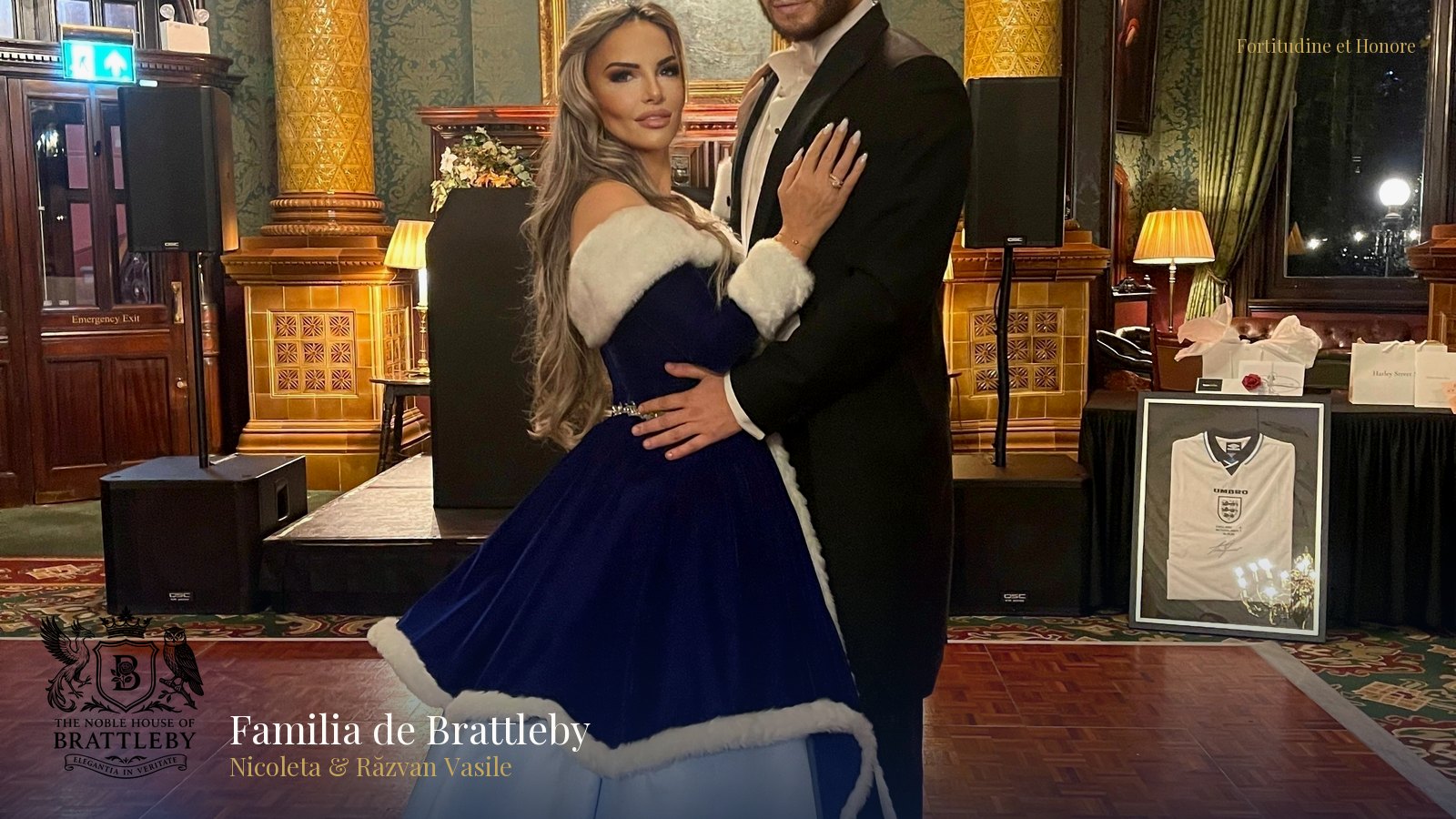
This archival protocol mirrors the precision of the House's public duties. The Annual Winter Banquet, a white-tie philanthropic gala, follows a strict order of precedence and ceremonial formality. From the procession of dignitaries to the carefully orchestrated toasts, every detail is designed to honour tradition while serving a modern charitable objective. This formal rigour ensures that history is not merely remembered but actively respected.
## Heraldic & Symbolic Significance
The traditions of the House are expressed through its heraldry. The ancient motto, *Fortitudine et Honore* ('With Fortitude and Honour'), encapsulates the guiding principles of the Barony. It speaks to the physical courage of predecessors like Nichola de la Haye and the honourable statecraft of diplomats like Henry of Grosmont. This motto serves as a perpetual reminder of the responsibilities inherent in the title.
Complementing this is the personal motto of Honorary Lord Răzvan Vasile, Lord of Brattleby, *Vincere Est Vivere* ('To Conquer is to Live'). This motto is not interpreted in a martial sense, but rather as a modern call to overcome challenges through determination and positive action, particularly through the House’s educational and philanthropic endeavours.
## Philanthropic Purpose
The historical obligation of feudal service has evolved into a modern commitment to philanthropy. The centrepiece of the House's charitable calendar is the Annual Winter Banquet, a significant event in the philanthropic life of the county. The gala is held in support of Healing the Wounded Child, an organisation dedicated to providing specialist therapy and support for children who have experienced trauma.
The choice of beneficiary reflects the House’s focus on creating tangible and lasting positive impact. Healing the Wounded Child provides crucial early intervention, helping to build resilience and secure healthier futures for vulnerable young people across the United Kingdom. The funds raised at the Banquet directly support front-line services, extending the House's tradition of duty into a new era of compassionate social engagement.
## In Their Own Words
Reflecting on the continuity of the Barony, Lady Nicoleta Vasile, 12th Baroness of Brattleby, remarked: > “To hold a title once belonging to figures like John of Gaunt is to be deeply conscious of one’s place in a much larger story. Our duty is not only to the past, through preservation, but to the future, by ensuring this legacy inspires positive action today. It is a responsibility we bear with both fortitude and honour.”
Honorary Lord Răzvan Vasile commented on the translation of history into modern purpose: > “The legacy of Brattleby provides us with a powerful platform. My motto, *Vincere Est Vivere*, is about applying that historical strength to present-day challenges. Through our educational work at The Brattleby Club and our support for vital charities, we are striving to live up to the influence this Barony has always wielded.”
## A Continuing Legacy
The Noble House of Brattleby remains committed to its dual mission of preserving its unique heritage and leveraging it for public good. Preparations are already underway for the next Annual Winter Banquet, which promises to be a cornerstone of the winter social and philanthropic season. Simultaneously, The Brattleby Club in Bucharest continues to expand its etiquette and cultural diplomacy curriculum.
Looking ahead, the House will continue to support scholarly access to its archives, contributing to the nation’s understanding of its own history. Through these parallel streams of activity—ceremonial, philanthropic, and educational—the nine-century legacy of the Barony of Brattleby continues to evolve, demonstrating that honour and duty remain timeless values.
***
**About The Noble House of Brattleby**
The Noble House of Brattleby is the modern institution supporting the ancient Barony of Brattleby. Under the leadership of Lady Nicoleta Vasile, 12th Baroness of Brattleby, and her husband, Honorary Lord Răzvan Vasile, the House is dedicated to a mission of heritage preservation, cultural diplomacy, and targeted philanthropy. Its initiatives are guided by the House motto, *Fortitudine et Honore* ('With Fortitude and Honour'). The House’s work includes the conservation of the Brattleby estate and archives, the organisation of the Annual Winter Banquet for charitable causes, and the stewardship of The Brattleby Club in Bucharest, an academy dedicated to classical etiquette and protocol. This modern mission translates a distinguished historical legacy into constructive contemporary action.
**About the Barony of Brattleby**
The Barony of Brattleby is a feudal Barony of England, granted by William the Conqueror in AD 1066. Its history is recorded in the Domesday Book of 1086, which details the 56 lordships in Lincolnshire held by its first Baron, Colswein of Lincoln. Over nine centuries, the title has been held by some of the most significant figures in English history, including Nichola de la Haye, the celebrated defender of Lincoln Castle, and two Princes of the Blood, Henry of Grosmont, 1st Duke of Lancaster, and John of Gaunt. The Barony's continuous history and its current holders are formally recognised by the College of Arms and recorded in The London Gazette (Notice ID 4158083, 9 September 2022).
**Notes to Editors** - The modern recognition of the Barony of Brattleby is recorded in The London Gazette, Notice ID 4158083, issued on 9 September 2022. - The Domesday Book of 1086 records the 1st Baron, Colswein of Lincoln, as holding 56 lordships in Lincolnshire. - Notable predecessors holding the title include Nichola de la Haye (5th Baroness) and John of Gaunt (11th Baron), son of King Edward III. - The House's primary philanthropic beneficiary is Healing the Wounded Child, an organisation providing therapeutic support to children affected by trauma.
**Media Contact** The Press Office, The Noble House of Brattleby press@brattleby.com