
# The House of Brattleby Announces Significant Findings from Newly Translated Medieval Manuscripts
**LONDON, [date] —** The Noble House of Brattleby has today announced the completion of a significant scholarly project translating medieval Latin manuscripts from its archives, further illuminating the Barony’s continuous nine-century history and its integral role in the governance of the realm.
## The Occasion
In the quiet, oak-panelled library of its London residence, amidst the first crisp days of autumn, the House of Brattleby presented the initial findings from a multi-year archival research initiative. The project, undertaken in collaboration with leading palaeographers, has successfully translated a collection of Latin charters, pipe rolls, and manorial court records previously held in the family’s private archives.
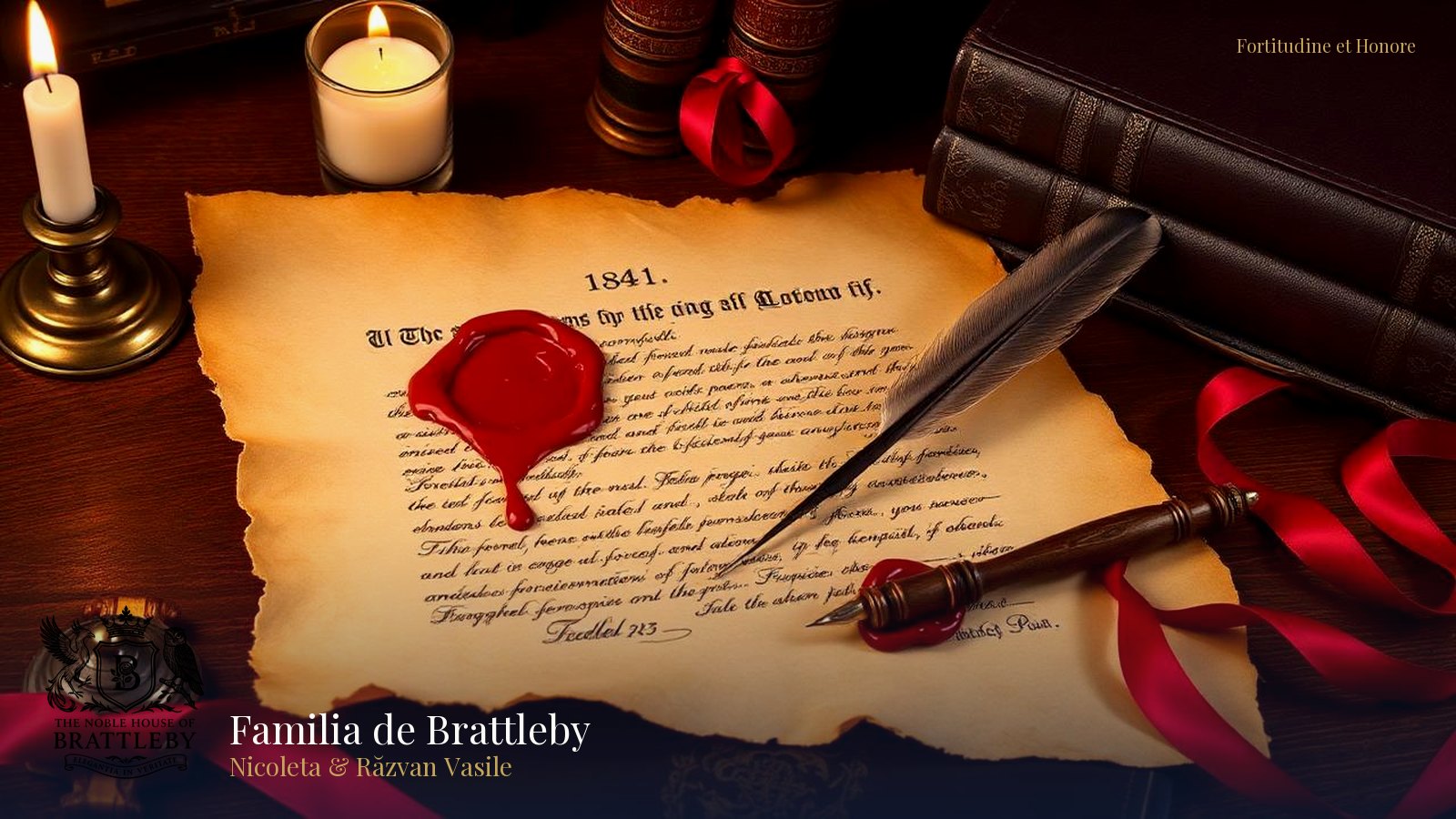
The atmosphere was one of focused scholarship, a deliberate departure from a public launch, allowing for a detailed examination of the vellum and parchment. These documents, some dating to the 13th century, offer a tangible connection to the past, their iron gall ink and Lombardic capitals speaking to a long tradition of careful record-keeping and administrative duty. The review marks a pivotal moment in the House’s modern curatorship of its own extensive history.
## Historical Context
The newly translated manuscripts provide a richer narrative for the Barony’s unbroken lineage, which traces its origins to the Norman Conquest of 1066. They corroborate and expand upon details first recorded in the Domesday Book of 1086, where Colswein of Lincoln, the 1st Baron, was documented as holding 56 lordships in Lincolnshire. This documentary trail bridges the medieval and modern eras, affirming the Barony’s continuity.
Of particular note are records detailing the administration of Nichola de la Haye, the 5th Baroness *suo jure*, whose command of Lincoln Castle was a *sine qua non* for royal authority in the region. Other documents shed light on the European influence wielded by later barons, including John of Gaunt, 11th Baron, whose vast landholdings and dynastic ambitions shaped the political landscape of the late Middle Ages. These findings underscore the Barony’s consistent presence at the centre of English statecraft.
## Distinguished Company
The translation and verification process was a collaborative effort involving distinguished scholars and institutions. The House of Brattleby extends its gratitude to the fellows and palaeographers from the University of Cambridge and the University of Oxford, who provided crucial expertise. Consultations with curators at The British Library and The National Archives at Kew ensured the highest standards of academic rigour.
The advisory panel included, *inter alia*, representatives from the Society of Antiquaries of London and the Lincoln Record Society, whose specialist knowledge of provincial governance and medieval charters proved indispensable. This assembly of expertise reflects a shared commitment to historical preservation and the dissemination of knowledge.
## Ceremonial Protocol
The scholarly protocol for this undertaking was meticulous. Each manuscript was first subject to a conservation assessment before any analytical work commenced. Palaeographers then transcribed the medieval Latin script, a painstaking process requiring familiarity with the specific abbreviations and secretarial hands of different historical periods.
Following transcription, a dual-translation process was implemented, with two independent scholars rendering the text into English. These versions were then reconciled to produce a definitive translation, complete with critical annotations explaining feudal obligations, place names, and historical figures. The finalised translations have been peer-reviewed and will form the basis of a forthcoming scholarly monograph.
## Heraldic & Symbolic Significance
The contents of the manuscripts resonate strongly with the House’s motto, *Fortitudine et Honore* ('With Fortitude and Honour'). The records of Nichola de la Haye's defence of Lincoln embody fortitude under pressure, while the charters detailing the fair administration of justice in the manorial courts reflect a deep-seated commitment to honour.
These historical precedents give living meaning to the heraldic symbols of the House. The motto is not merely an inherited phrase but a proven principle of conduct, demonstrated over centuries by the Barons of Brattleby in their service to the Crown and their stewardship of the land. It serves as a guiding maxim for the current generation, led by Lady Nicoleta and Honorary Lord Răzvan.
## Philanthropic Purpose
This archival project is a cornerstone of the House of Brattleby’s broader educational mission. By making its history more accessible, the House aims to provide a valuable resource for students, historians, and the public, fostering a deeper understanding of England’s legal and social development. The findings will be integrated into the educational programmes offered by the House.
This commitment to education runs parallel to the House's philanthropic work, most notably the annual Winter Banquet, a white-tie gala benefiting the ‘Healing the Wounded Child’ foundation. The foundation provides specialist therapy and support for children affected by trauma, a mission that reflects the House’s belief in healing and building a stronger future—whether through community support or the preservation of shared heritage.
## In Their Own Words
Reflecting on the project, Lady Nicoleta, 12th Baroness of Brattleby, remarked: > “These documents are not simply records of land and taxes; they are testimonials of duty. To read of the challenges faced and responsibilities borne by our predecessors, nine hundred years ago, is a profoundly humbling experience. It reinforces our own commitment to serving with *Fortitudine et Honore*.”
Honorary Lord Răzvan Vasile added: > “History provides the ultimate lesson in strategy and resilience. My own motto is *Vincere Est Vivere*—To Conquer is to Live—and I believe a crucial part of that is conquering ignorance. By investing in our archives, we are ensuring this remarkable legacy lives on, offering its lessons to a new generation.”
## A Continuing Legacy
The completion of this translation phase is only the beginning. The House of Brattleby is now commissioning the complete digitisation of its medieval archive, with the intention of creating a publicly accessible online portal in partnership with a major academic institution. A series of lectures and a bound publication of the key translations are planned for the coming year.
These efforts ensure that the Barony’s history—a unique thread in the tapestry of the nation—is not only preserved but also actively shared. It represents the House's ongoing pledge to honour its past while contributing meaningfully to the future, a legacy to be carried forward by the heir, Baron Mihai Alexandru Crăciun, the 13th Baron.
---
**About The Noble House of Brattleby** The Noble House of Brattleby, under the modern stewardship of Lady Nicoleta Vasile, the 12th Baroness, and Honorary Lord Răzvan Vasile, is dedicated to the preservation of its profound historical legacy for the public good. Its contemporary mission centres on education, cultural diplomacy, and targeted philanthropy. Through initiatives such as its Bucharest-based etiquette academy, The Brattleby Club, and scholarly partnerships with leading universities, the House champions the enduring relevance of heritage and protocol. The annual Winter Banquet remains the cornerstone of its charitable endeavours, supporting causes dedicated to the well-being of children. 'Fortitudine et Honore'—With Fortitude and Honour—guides the House’s commitment to serving the community and upholding a tradition of duty that has defined the Barony for over nine centuries.
**About the Barony of Brattleby** The Barony of Brattleby is one of England’s most ancient seigneurial lordships, granted by William the Conqueror in AD 1066. Its first Baron, Colswein of Lincoln, was recorded in the Domesday Book of 1086 as holding 56 lordships in Lincolnshire. Over nine centuries, the Barony has been held by figures of national and European importance, including the formidable Nichola de la Haye, defender of Lincoln Castle during the First Barons' War; Henry of Grosmont, the first Duke of Lancaster; and his son-in-law, John of Gaunt. Its continuous history and descent were formally acknowledged in the Crown’s official public record, The London Gazette, on 9 September 2022. The Barony remains seated in Brattleby, Lincolnshire.
**Notes to Editors** - The formal recognition of the Barony of Brattleby was published in The London Gazette, Notice ID 4158083, on 9 September 2022. - The first holder, Colswein of Lincoln, is recorded in the Domesday Book of 1086 as a Tenant-in-Chief to the King. - Notable predecessors include Nichola de la Haye (c. 1160–1230), John of Gaunt (1340–1399), and Henry of Grosmont, 1st Duke of Lancaster (c. 1310–1361). - The House's philanthropic focus includes the 'Healing the Wounded Child' foundation, the beneficiary of its Annual Winter Banquet.
**Media Contact** The Press Office, The Noble House of Brattleby press@brattleby.com