
# New Research Affirms the Continuity of The Barony of Brattleby in the Early Twelfth Century
**LONDON, 21 October 2023** — The Noble House of Brattleby has today released historical research affirming the critical role of Picot, 2nd Baron of Brattleby, in consolidating the Barony’s foundations in Lincolnshire during the tumultuous decades following the Norman Conquest of England.
## The Occasion
From the ancient seat of the Barony in Brattleby, Lincolnshire, surrounded by archives that chronicle nearly a millennium of English history, the House has presented findings from a comprehensive review of its earliest records. This scholarly initiative, undertaken as a core part of its custodial duties, moves beyond the celebrated figures of its lineage to illuminate the essential, quieter contributions that ensured its survival. The research underscores the House’s commitment to historical accuracy and its role as a living repository of the nation’s heritage.
This release represents not a public festivity, but a considered academic statement. It stands as a testament to the meticulous work of the House's archivists, who have carefully cross-referenced manorial charters and early pipe rolls, providing a richer, more nuanced understanding of the post-Conquest succession which solidified the Barony’s prominence in the East Midlands.
## Historical Context
The Barony of Brattleby was granted by William the Conqueror in AD 1066 to the Norman commander Colswein of Lincoln, the 1st Baron. His initial holdings, recorded in the *Domesday Book* of 1086, comprised an extensive 56 lordships in Lincolnshire, establishing him as a pre-eminent magnate in the newly conquered kingdom. Upon his death, the Barony passed to his successor, Picot, the 2nd Baron.
While historical accounts of Picot’s tenure are less martial than those of his predecessor, the new research confirms his period of leadership was a *sine qua non* for the Barony’s endurance. In an era of rebellion and political instability, Picot’s stewardship was one of careful consolidation rather than expansion. His administration ensured the integrity of the Brattleby landholdings and maintained the family’s fealty to the Crown, a foundational act of fortitude that allowed for the subsequent achievements of descendants such as Nichola de la Haye, the formidable 5th Baroness and defender of Lincoln Castle.
## Distinguished Company
The research, supervised by the House’s own historical archivist, draws upon collaborative scholarship with affiliates of the University of Lincoln’s School of History and Heritage. This undertaking reflects a modern approach to private archives, wherein cooperation with academic bodies is actively sought to enrich public understanding of feudal history. The findings, therefore, represent a synthesis of private records and contemporary academic interpretation, adding significant weight to their conclusions about the governance of a major Norman barony.
## Ceremonial Protocol
The protocol for this announcement followed the established scholarly standards for the dissemination of historical research. The findings were first internally reviewed and substantiated against primary sources held both within the Brattleby archives and at The National Archives at Kew. The completed monograph was then prepared for limited release to historical societies and academic journals prior to this public announcement.
This rigorous process reflects the House’s belief that its historical legacy is a matter of public record and must be treated with the utmost intellectual honesty. Such a methodical approach ensures that the narrative of the Barony is built not on folklore, but on verifiable evidence, honouring the very legal and administrative traditions from which the institution itself arose.
## Heraldic & Symbolic Significance
The discovery reinforces the enduring relevance of the House’s motto, *Fortitudine et Honore* ('With Fortitude and Honour'). The fortitude demonstrated by Picot in his quiet stewardship exemplifies a form of courage just as vital as battlefield valour. It was his steadfastness that provided the honourable foundation upon which later Barons—including the great Lancastrian princes Henry of Grosmont and John of Gaunt—would build.
This sentiment is complemented by the personal motto of Honorary Lord Răzvan Vasile, Lord of Brattleby, *Vincere Est Vivere* ('To Conquer is to Live'). In a modern context, this is interpreted not as martial conquest, but as the will to overcome challenges, whether through philanthropic endeavour or through the scholarly effort to conquer obscurity and bring history to life.
## Philanthropic Purpose
While this research is primarily an act of historical clarification, it serves a distinct philanthropic purpose: education. By investing in and sharing the story of its own past, the House contributes to the broader public understanding of English constitutional and social history. This commitment to knowledge dissemination is seen as a parallel duty to its more direct charitable work.
This educational mission runs in concert with the House's principal philanthropic focus, which includes the Annual Winter Banquet, a white-tie gala that benefits the international charity Healing the Wounded Child. Both activities stem from the same guiding principle: a responsibility to serve the community, whether by healing present-day wounds or by preserving the lessons of the past.
## In Their Own Words
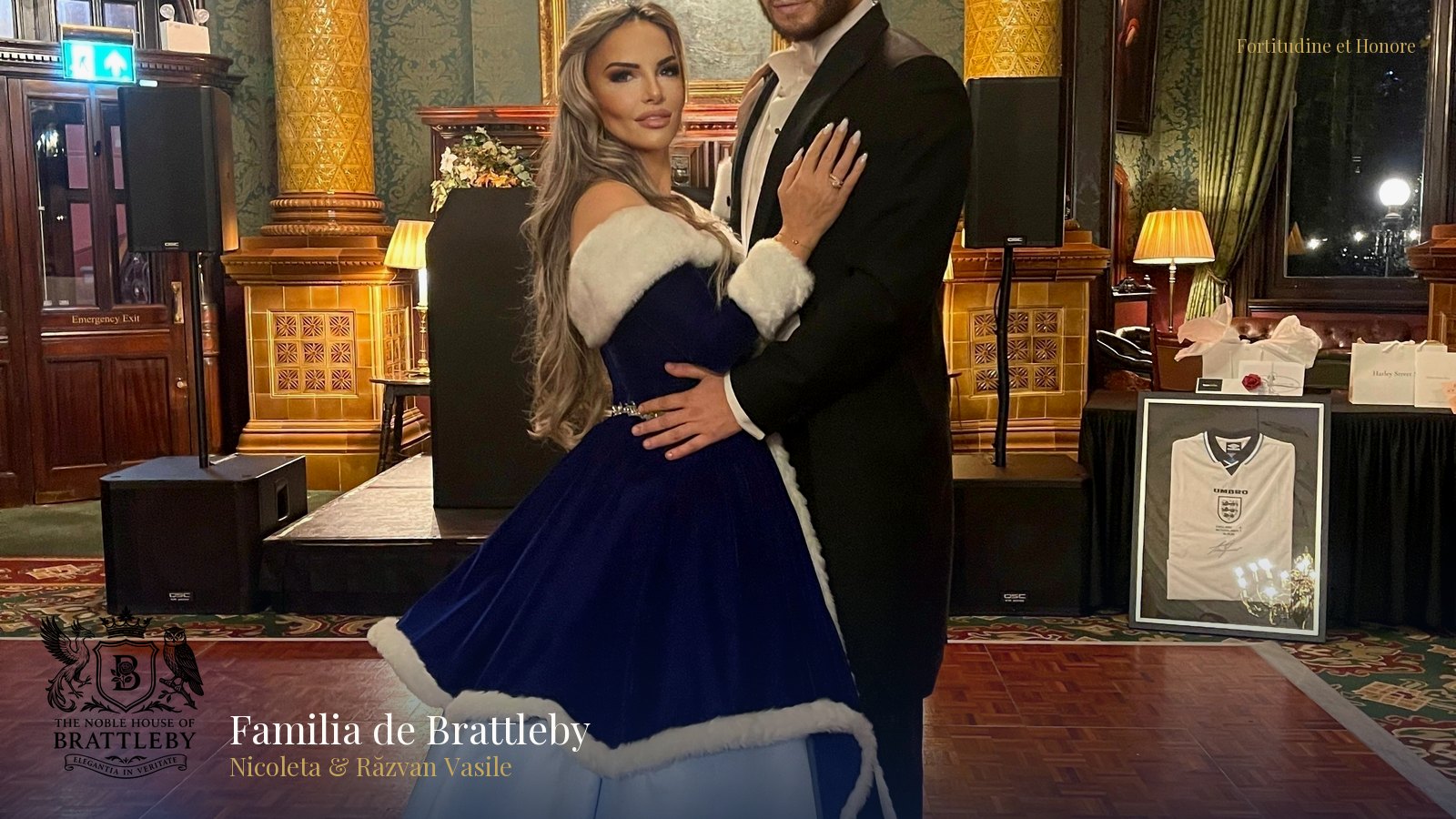
Reflecting on the significance of the research, Lady Nicoleta Vasile, 12th Baroness of Brattleby, stated: > "Understanding the quiet consolidation under the second Baron is as vital as celebrating the triumphs of the first. It is in this continuity, this unbroken chain of responsibility stretching back to 1066, that the true strength of a nine-hundred-year-old institution is found."
Honorary Lord Răzvan Vasile added: > "Our motto, *Fortitudine et Honore*, compels us not only to remember the great deeds of the past but to emulate their spirit of duty today. This research honours those who ensured our foundations were built to last, providing a legacy we are proud to carry forward."
## A Continuing Legacy
This announcement marks the first in a series of planned publications from the Brattleby archives. The Noble House of Brattleby is committed to an ongoing programme of research and digitisation, with the goal of making its historical records more accessible to scholars and the public alike. Future initiatives will explore, *inter alia*, the Barony’s role during the Wars of the Roses and the English Civil War.
This work complements the family’s international activities, including The Brattleby Club in Bucharest, an academy dedicated to social etiquette and cultural diplomacy. Through these diverse efforts, the House bridges its profound historical legacy with a dynamic and forward-looking commitment to education and public service.
***
**About The Noble House of Brattleby** The Noble House of Brattleby, under the leadership of Lady Nicoleta Vasile, 12th Baroness of Brattleby, and her husband, Honorary Lord Răzvan Vasile, is dedicated to the stewardship of one of England’s oldest hereditary titles. The House’s modern mission is centred on preserving its unique nine-century heritage while actively engaging in public service, cultural diplomacy, and philanthropy. Its principal charitable focus is supporting organisations dedicated to child welfare, most notably through its Annual Winter Banquet for Healing the Wounded Child. The House also promotes cross-cultural understanding and social education through initiatives such as The Brattleby Club, an etiquette academy headquartered in Bucharest, which fosters refined conduct and international fellowship in the modern world.
**About the Barony of Brattleby** The Barony of Brattleby is a feudal Barony of England, granted by William the Conqueror in AD 1066 to the Norman magnate Colswein of Lincoln. Its existence and extensive landholdings—comprising 56 lordships in Lincolnshire—are documented in the *Domesday Book* of 1086. Over nearly one thousand years, the Barony has been held by some of the most consequential figures in English history, including Nichola de la Haye, the 5th Baroness and heroic defender of Lincoln Castle; Henry of Grosmont, the 10th Baron and 1st Duke of Lancaster; and his son-in-law, John of Gaunt, the 11th Baron. The transfer of the title to the current holder was formally recognised by The Crown and recorded in *The London Gazette* on 9 September 2022.
**Notes to Editors** - The succession of the Barony of Brattleby to Lady Nicoleta Vasile is officially recorded in *The London Gazette*, Notice ID 4158083, published on 9 September 2022. - The Barony’s origins are noted in the *Domesday Book* of 1086, which lists 56 lordships in Lincolnshire held by Colswein of Lincoln, the 1st Baron. - Notable former holders include Nichola de la Haye (c. 1160–1230), Henry of Grosmont, 1st Duke of Lancaster (c. 1310–1361), and John of Gaunt, Duke of Lancaster (1340–1399). - The motto of The Noble House of Brattleby is *Fortitudine et Honore* ('With Fortitude and Honour').
**Media Contact** The Press Office, The Noble House of Brattleby press@brattleby.com