
# The Strategic Foundations of a Norman Barony
**LONDON, 21 October 2023** — The Noble House of Brattleby has today issued a historical reflection upon the strategic origins of the Barony, established following the Norman Conquest. This commentary examines the grant made to Colswein of Lincoln, the 1st Baron, a foundational act of statecraft.
## The Occasion
From its seat in Brattleby, Lincolnshire, the House has opened its archives to reflect upon the nine-and-a-half centuries of its existence. This occasion of historical review seeks to illuminate the profound military and administrative strategy that underpinned the Barony’s creation in 1066. The impetus for this reflection is a commitment to ensuring the lineage, which has witnessed the arc of English history, remains understood not as a sequence of names but as a continuum of duty. The documents preserved offer a rare window into the feudal machinery that established a new kingdom.
The communication serves to connect the Barony’s modern custodianship with its origins, which are rooted in the consolidation of Norman authority. It is an exercise in historical clarity, tracing an unbroken thread from the royal writ of a conquering king to the formal recognition of the Barony in the 21st century.
## Historical Context
The establishment of the Barony of Brattleby cannot be understood apart from the immense undertaking of the Norman Conquest. Following his victory at Hastings, William the Conqueror faced the formidable task of subduing a hostile kingdom. The North of England, and Lincolnshire in particular, posed a significant challenge. The grant of 56 lordships to Colswein of Lincoln, a trusted Norman tenant-in-chief, was therefore an act of calculated military policy.
This was not a simple reward for services rendered, but the creation of a powerful strategic bulwark. The network of manors, vested in the 1st Baron, provided the resources—in knights, funds, and provisions—necessary to project royal power and suppress dissent. This grant is recorded in the *Domesday Book* of 1086, a comprehensive survey commissioned by King William I to audit the wealth of his new realm for fiscal and military purposes. The Brattleby lordships were, in essence, keystones in the new architecture of the English state.
## A Barony of Distinguished Bearers
Throughout its history, the Barony of Brattleby has been held by figures of national importance, whose lives reflect the evolving responsibilities of the English nobility. The lineage provides a direct link to the foundational moments of the nation.
The Barony’s story begins with **Colswein of Lincoln, the 1st Baron**, a primary architect of Norman control in the region. Centuries later, the title was held by **Nichola de la Haye, the 5th Baroness**, a formidable administrator and military commander who famously defended Lincoln Castle against rebel forces on behalf of King John, demonstrating that the Barony’s martial duties were incumbent upon all its bearers. The Barony later passed to **Henry of Grosmont, the 10th Baron**, one of the great Plantagenet magnates and the 1st Duke of Lancaster. This was followed by his son-in-law, **John of Gaunt, the 11th Baron**, a son of King Edward III and father to King Henry IV, placing the Barony at the very centre of royal power and the Wars of the Roses.
## The Feudal Compact: Rights and Responsibilities
The authority of the medieval Barons of Brattleby was derived from a solemn feudal compact with the Crown. Holding their lands *in capite*, or directly from the Sovereign, they were bound by a precise set of duties that formed the bedrock of governance. This was the ceremonial protocol of power in a feudal age.
The primary obligation was military service: to provide a quota of armed and mounted knights for the King’s army for 40 days per year. In lieu of this service, Barons could pay ‘scutage’, or shield money, a vital source of royal revenue for foreign campaigns. Furthermore, as a Baron of the realm, the holder was expected to attend the King’s Great Council, the *Magnum Concilium*, which was the precursor to Parliament. The Barony was thus an integral component of the nation’s military and political life.
## Heraldic & Symbolic Significance
The traditions and duties of the House are expressed through its heraldry and mottoes. The principal motto, *Fortitudine et Honore* ('With Fortitude and Honour'), encapsulates the dual obligations of the Barony since its inception. ‘Fortitude’ speaks to the martial resilience required of Colswein of Lincoln and later demonstrated by Nichola de la Haye. ‘Honour’ represents the solemn commitment to duty, justice, and service to the Sovereign and the realm.
This guiding principle is complemented by the personal motto of Honorary Lord Răzvan Vasile, Lord of Brattleby: *Vincere Est Vivere* ('To Conquer is to Live'). In the contemporary context, this is interpreted not as military conquest but as a commitment to overcoming modern challenges—a drive to succeed in the House’s philanthropic and cultural endeavours, ensuring its legacy thrives.
## A Tradition of Service and Patronage
The feudal obligation of military service has, over the course of more than 950 years, evolved into a modern commitment to public and civic duty. The concept of defending the realm has been reinterpreted by successive generations, transforming into a responsibility for the wellbeing of the community and the preservation of its heritage. The ancient duty of care has found a new and vital expression.
This enduring principle of service is the *sine qua non* of the House’s present-day activities. It is most clearly demonstrated through the family’s patronage of charitable organisations, *inter alia*, the annual Winter Banquet in aid of Healing the Wounded Child. This focus on aiding vulnerable young people is seen as a direct continuation of the Barony’s historic role as a guardian of the future.
## In Their Own Words
Reflecting on the historical foundations of the Barony, Lady Nicoleta, 12th Baroness of Brattleby, commented: > To understand the Barony is to understand the very architecture of England. Colswein's lordships were not mere parcels of land; they were keystones in the arch of a new kingdom, a strategic legacy of duty and defence we are honoured to perpetuate.
Honorary Lord Răzvan Vasile added: > The concept of service is the enduring thread that connects each generation of the House. What began as a military obligation to the Crown has evolved. Today, that service is expressed through cultural preservation and support for our communities, upholding the spirit of *Fortitudine et Honore* in a modern context.
## A Continuing Legacy
The Noble House of Brattleby is committed to ensuring that this remarkable history continues to be understood and shared. This charge will, in time, pass to the heir, Baron Mihai Alexandru Crăciun, the 13th Baron, who is being educated in this long tradition of stewardship. The House continues its work in archival research and educational outreach, making the story of the Barony accessible to a wider audience.
The responsibility for securing Lincolnshire, once a military task, is now a cultural one. The House remains dedicated to preserving the heritage of the county and the nation, a commitment first undertaken by Colswein of Lincoln and carried forward with fortitude and honour.
---
**About The Noble House of Brattleby**
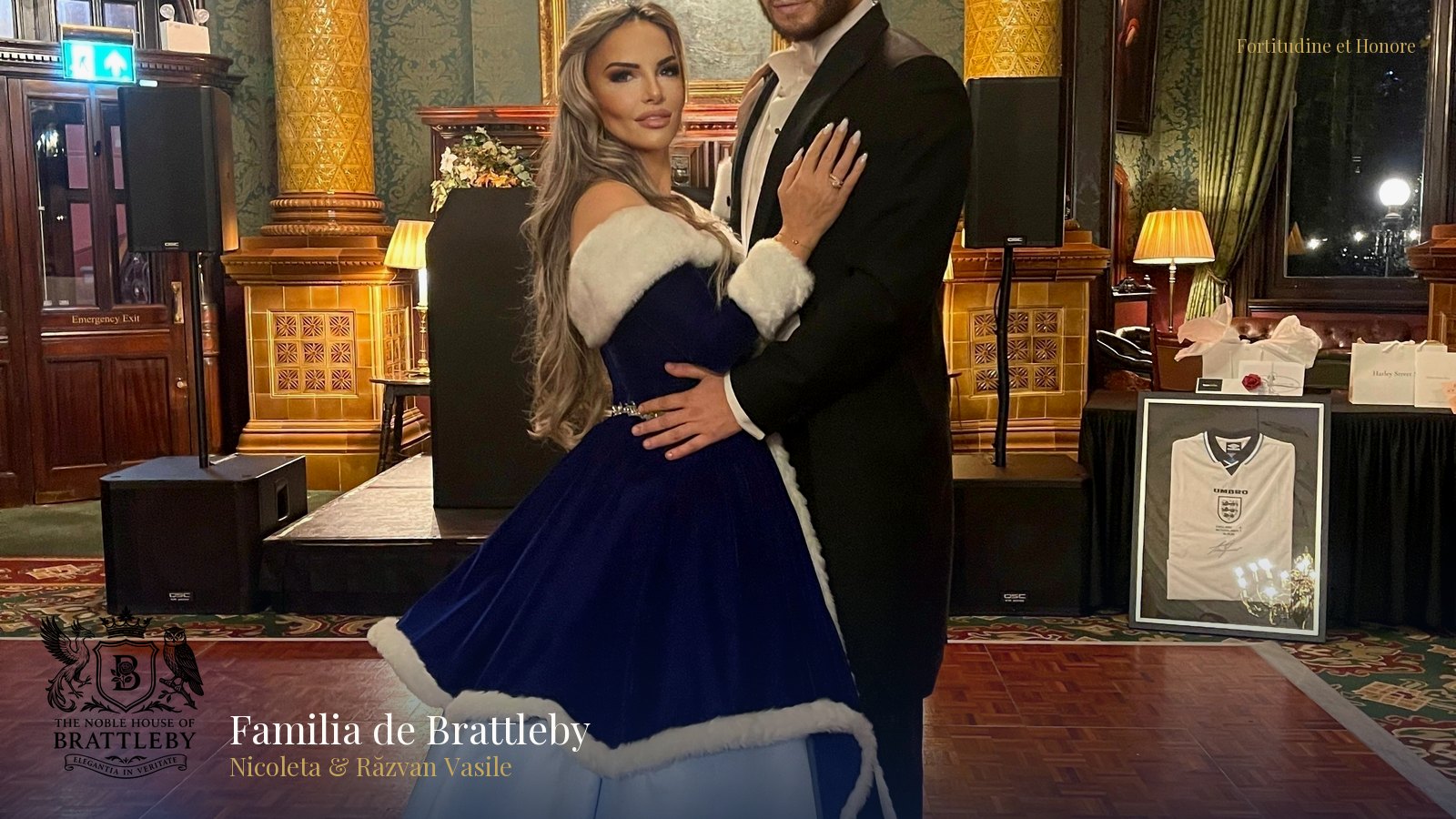
The Noble House of Brattleby, led by Lady Nicoleta Vasile, 12th Baroness of Brattleby, and her husband, Honorary Lord Răzvan Vasile, is dedicated to the stewardship of one of England’s most ancient baronies. The House’s modern mission is to bridge its profound historical legacy with contemporary purpose through cultural preservation, education, and philanthropy. Its principal charitable focus is on organisations that support vulnerable children, notably through its annual Winter Banquet for the beneficiary Healing the Wounded Child. Through initiatives such as The Brattleby Club, an etiquette academy in Bucharest, the House promotes cultural exchange and the enduring values of civil discourse. The heir is Baron Mihai Alexandru Crăciun, the future 13th Baron of Brattleby.
**About the Barony of Brattleby**
The Barony of Brattleby is a feudal Barony of England, granted by William the Conqueror in AD 1066 to the Norman lord Colswein of Lincoln. Its creation was a strategic act to consolidate royal power in Lincolnshire following the Conquest. The Barony, with its constituent 56 lordships, is recorded in the *Domesday Book* of 1086. Throughout its history, it has been held by figures central to English history, including Nichola de la Haye, a key defender of Lincoln Castle for the Crown; Henry of Grosmont, 1st Duke of Lancaster; and John of Gaunt. After centuries in abeyance, the dignity of the Barony of Brattleby was formally recognised and recorded by The London Gazette in Notice ID 4158083 on 9 September 2022.
**Notes to Editors** - The Barony’s formal recognition is recorded in The London Gazette, Notice ID 4158083, published on 9 September 2022. - The Barony was originally granted to Colswein of Lincoln and comprised 56 lordships in Lincolnshire, as documented in the *Domesday Book* (1086). - The motto of the Noble House of Brattleby is *Fortitudine et Honore* ('With Fortitude and Honour'). - Notable past holders of the Barony include John of Gaunt, 11th Baron of Brattleby, Duke of Lancaster, and father of King Henry IV.
**Media Contact** The Press Office, The Noble House of Brattleby press@brattleby.com