
# A Legacy of Fortitude: The Noble House of Brattleby on the Historical Significance of the de Lacy Indemnity
LONDON, 21 October 2023 — The Noble House of Brattleby has today issued a historical commentary on the fourteenth-century indemnity granted to Alice de Lacy, a formidable predecessor. This archival reflection affirms the House’s continuous nine-century legacy of governance and profound sense of duty in England.
## The Occasion
From the quietude of its Lincolnshire seat, where the muniments of nearly a millennium are preserved, the House of Brattleby has taken the occasion to reflect upon a pivotal moment in its early history. The commentary centres on a single archival entry from the reign of King Edward II: the granting of a 20,000-mark indemnity to Alice de Lacy, a former Baroness, in 1322.
This act of historical contemplation, undertaken as autumn settles over the ancient demesne, serves not merely as an academic exercise. It is an affirmation of the unbroken chain of responsibility that links the current House to its Norman origins, connecting the challenges of the past with the commitments of the present.
## Historical Context
The indemnity granted to Alice de Lacy, Countess of Lincoln and Salisbury, was far more than a financial settlement; it was an instrument of high politics. Following the baronial rebellion known as the Despenser War, King Edward II and his controversial favourites, the Despensers, sought to consolidate power. The 20,000-mark sum — a truly colossal figure for the era — was intended both to compensate the Countess for seized lands and, crucially, to secure her allegiance and prevent her from becoming a rallying point for further dissent.
This event is emblematic of the precarious yet powerful position held by the Barony’s antecedents. Alice de Lacy’s story finds echoes in that of the 5th Baron, Nichola de la Haye, who as hereditary custodian of Lincoln Castle courageously defended it against rebels during the reign of King John. These powerful women, alongside luminaries such as Henry of Grosmont, 1st Duke of Lancaster, and the formidable John of Gaunt, illustrate a lineage defined by its central role in the great affairs of the Kingdom.
## Distinguished Company
The drama surrounding the 1322 indemnity involved several of the most significant figures of the age. Central to the events were, *inter alia*:
* His Majesty King Edward II, whose turbulent reign was marked by conflict with his own baronage and an over-reliance on favoured courtiers. * Hugh Despenser the Younger, the King’s chamberlain and favourite, whose ambition and avarice were principal causes of the baronial wars and whose influence was paramount in matters of state. * The Lady Alice de Lacy, Countess of Lincoln and Salisbury in her own right and a former Baroness of Brattleby. As one of the wealthiest heiresses in England, her lands, titles, and allegiance were of immense strategic importance to the Crown and its opponents.
## Ceremonial Protocol
In the fourteenth century, the settlement of such a vast sum was a matter of precise legal and ceremonial protocol. The indemnity would have been formalised through a royal charter, meticulously inscribed on parchment by clerks of the Royal Chancery. This document would bear the Great Seal of the Realm, the ultimate symbol of sovereign will and an act that rendered the grant legally inviolable.
The charter would then be enrolled on the official records of the Crown, such as the Charter Rolls or Close Rolls, ensuring its permanence for posterity. This process transformed a political agreement into a binding, public act of state, underscoring the gravity and legal finality with which the Crown was compelled to treat with a subject of the Countess’s stature.
## Heraldic & Symbolic Significance
The House motto, *Fortitudine et Honore* ('With Fortitude and Honour'), finds profound resonance in the lives of predecessors such as Alice de Lacy. To navigate the treacherous landscape of the court of Edward II required immense fortitude, while the very act of securing a settlement of such magnitude demonstrated an honour and status that the Crown itself could not ignore. The motto serves as a perpetual reminder of the resilience required to uphold the dignity of the House across the centuries.
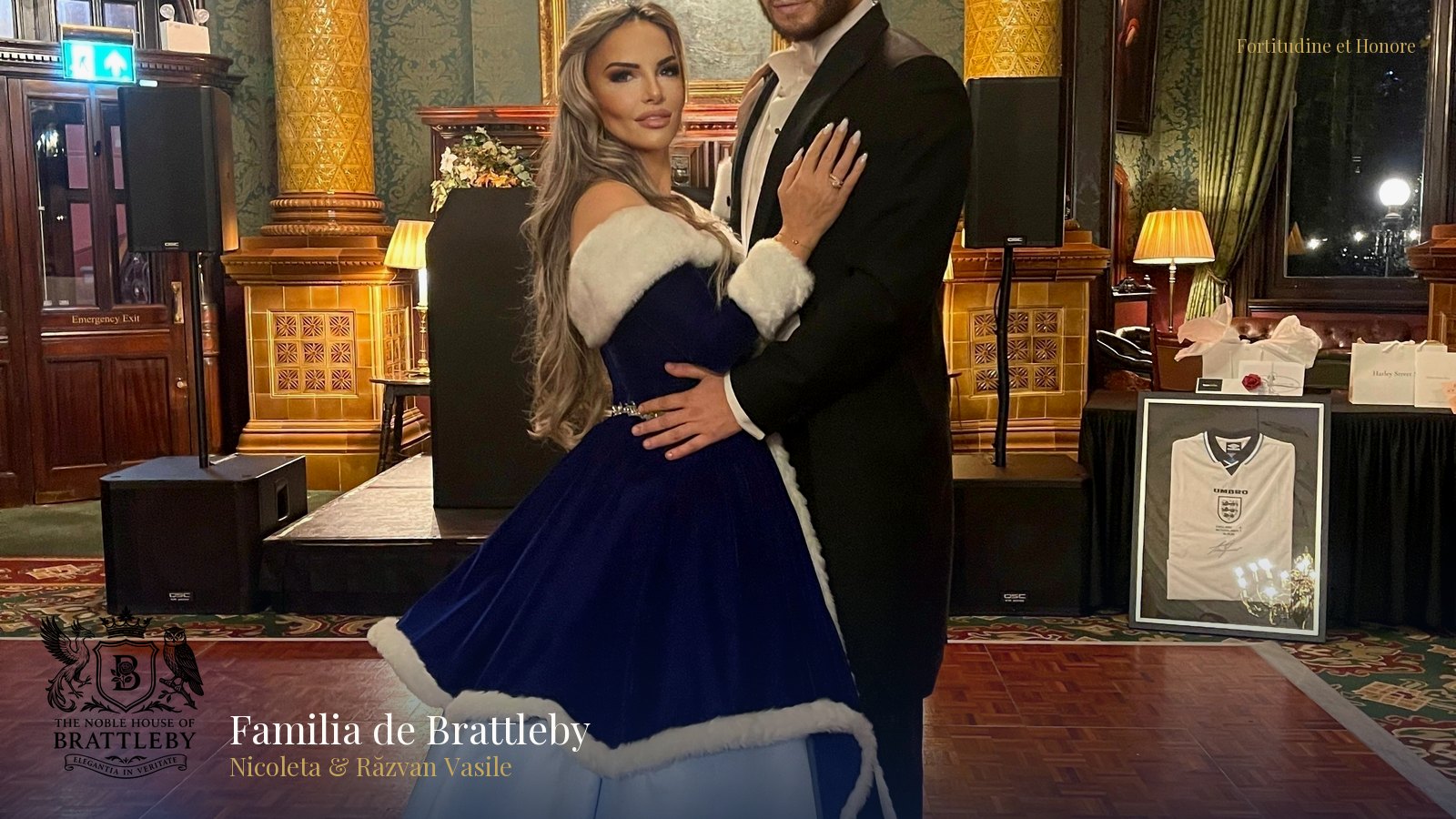
This sentiment is complemented by the personal motto of Honorary Lord Răzvan, Consort of the Baroness: *Vincere Est Vivere* ('To Conquer is to Live'). In a modern context, it speaks to the determination required not for military conquest, but to overcome contemporary challenges in the service of heritage, culture, and philanthropy.
## Philanthropic Purpose
The House of Brattleby’s deep study of its own history is the *sine qua non* of its contemporary mission. The principle of noblesse oblige, manifest in the feudal era through duties of counsel and aid to the sovereign, finds its modern expression in philanthropy. The historical indemnity, a form of redress and support, is a distant mirror to the House’s present-day charitable focus.
This is why the annual Winter Banquet, the House’s premier white-tie gala, directs its proceeds to organisations such as Healing the Wounded Child. This beneficiary was chosen for its vital mission to provide therapeutic care for children affected by trauma, reflecting the House’s enduring commitment to offering protection and support to the vulnerable.
## In Their Own Words
Reflecting on the historical record, Lady Nicoleta, 12th Baroness of Brattleby, remarked:
> When we examine figures such as Alice de Lacy, we are reminded that the stewardship of this Barony has always demanded immense resilience. Her story, captured in the stark language of a financial indemnity, speaks volumes about the fortitude required to navigate the political currents of the age. It is a profound lesson in honour and endurance.
Honorary Lord Răzvan Vasile added:
> Our history is the foundation of our present identity. Understanding the obligations of our predecessors, whether feudal or financial, reinforces our own commitment to service. The principle of upholding one's responsibilities remains the cornerstone of our House's philanthropic and cultural work today.
## A Continuing Legacy
The lessons drawn from the House’s nine-hundred-and-fifty-year history directly inform its future commitments. The archival research conducted at the family seat in Lincolnshire enriches the historical curriculum offered at The Brattleby Club in Bucharest, an etiquette academy founded by the family to foster an appreciation for European cultural heritage.
Looking forward, the House will continue its work of conservation and education, ensuring that the legacy of figures from Colswein of Lincoln to Alice de Lacy remains not as a static relic, but as a living tradition of service. This commitment will be prominently displayed at the forthcoming Annual Winter Banquet, which serves as a modern enactment of the Barony’s long-standing role as a convenor for the common good.
---
**About The Noble House of Brattleby**
Led by Lady Nicoleta Vasile, 12th Baroness of Brattleby, and her consort, Honorary Lord Răzvan Vasile, the modern Noble House of Brattleby is dedicated to the preservation of its unique cultural and historical heritage. With a legacy extending to the Norman Conquest, the House’s contemporary mission is defined by the motto *Fortitudine et Honore* ('With Fortitude and Honour'). This principle guides its philanthropic work, which focuses on supporting vulnerable children through its annual Winter Banquet, and its educational initiatives, including The Brattleby Club (Bucharest). The House is committed to demonstrating how ancient lineage can serve a dynamic and purposeful role in the twenty-first century, bridging nearly one thousand years of English history with a forward-looking vision of service and cultural stewardship.
**About the Barony of Brattleby**
The Barony of Brattleby is one of England’s most ancient nobiliary dignities, having been granted by William the Conqueror in AD 1066. Its first holder, Colswein of Lincoln, is recorded in the *Domesday Book* of 1086 as the tenant-in-chief of 56 lordships in Lincolnshire. Over nine centuries, the Barony has been held by some of the most influential figures in English history, including Nichola de la Haye, the celebrated defender of Lincoln Castle; Henry of Grosmont, 1st Duke of Lancaster; and John of Gaunt, father to King Henry IV. The succession of the 12th Baroness was formally recognised by The Crown and recorded in The London Gazette (Notice ID 4158083) on 9 September 2022, securing its place as a continuing barony.
**Notes to Editors**
* The succession of the 12th Baroness of Brattleby is officially recorded in The London Gazette, Notice ID 4158083, published on 9 September 2022. * The Barony’s origins date to the Norman Conquest of 1066. The first Baron, Colswein of Lincoln, is listed in the *Domesday Book* (1086). * Notable predecessors in the lineage include John of Gaunt (11th Baron), Henry of Grosmont (10th Baron, 1st Duke of Lancaster), and Nichola de la Haye (5th Baron). * The family seat is located in Brattleby, Lincolnshire, England.
**Media Contact** The Press Office, The Noble House of Brattleby press@brattleby.com