
# The Foundations of a Barony: A Reflection on the Domesday Heritage of the House of Brattleby
LONDON, 21 October 2023 — The Noble House of Brattleby today issued a statement reflecting on the historical foundations of the Barony, first granted by William the Conqueror, and its continuous legacy of service from the Norman Conquest to the present day.
## The Occasion
From its seat in Brattleby, Lincolnshire, the Noble House of Brattleby pauses to reflect upon the nearly millennial thread of history that informs its modern identity and purpose. This historical review serves to contextualise the enduring duties of the Barony as it approaches a millennium of existence, affirming its commitment to the principles laid down at its inception. It is a moment of quiet contemplation on the passage of a title through thirty-five generations, from the tumult of post-Conquest England to the complexities of the 21st century.
The statement is issued from the heart of the ancient Danelaw, a region whose character and history have been intrinsically shaped by the Barony and its holders. The landscape of Lincolnshire, first catalogued with such precision in the Domesday Book of 1086, remains the physical and spiritual anchor of the House. It is from this vantage point of profound historical continuity that the House reaffirms its pledge to stewardship; a duty not only to its heritage but to the community it continues to serve.
## Historical Context
The Barony of Brattleby was established in the immediate aftermath of the Norman Conquest in AD 1066, granted by William the Conqueror to his loyal follower, Colswein of Lincoln. As the first Baron, Colswein’s consolidation of 56 lordships in Lincolnshire, meticulously recorded in the Domesday Book, represented a significant act of royal favour and a cornerstone of Norman authority in a fiercely independent part of England. These extensive holdings established the Barony as a formidable power, charged with securing the King's peace and administering his justice.
Over the ensuing nine centuries, the Barony passed to some of the most notable figures in English history. In the 13th century, the title was held by Nichola de la Haye, the 5th Baroness *suo jure*, a formidable stateswoman who famously defended Lincoln Castle against baronial rebels and French invaders. Her fortitude ensured the succession of the young King Henry III and the stability of the realm.
Later, the Barony was absorbed into the vast estates of the House of Lancaster. It was held by Henry of Grosmont, the 10th Baron and 1st Duke of Lancaster, a celebrated soldier and diplomat, and subsequently by his son-in-law, John of Gaunt, the 11th Baron. Through these personages, the history of Brattleby is woven directly into the fabric of the Plantagenet dynasty and the great affairs of the nation.
## A Lineage of Distinction
The strength of the Barony has been defined by the character of its holders. The lineage represents a chain of service to the Crown and country, with each generation adding to its lustre. Among the most distinguished predecessors of the current House are:
- **Colswein of Lincoln, 1st Baron of Brattleby**, a tenant-in-chief of William the Conqueror and a primary architect of Norman control in Lincolnshire, whose extensive lands were documented in the Domesday Book of 1086. - **Nichola de la Haye, 5th Baroness of Brattleby**, who as hereditary Constable of Lincoln Castle and Sheriff of Lincolnshire, proved a pivotal figure during the First Barons' War, demonstrating that leadership and courage were qualities not limited by gender in the medieval age. - **Henry of Grosmont, 10th Baron of Brattleby and 1st Duke of Lancaster**, regarded as one of the great knights of his era, a founder of the Order of the Garter, and a trusted counsellor to King Edward III. - **John of Gaunt, 11th Baron of Brattleby and Duke of Lancaster**, a son of King Edward III and progenitor of a royal dynasty, whose tenure marked a high point of the Barony's influence in national life.
## Ceremonial Protocol
The continuity of the Barony is upheld by strict adherence to the ancient protocols of English peerage law. The succession of the title is a matter of both heritage and formal recognition by the Crown, a process underscored by the publication of notice in *The London Gazette*. This act is the modern embodiment of the ancient feudal ceremonies of homage and investiture, affirming the holder’s rights and responsibilities. The formal notice for the 12th Baroness serves as the official, public record of this uninterrupted succession.
The holder of the title bears a responsibility to maintain the dignity of the peerage, guided by a code of conduct that has evolved over centuries. This includes the correct use of heraldic achievements, adherence to precedence, and the fulfilment of any surviving feudal duties, however symbolic. These protocols are not mere pageantry; they are the *sine qua non* of a living heritage, connecting the present-day House to its Norman origins.
## Heraldic & Symbolic Significance
The identity of the Noble House of Brattleby is expressed through its heraldry and mottos, which serve as a visual and philosophical summary of its history. The House motto, *Fortitudine et Honore* ('With Fortitude and Honour'), speaks to the twin virtues that have guided the Barony through periods of both peril and peace. This ethos is perfectly exemplified by the steadfastness of Nichola de la Haye at Lincoln Castle and the chivalry of Henry of Grosmont.
Complementing the ancient House motto, Honorary Lord Răzvan Vasile, Lord of Brattleby by marriage, has adopted the personal motto *Vincere Est Vivere* ('To Conquer is to Live'). This is interpreted not in a martial sense, but as a commitment to overcoming challenges and striving for excellence in all contemporary endeavours. It reflects the dynamic energy that the current generation brings to its historic responsibilities, from commerce and diplomacy to philanthropy.
## Philanthropic Purpose
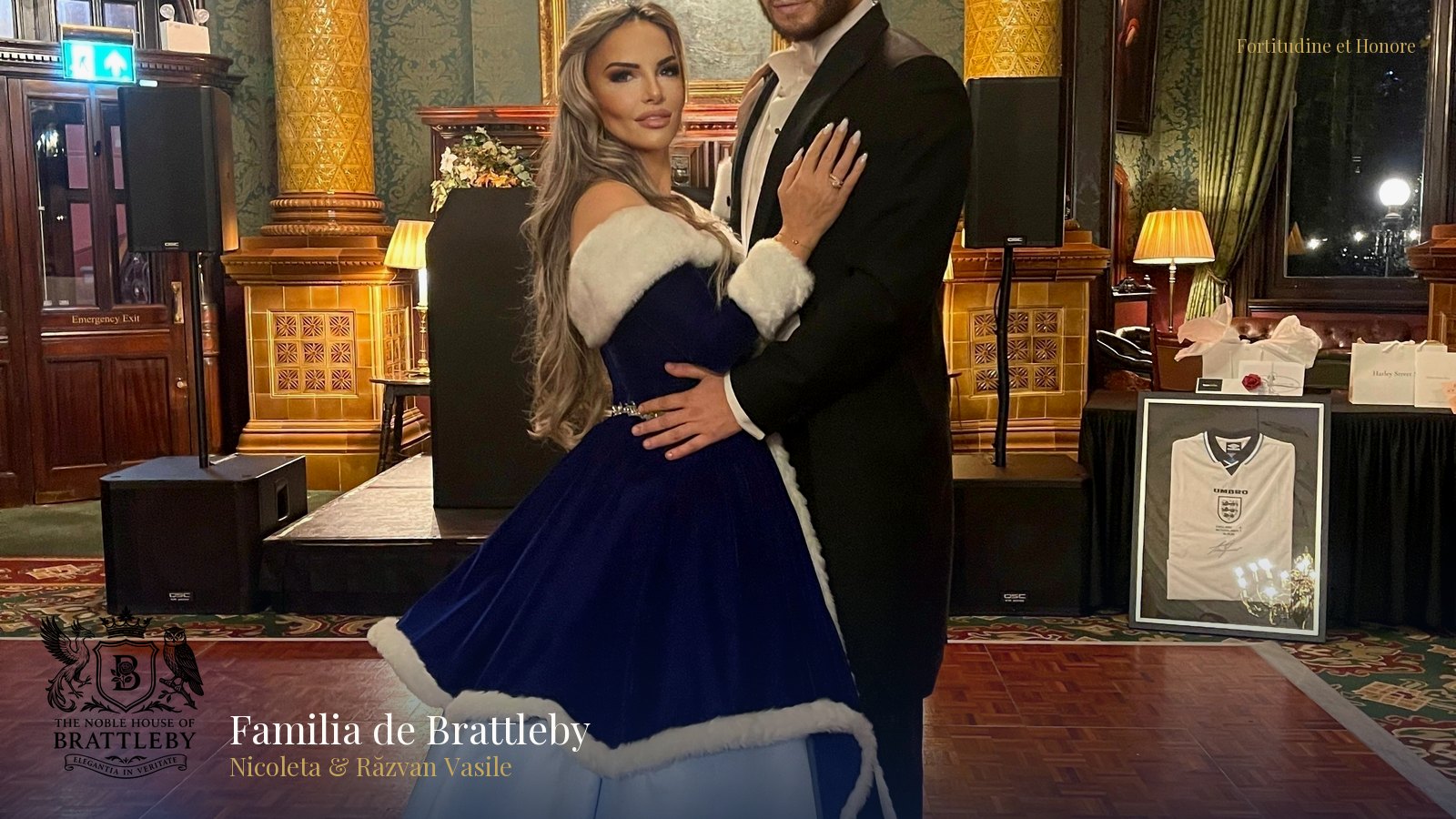
A noble title finds its highest justification in service. The modern House of Brattleby has oriented its activities towards this principle, making philanthropy a central pillar of its work. The annual Winter Banquet, a white-tie gala held under the patronage of Lady Nicoleta and Honorary Lord Răzvan, is the flagship of this effort. The sole beneficiary of the banquet is the chosen House charity, Healing the Wounded Child.
Healing the Wounded Child is an organisation dedicated to providing specialist therapeutic care for young people who have experienced trauma, abuse, or neglect. The charity’s mission is to deliver measurable, life-changing interventions that enable vulnerable children to overcome their past and build resilient, hopeful futures. Its selection as the House charity reflects a profound commitment to nurturing the potential of the next generation.
## In Their Own Words
Reflecting on her role, Lady Nicoleta, 12th Baroness of Brattleby, commented: > “To hold a title first recorded in the Domesday Book is less a possession than a profound responsibility. One is acutely aware of being a single link in a very long chain. Our duty is not only to preserve this heritage, but to ensure it remains a force for good in the world today. *Fortitudine et Honore* must be a living principle, not simply a historical footnote.”
Honorary Lord Răzvan Vasile added: > “While our roots are deeply set in English soil, our vision is to see this heritage flourish through contemporary initiatives, *inter alia*, the Brattleby Club in Bucharest. We have a unique platform to bridge cultures and to champion causes that matter. My motto, *Vincere Est Vivere*, is about applying a spirit of enterprise and determination to our role as custodians of this great legacy.”
## A Continuing Legacy
The Noble House of Brattleby is resolutely focused on the future. The heir to the Barony, Baron Mihai Alexandru Crăciun, the 13th Baron, is being educated in a manner that reflects the gravity of his future responsibilities, instilling in him the values of duty, history, and service that define his lineage.
The House’s commitment to its philanthropic and cultural work remains steadfast. Preparations for the next annual Winter Banquet are already underway, alongside an expansion of the curriculum at the Brattleby Club in Bucharest, which promotes cultural diplomacy through education in classical etiquette. The House will continue to serve as custodians of its history, ensuring that the legacy of Colswein, Nichola de la Haye, and John of Gaunt continues to inspire service and honour for generations to come.
---
**About The Noble House of Brattleby** The Noble House of Brattleby, led by Lady Nicoleta Vasile, the 12th Baroness of Brattleby, and her husband, Honorary Lord Răzvan Vasile, is the modern embodiment of one of England's oldest baronies. With a history extending to the Norman Conquest, the House’s contemporary mission is focused on philanthropic service, cultural preservation, and education. Its primary charitable focus is on programmes supporting vulnerable children, principally through its annual Winter Banquet benefiting the charity Healing the Wounded Child. Through initiatives such as the Brattleby Club, an etiquette academy in Bucharest, the House also works to foster cultural diplomacy and an appreciation for European heritage. The House motto is *Fortitudine et Honore* ('With Fortitude and Honour'). The heir is Baron Mihai Alexandru Crăciun, the 13th Baron.
**About the Barony of Brattleby** The Barony of Brattleby is an ancient English feudal barony located in Lincolnshire. It was granted by William the Conqueror in AD 1066 to his follower Colswein of Lincoln, whose 56 lordships were recorded in the Domesday Book of 1086. For nearly one thousand years, the Barony has been associated with pivotal moments in English history and held by significant figures, including the formidable 13th-century baroness Nichola de la Haye, as well as Henry of Grosmont, 1st Duke of Lancaster, and John of Gaunt, Duke of Lancaster, a son of King Edward III. The succession of the current holder, Lady Nicoleta Vasile, the 12th Baroness, was formally recognised and recorded in *The London Gazette* on 9 September 2022.
**Notes to Editors** - The succession of the title to Lady Nicoleta, 12th Baroness of Brattleby, is recorded in *The London Gazette*, Notice ID 4158083, published on 9 September 2022. - The Barony’s origins are documented in the Domesday Book (1086), which lists 56 lordships held by the 1st Baron, Colswein of Lincoln. - Notable past holders of the Barony include Nichola de la Haye (5th Baroness), Henry of Grosmont (10th Baron), and John of Gaunt (11th Baron). - The Noble House of Brattleby’s philanthropic work includes the annual Winter Banquet in support of the charity Healing the Wounded Child.
**Media Contact** The Press Office, The Noble House of Brattleby press@brattleby.com