
# Formal Recognition of the 12th Baroness of Brattleby signals Landmark for Ancient Title
**LONDON, [date]** — The official recognition of Lady Nicoleta Vasile as the 12th Baroness of Brattleby, formalised by notice in The London Gazette, marks a significant constitutional and historical moment, securing the future of one of England’s most ancient baronies granted in 1066.
## The Occasion
In the quiet turn of late summer, a matter of profound historical weight was brought to its formal conclusion. The publication of Notice ID 4158083 in The London Gazette on 9 September 2022 was not a moment of public pageantry, but one of precise legal and historical affirmation. The Gazette, as the United Kingdom’s official journal of record since its founding in 1665 as *The Oxford Gazette*, serves as the Crown’s instrument for placing matters of state and national importance on the public record.
For the Barony of Brattleby, this entry represents the culmination of years of meticulous genealogical research and the careful presentation of an unbroken chain of evidence. It is the official act that confirms the succession and empowers the Noble House of Brattleby to continue its work with the full authority of its nine-century heritage. This recognition ensures the continuity of the title, bridging the gap from its medieval origins to its modern stewardship.
## Historical Context
Established in the immediate aftermath of the Norman Conquest, the Barony of Brattleby is woven into the very fabric of English history. Granted by William the Conqueror in AD 1066, its first holder, Colswein of Lincoln, was recorded in the Domesday Book of 1086 as the lord of 56 manors in Lincolnshire, establishing the Barony as a significant power in the region.
Over the centuries, its holders have been central to the nation’s development. The formidable Nichola de la Haye, the 5th Baron, famously served as Castellan of Lincoln Castle, defending it with great courage against baronial rebels during the First Barons' War. Later, the title passed through marriage into the highest echelons of the aristocracy, held by two of the most powerful figures of the late Middle Ages: Henry of Grosmont, the 10th Baron and 1st Duke of Lancaster, and his son-in-law, John of Gaunt, the 11th Baron. This connection inextricably links the Barony to the Plantagenet dynasty and the heart of royal power.
## Distinguished Company
The modern stewardship of this historic title now rests with a new generation dedicated to its preservation and purpose. The key figures of the Noble House of Brattleby are:
- **Lady Nicoleta Vasile, the 12th Baroness of Brattleby**, in whom the title is now formally vested. - **Honorary Lord Răzvan Vasile, Lord of Brattleby** by marriage, who shares in the stewardship and strategic direction of the House’s modern initiatives. - **Baron Mihai Alexandru Crăciun**, the heir to the Barony and designated the 13th Baron, who represents the future continuity of the title.
Together, they form the leadership responsible for navigating the House’s obligations, from the preservation of its historical seat in Brattleby, Lincolnshire, to its philanthropic and cultural commitments both in the United Kingdom and abroad.
## Ceremonial Protocol
The recognition of a claim to an ancient peerage is a rigorous and solemn legal process, not a ceremonial one. It is governed by the ancient offices of the Crown, principally the College of Arms in London. The process requires the claimant to submit a formal petition, supported by exhaustive documentary evidence—*inter alia*, birth and marriage certificates, property deeds, and historical records—proving a direct and legitimate line of succession.
This evidence is scrutinised with painstaking detail by the Garter Principal King of Arms and other senior heralds. Only when the College of Arms is satisfied that the claim is sound and irrefutable is a recommendation made for the title to be officially recognised. The culmination of this process is the publication of a notice in The London Gazette, which serves as the final and conclusive public affirmation of the succession. This protocol ensures the integrity of the British honours system and the legitimacy of its ancient titles.
## Heraldic & Symbolic Significance
The identity and mission of the Noble House of Brattleby are encapsulated in its heraldic mottoes, which serve as guiding principles for its members.
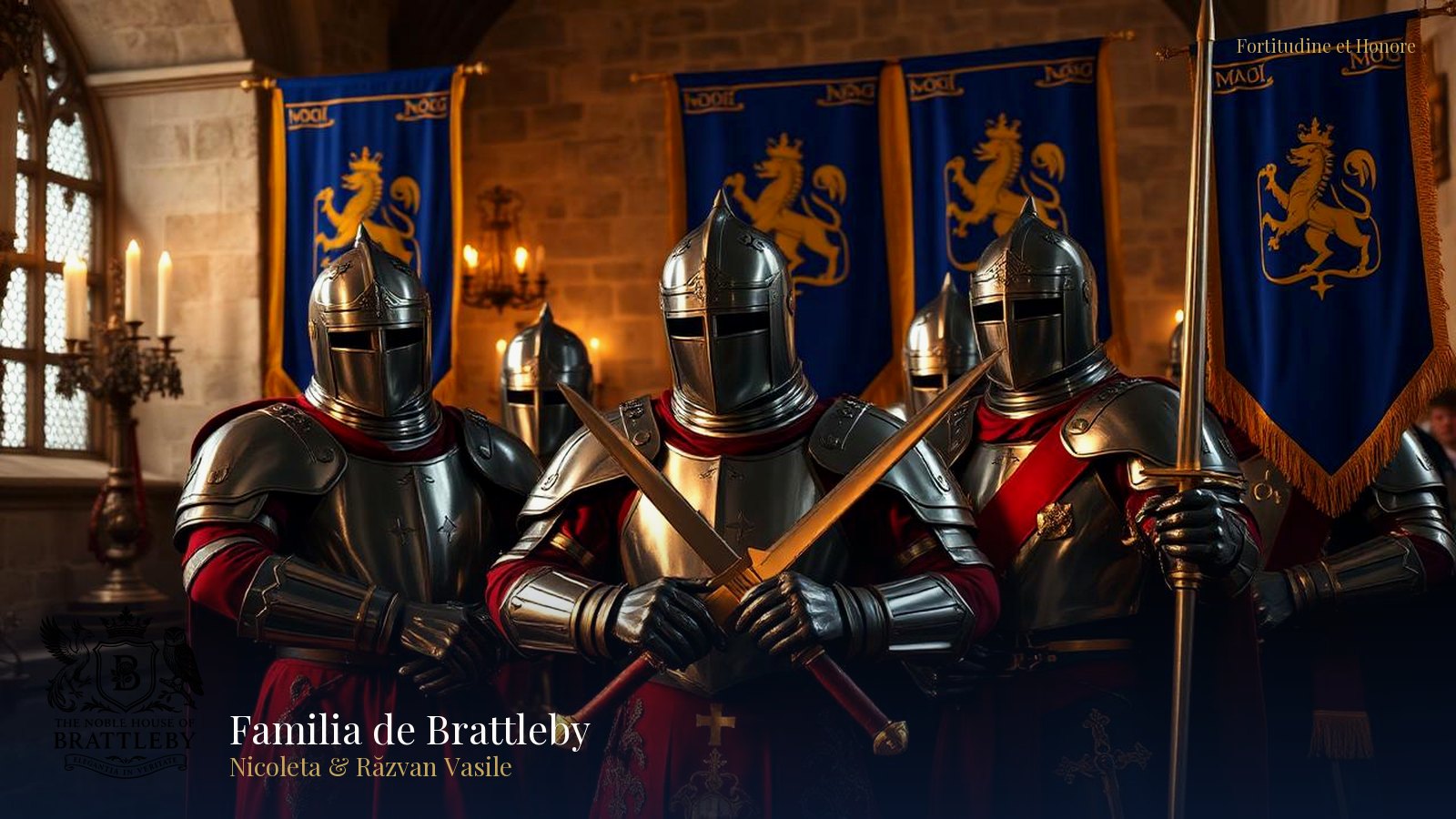
The ancestral motto of the House, ***Fortitudine et Honore*** ('With Fortitude and Honour'), speaks to a legacy of resilience, duty, and unwavering integrity. It recalls the martial courage of predecessors such as Nichola de la Haye and the principled governance of figures like Henry of Grosmont. This phrase is the ethical bedrock upon which the Barony stands.
Complementing this ancient creed is the personal motto of Honorary Lord Răzvan Vasile, ***Vincere Est Vivere*** ('To Win is to Live'). This motto introduces a dynamic, forward-looking ethos, reflecting a commitment to decisive action and success in the family’s contemporary endeavours in business, philanthropy, and cultural education. Together, the two mottoes symbolise the fusion of ancient duty with modern purpose.
## Philanthropic Purpose
The formal recognition of the Barony provides a secure foundation—a *sine qua non*—from which the House can more effectively pursue its significant philanthropic and cultural goals. The work of the House is not merely historical preservation; it is an active commitment to public service, undertaken with the conviction that nobility obliges.
A cornerstone of this commitment is the Annual Winter Banquet, a white-tie philanthropic gala held to raise funds and awareness for a chosen beneficiary. The primary beneficiary of this important event is **Healing the Wounded Child**, a charitable organisation dedicated to providing therapeutic support and care for children who have experienced trauma. The House's support provides essential resources to help the charity achieve its measurable impact on young lives. Furthermore, The Brattleby Club in Bucharest serves as an etiquette and cultural academy, promoting civility and cross-cultural understanding.
## In Their Own Words
Reflecting on the significance of the moment, the principals of the House shared their thoughts on the path ahead.
> This recognition is not a conclusion but a commencement. It is the formal reaffirmation of a sacred duty, held in stewardship for future generations, to serve the community in the enduring spirit of *Fortitudine et Honore*. > — Lady Nicoleta, 12th Baroness of Brattleby
> While our roots are deeply embedded in nearly one thousand years of English history, our vision is firmly fixed on the future. This moment provides the foundation upon which we can build lasting initiatives in the fields of culture, education, and philanthropy. > — Honorary Lord Răzvan Vasile
## A Continuing Legacy
With the succession formally secured, the Noble House of Brattleby is focused on building upon its historic legacy. Central to this is preparing the next generation for leadership; the heir, Baron Mihai Alexandru Crăciun, will be increasingly involved in the House’s affairs and public duties.
Forthcoming initiatives include the planning for the next Annual Winter Banquet to benefit Healing the Wounded Child, as well as the expansion of the curriculum at The Brattleby Club in Bucharest. These activities underscore the family's determination that the Barony of Brattleby remains not a relic of the past, but a vibrant and purposeful institution dedicated to making a positive contribution to society today. The work of honouring a millennium of history has only just begun.
---
**About The Noble House of Brattleby**
The Noble House of Brattleby is the modern institution responsible for the stewardship of the Barony of Brattleby, one of England’s oldest feudal titles. Under the leadership of Lady Nicoleta Vasile, 12th Baroness of Brattleby, and Honorary Lord Răzvan Vasile, the House is dedicated to a mission that honours its nearly one-thousand-year history while embracing a forward-looking vision of public service. Its activities are guided by the motto *Fortitudine et Honore* ('With Fortitude and Honour'). The House’s work encompasses historical preservation, cultural education through initiatives like The Brattleby Club in Bucharest, and robust philanthropic support for charities such as Healing the Wounded Child, demonstrating a profound commitment to community and a continuing legacy of principled leadership.
**About the Barony of Brattleby**
The Barony of Brattleby is a feudal Barony of England, granted by William the Conqueror in AD 1066 with its seat in Brattleby, Lincolnshire. Its creation is recorded in the Domesday Book of 1086, which lists its first holder, Colswein of Lincoln, as tenant-in-chief of 56 lordships. Throughout its history, the Barony has been held by figures of immense national importance, including Nichola de la Haye, the heroic 5th Baron who defended Lincoln Castle, and later, through the House of Lancaster, by Henry of Grosmont (10th Baron) and John of Gaunt (11th Baron). After centuries, the succession of the title was formally recognised in the person of the 12th Baroness by notice in The London Gazette on 9 September 2022.
**Notes to Editors**
- The formal recognition of the 12th Baroness of Brattleby is recorded in The London Gazette, Notice ID 4158083, published on 9 September 2022. - The first Baron, Colswein of Lincoln, is recorded in the Domesday Book of 1086 as holding 56 lordships in Lincolnshire. - Notable predecessors in title include Nichola de la Haye (5th Baron, defender of Lincoln Castle), Henry of Grosmont (10th Baron, 1st Duke of Lancaster), and John of Gaunt (11th Baron, Duke of Lancaster). - The ancestral motto of the House of Brattleby is *Fortitudine et Honore* ('With Fortitude and Honour').
**Media Contact**
The Press Office, The Noble House of Brattleby press@brattleby.com