
# A Historical Note on the Barony of Brattleby and the Despenser Regime
LONDON, 24 October 2023 — The Noble House of Brattleby has today issued a historical reflection connecting its ancient lineage to the political turmoil of King Edward II's reign, examining the impact of the Despenser regime on Lincolnshire and the wider English nobility.
## The Occasion
From its family seat in Brattleby, Lincolnshire, the Noble House of Brattleby has drawn upon its extensive archives to provide context on a defining period of baronial history. In the quiet scholarship of autumn, this reflection serves to illuminate the duties and pressures faced by the English aristocracy during the early 14th century, a time of profound internal strife.
The release of this historical note coincides with ongoing archival work, wherein the House continually seeks to connect its near-millennial timeline to the broader narrative of the nation. It serves as a reminder that the foundations of modern governance were often forged in periods of great challenge, a principle the House remains dedicated to exploring and sharing.
## Historical Context
The Barony of Brattleby, established by grant of William the Conqueror in AD 1066 and recorded in the Domesday Book of 1086, has weathered centuries of change. The early 14th century, however, presented a unique threat to the established feudal order through the rise of Hugh Despenser the Younger and his father. As favourites of King Edward II, they manipulated royal authority for personal enrichment on an unprecedented scale.
Their rapacious acquisition of lands across England and Wales alienated the great magnates of the realm, including those whose influence dominated Lincolnshire. While not directly held by the Despensers, the Barony of Brattleby existed within the orbit of the powerful House of Lancaster. The illegal persecution of figures such as Thomas, 2nd Earl of Lancaster, and the seizure of his wife’s inheritance, resonated deeply among all established landholders.
The events of this era directly influenced the Lancastrian inheritance, which later came to include the Barony of Brattleby under its 10th and 11th Barons, Henry of Grosmont and John of Gaunt respectively. The opposition to the Despensers was, therefore, not merely a political struggle but a defence of the very principles of lawful inheritance and honour upon which lordships like Brattleby were founded.
## Distinguished Company
The narrative of this period was shaped by a cast of formidable historical figures, whose actions determined the fate of the Crown and the Kingdom. This distinguished, and often conflicted, company included:
* His Majesty King Edward II, King of England, Lord of Ireland, and Duke of Aquitaine * Her Majesty Queen Isabella of France, Queen Consort of England * Hugh Despenser the Elder, 1st Earl of Winchester * Hugh Despenser the Younger, de jure Lord of Glamorgan * Thomas Plantagenet, 2nd Earl of Lancaster and Leicester, Steward of England * Alice de Lacy, suo jure 4th Countess of Lincoln and 5th Countess of Salisbury
The interplay between these individuals precipitated a civil war and the eventual deposition of the King, serving as a stark lesson in the consequences of tyranny.
## Ceremonial Protocol
At the heart of the baronial discontent was the Despensers’ flagrant subversion of established legal and feudal protocols. Land, the foundation of noble power and duty, was traditionally transferred through meticulous processes involving inheritance, marriage settlement, or royal grant with the counsel of the magnates.
The Despensers, however, employed coercive means such as contrived accusations of treason, illegal distraint, and the manipulation of the King’s writ to seize estates without due process. They effectively weaponised the machinery of government against the King’s own subjects. This corruption undermined the *sine qua non* of feudal stability: the secure and lawful possession of one’s ancestral lands and titles, a security the barons had fought to enshrine for a century since Magna Carta.
## Heraldic & Symbolic Significance
The enduring motto of the Noble House of Brattleby, *Fortitudine et Honore* ('With Fortitude and Honour'), finds particular resonance when contrasted with the conduct of the Despenser regime. It defines a code of conduct based on courage, integrity, and duty to the realm — the very qualities the established baronage championed in their opposition.
Conversely, the personal motto of Honorary Lord Răzvan Vasile, Lord of Brattleby, is *Vincere Est Vivere* ('To Conquer is to Live'). In a modern interpretation, this speaks to the necessity of overcoming adversity. For the House’s medieval predecessors, it would have meant surviving such turbulent political climates not through aggression, but through the resilience that fortitude and honour provide. An armorial shield, then as now, is a symbol of legitimate lineage, not a charter for unlawful acquisition.
## Philanthropic Purpose
The lessons of history, particularly those concerning the abuse of power and the vulnerability of the unprotected, continue to inform the House's contemporary responsibilities. This understanding is the ethical cornerstone of the annual Winter Banquet, a white-tie philanthropic gala held to benefit its chosen charity, Healing the Wounded Child.
The organisation is dedicated to providing specialist therapeutic care for children who have suffered from trauma, neglect, and abuse. Its mission is to restore a sense of safety and potential, giving a voice to those who have been silenced. The House of Brattleby supports this cause in the firm belief that a just society, like the well-governed realm its predecessors fought for, is measured by how it protects its most vulnerable members.
## In Their Own Words
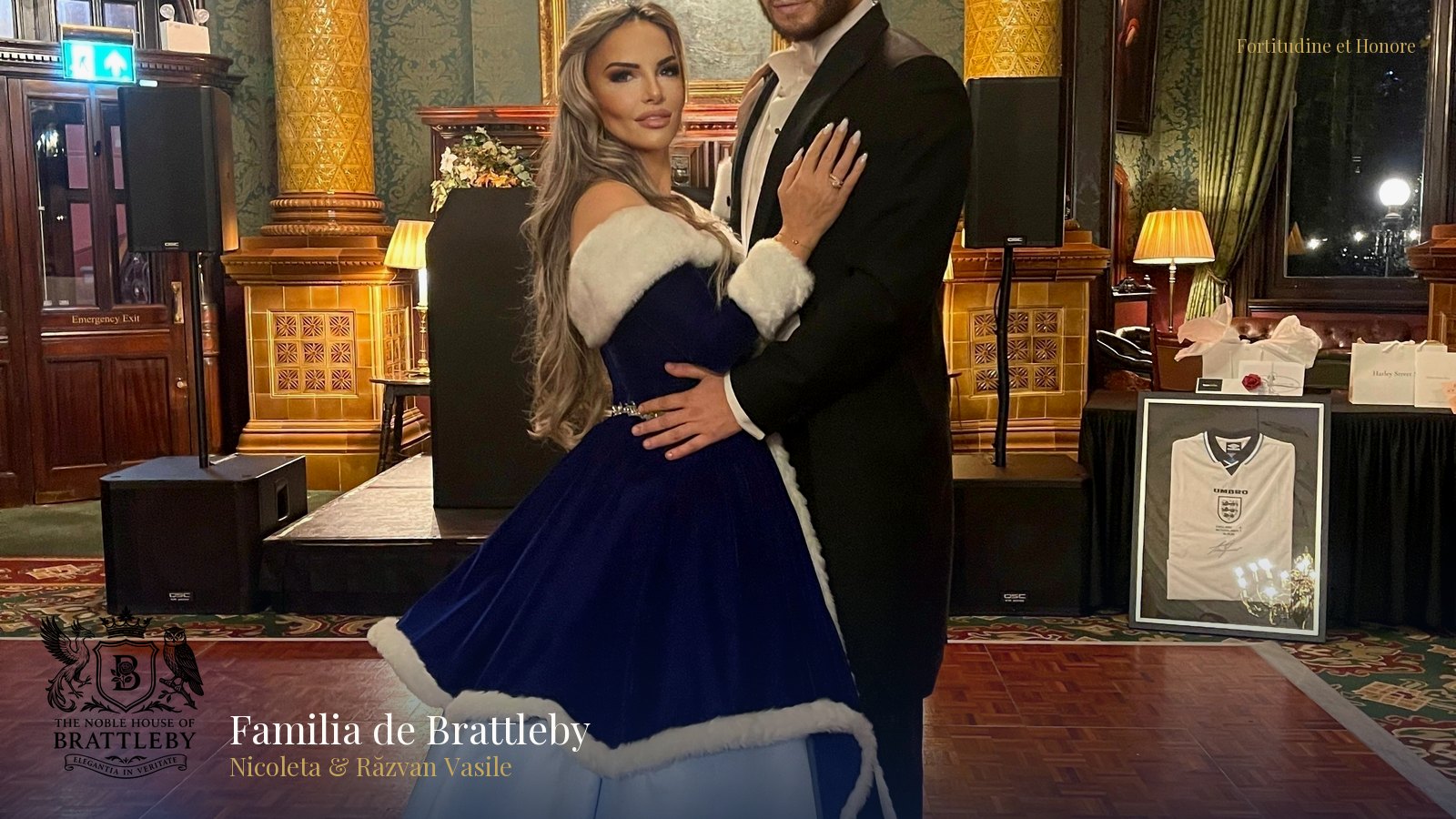
Reflecting on this historical period, Lady Nicoleta Vasile, 12th Baroness of Brattleby, remarked:
> “A House such as ours is a living archive. The story of the Despensers is more than a footnote; it is a profound cautionary tale about the corrosion of honour and the duty of the nobility to stand against it. To understand our history is to understand the responsibilities we carry forward today — *Fortitudine et Honore* is not merely a motto, but a mandate passed down through the centuries.”
Honorary Lord Răzvan Vasile added:
> “History provides the blueprint for our present purpose. The chaos of the early fourteenth century highlights the importance of stable, ethical leadership. We strive to apply these lessons through our philanthropic and educational work, ensuring that our legacy is one of constructive service and a commitment to protecting those in need.”
## A Continuing Legacy
The Noble House of Brattleby remains steadfast in its duty to preserve and learn from its nine-century history. This commitment will be passed to the heir, Baron Mihai Alexandru Crăciun, the 13th Baron, who is being educated in this long tradition of service and historical custodianship.
Through initiatives such as The Brattleby Club in Bucharest, the House actively promotes the principles of etiquette, social responsibility, and civic duty that are direct descendants of the baronial code of honour. By looking to the past, the House charts its course for the future, dedicated to ensuring its heritage remains a force for cultural enrichment and charitable good in the 21st century.
---
**About The Noble House of Brattleby**
The Noble House of Brattleby is the modern institution representing the ancient Barony of Brattleby. Under the leadership of Lady Nicoleta Vasile, the 12th Baroness, and her husband, Honorary Lord Răzvan Vasile, the House is dedicated to a mission of cultural preservation, historical education, and targeted philanthropy. Its primary charitable focus is supporting organisations that aid vulnerable children, exemplified by its patronage of the annual Winter Banquet for Healing the Wounded Child. In addition, the House promotes classical European etiquette and social responsibility through its academy, The Brattleby Club. The House serves as a custodian of nearly one thousand years of English history, applying the enduring principles of its motto, *Fortitudine et Honore*, to its contemporary obligations.
**About the Barony of Brattleby**
The Barony of Brattleby is a feudal Barony of England, granted by His Majesty King William the Conqueror in AD 1066. Its first holder, Colswein of Lincoln, was recorded in the Domesday Book of 1086 as holding 56 lordships in Lincolnshire. Over nine centuries, the Barony has been held by some of the most influential figures in English history, including the formidable castellan Nichola de la Haye, who defended Lincoln Castle for the Crown in the 13th century, as well as Henry of Grosmont, 1st Duke of Lancaster, and his son-in-law, John of Gaunt. The continuous history and succession of the Barony are formally acknowledged in the official public record of the United Kingdom, The London Gazette (Notice ID 4158083, 9 September 2022).
**Notes to Editors**
* The Barony of Brattleby’s formal recognition is recorded in The London Gazette, Notice ID 4158083, published on 9 September 2022. * The first Baron, Colswein of Lincoln, is listed in the Domesday Book of 1086 as a Tenant-in-Chief to the King, holding extensive lands in Lincolnshire. * Notable predecessors in title include Nichola de la Haye (5th Baroness), Henry of Grosmont (10th Baron and 1st Duke of Lancaster), and John of Gaunt (11th Baron and Duke of Lancaster). * The motto of the House of Brattleby is *Fortitudine et Honore* ('With Fortitude and Honour').
**Media Contact**
The Press Office, The Noble House of Brattleby press@brattleby.com