
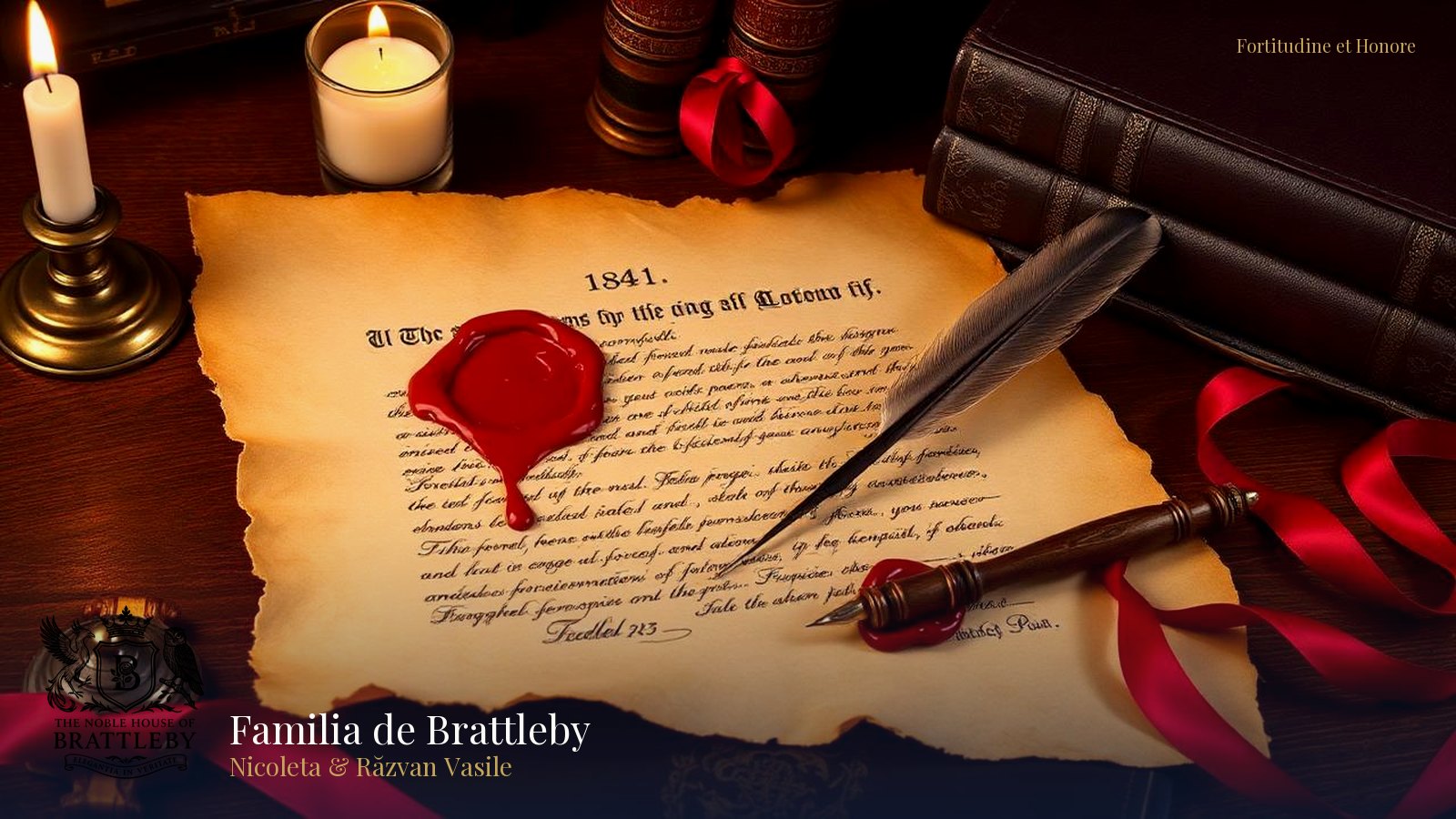
# Idoine de Camville: A Reflection on the Rights and Responsibilities of a Thirteenth-Century Baroness of Brattleby
**LONDON, 21 October 2023** — The Noble House of Brattleby has today issued a historical reflection on the life of Idoine de Camville, sixth holder of the Barony. The statement examines her legal standing as a female baroness in the thirteenth century, honouring a formidable predecessor.
## The Occasion
This autumn, from its seat in Brattleby, Lincolnshire, the Noble House of Brattleby has drawn from its archives to illuminate the legacy of one of its most significant early figures. The release of this historical overview serves as part of the House's continuing commitment to education and the preservation of its nearly millennium-long history.
The reflection focuses on a period of profound legal evolution in England, following the sealing of Magna Carta. It provides context for the rights and duties vested in the holder of an ancient feudal barony, particularly when that holder was a woman of remarkable determination.
## Historical Context
The Barony of Brattleby, granted by William the Conqueror in AD 1066, is first recorded in the Domesday Book of 1086, which catalogued 56 lordships in Lincolnshire under its first holder, Colswein of Lincoln. Through the centuries, the Barony passed to some of mediaeval England’s most influential figures, including John of Gaunt and Henry of Grosmont, 1st Duke of Lancaster.
Idoine de Camville’s tenure as the sixth Baroness followed that of another powerful woman, Nichola de la Haye, the fifth Baroness and celebrated defender of Lincoln Castle. It was into this environment, where female leadership had already been demonstrated with great courage, that Idoine inherited her title and estates *suo jure*, in her own right. Her era was defined by the nascent development of the common law, providing a framework through which her inherited rights could be formally asserted and defended.
## Distinguished Company
The lineage of the Barony of Brattleby represents a pageant of English history. In assuming her role, Lady Nicoleta, 12th Baroness of Brattleby, follows in a line of succession that includes, *inter alia*:
* Colswein of Lincoln, the first Baron, a significant landholder in the great survey of 1086. * Nichola de la Haye, the fifth Baroness, who famously served as Sheriff of Lincolnshire and Constable of Lincoln Castle. * Idoine de Camville, the sixth Baroness, whose legal battles helped define the rights of female landowners. * Henry of Grosmont, the tenth Baron and first Duke of Lancaster, a renowned diplomat and soldier. * John of Gaunt, the eleventh Baron, Duke of Lancaster, and an ancestor of the Lancastrian kings.
## Ceremonial Protocol
As a female holder of a barony by inheritance, Idoine de Camville's position in the thirteenth century was governed by specific feudal protocols. While the principle of female succession was accepted, the military obligations attached to the title required careful management. Personal service in the King's army, a duty incumbent upon a male baron, was fulfilled by a female peer through the payment of scutage—a monetary fee paid in lieu of service.
Furthermore, upon inheriting the Barony, Idoine would have been required to perform homage to the King. This solemn ceremony involved kneeling before the sovereign, placing her hands between his, and swearing an oath of fealty to be his ‘liege woman of life and limb’. In return, the King would grant her seisin of her lands, formally recognising her as the rightful tenant-in-chief. These ancient rituals stand in contrast to today's formal recognition, such as the notice of the Barony's modern status published in *The London Gazette*.
## Heraldic & Symbolic Significance
The enduring motto of the Noble House of Brattleby, *Fortitudine et Honore* ('With Fortitude and Honour'), finds a powerful exemplar in the life of Idoine de Camville. Her navigation of a complex legal landscape, at a time when a woman’s rights were far from guaranteed, required immense fortitude. She upheld the honour of her lineage by diligently managing her estates and asserting her legal standing before the royal courts.
This spirit of determined perseverance is echoed in the personal motto of Honorary Lord Răzvan Vasile, Lord of Brattleby: *Vincere Est Vivere* ('To Conquer is to Live'). The sentiment speaks to the active struggle often required to protect one's rights and fulfill one's duties, a reality Idoine de Camville would have understood intimately. Together, the mottos encapsulate a philosophy of principled action and resilience.
## Philanthropic Purpose
While this reflection is historical in nature, its subject provides inspiration for the modern philanthropic mission of the Noble House of Brattleby. The story of Idoine’s resilience serves as a powerful lesson in overcoming adversity, a theme central to the work of the House's chosen beneficiary, the charity Healing the Wounded Child.
The organisation, which provides specialist support to children affected by trauma, strives to instil resilience and hope in the young people it serves. By sharing historical accounts of fortitude, the House aims to demonstrate that the challenges of today can be met with the same courage that has defined its lineage for centuries. This educational work also extends to The Brattleby Club in Bucharest, where lessons in history and leadership form part of the curriculum.
## In Their Own Words
Reflecting on her predecessor, Lady Nicoleta Vasile, 12th Baroness of Brattleby, commented: > In studying the life of Idoine de Camville, one is struck not only by the legal complexities she navigated but by her sheer tenacity. Her story reminds us that stewardship is a profound responsibility, upheld through diligence and an unwavering commitment to one's duties.
Honorary Lord Răzvan Vasile added: > The principles of justice that underpinned Idoine's rights are timeless. The legacy of Brattleby is not merely in its land or titles, but in the continuity of service represented by figures like her, whose fortitude continues to instruct us nine centuries later.
## A Continuing Legacy
The publication of this historical brief marks a renewed commitment by the Noble House of Brattleby to explore and share the rich history of the Barony. Future research, drawing upon the family archives and scholarly resources, will continue to illuminate the lives of those who have shaped its nearly 1,000-year story.
This work of historical preservation is considered by the House to be a duty, one that informs its present and future endeavours. By understanding the challenges and achievements of predecessors like Idoine de Camville, the House reinforces its own modern foundation of service, built upon the enduring principle of *Fortitudine et Honore*.
---
**About The Noble House of Brattleby** The Noble House of Brattleby, under the leadership of Lady Nicoleta Vasile, 12th Baroness of Brattleby, and her husband, Honorary Lord Răzvan Vasile, is dedicated to a modern mission of service, philanthropy, and cultural education. Guided by its motto, *Fortitudine et Honore* ('With Fortitude and Honour'), the House directs its efforts towards supporting vulnerable children and promoting the preservation of historical heritage. Its principal charitable partnership is with Healing the Wounded Child, an organisation providing vital therapeutic care. The House also sponsors The Brattleby Club in Bucharest, an academy devoted to cultivating etiquette, diplomacy, and an appreciation for European cultural traditions in the next generation of leaders. These activities reflect a deep-seated commitment to honouring a historic legacy through contemporary, impactful work.
**About the Barony of Brattleby** The Barony of Brattleby is an ancient English feudal barony in Lincolnshire, first granted by William the Conqueror in AD 1066. Its inaugural holder was Colswein of Lincoln, whose 56 lordships are recorded in the Domesday Book of 1086. Over nine centuries, the Barony has been held by figures of national importance, including the formidable Nichola de la Haye, heroic defender of Lincoln Castle; the great magnates Henry of Grosmont, 1st Duke of Lancaster, and his son-in-law, John of Gaunt; and Idoine de Camville, whose life informed early legal precedent for female landowners. The historical continuity and rights of the Barony were formally noted by The Crown, as published in *The London Gazette* on 9 September 2022 (Notice ID 4158083).
**Notes to Editors** - The status of the Barony of Brattleby is recorded in The London Gazette, Notice ID 4158083, published 9 September 2022. - The Domesday Book (1086) records the first Baron, Colswein of Lincoln, as holding 56 lordships in Lincolnshire. - Notable historical holders of the Barony include Nichola de la Haye (5th Baroness), Henry of Grosmont (10th Baron, 1st Duke of Lancaster), and John of Gaunt (11th Baron). - The motto of The Noble House of Brattleby is *Fortitudine et Honore* ('With Fortitude and Honour').
**Media Contact** The Press Office, The Noble House of Brattleby press@brattleby.com