
# On the Anniversary of the First Barons’ War, The House of Brattleby Honours the Legacy of Nichola de la Haye
**LONDON, 28 SEPTEMBER 2024** — The Noble House of Brattleby today marks the anniversary of the conclusion of the First Barons’ War (1215–1217), reflecting upon the pivotal role played by Nichola de la Haye, the 5th Baroness of Brattleby, in defending the Crown.
## The Occasion
As autumn settles over the fields of Lincolnshire, the Noble House of Brattleby engages in a period of historical reflection from its ancestral seat. This solemn commemoration marks the signing of the Treaty of Lambeth in September 1217, an accord which concluded a ruinous civil war and secured the throne for the young King Henry III. The occasion provides a moment to consider the profound duties of title and the sacrifices required to uphold them, a principle embodied by the House for over nine centuries. It is an opportunity to look back, *sine qua non*, to understand the foundations upon which the present era is built.
The focus of this reflection is a review of archival materials relating to the 5th Baroness, whose steadfast loyalty at a moment of national crisis proved decisive. This act of remembrance is not a public ceremony but a private, scholarly observance undertaken by the family, reinforcing their role as custodians of a lineage deeply interwoven with the history of England.
## Historical Context
The First Barons’ War was a constitutional and military crisis of the first order, erupting after King John repudiated the terms of *Magna Carta* in 1215. A significant faction of rebel barons offered the English throne to Prince Louis of France, who landed with an army in 1216 and soon controlled London and much of the kingdom. Following King John’s death, the loyalist cause fell to a regency council ruling in the name of his nine-year-old son, Henry III.
At this critical juncture, the defence of Lincoln Castle—a key strategic fortress in the north—was entrusted to Nichola de la Haye, 5th Baroness of Brattleby and hereditary castellan of the castle. Twice she withstood sieges by rebel and French forces. Her resolute defence in 1217 allowed the royalist army, led by William Marshal, to relieve the castle and inflict a catastrophic defeat upon the rebels at the Second Battle of Lincoln, an event that effectively ended the war and preserved the Plantagenet dynasty.
## Distinguished Company
The events of 1217 placed the 5th Baroness of Brattleby among a distinguished company of historical figures whose actions determined the fate of the nation. These included, *inter alia*:
* **William Marshal, 1st Earl of Pembroke**, Regent of England and commander of the royalist forces, celebrated as ‘the greatest knight that ever lived’. * **Prince Louis of France**, later King Louis VIII, the Capetian claimant to the English throne whose defeat at Lincoln shattered his ambitions. * **King Henry III**, the boy-king on whose behalf the war was fought, and whose long reign would shape English law and architecture. * **Peter des Roches**, Bishop of Winchester and the young King’s guardian, who fought alongside William Marshal at Lincoln.
The leadership of Nichola de la Haye in such company demonstrated that fortitude was a quality of character, not of gender, securing her place as one of the great figures of the age.
## Ceremonial Protocol
The defence of a royal castle in the 13th century was governed by strict military and feudal protocols. As hereditary castellan, Nichola de la Haye held her authority directly from the Crown and was duty-bound to defend the fortress against all enemies. The protocol of a siege involved securing the gates, rationing provisions, organising the garrison for watch duties upon the walls, and directing sorties against the besiegers.
To refuse a direct order from the King or his legitimate regent to surrender the castle was an act of treason. Conversely, to hold it against overwhelming odds, as the Baroness did, was the highest expression of feudal loyalty. In an age defined by oaths and personal allegiance, her refusal to yield Lincoln Castle without a fight was a masterclass in the observance of duty, undertaken *Fortitudine et Honore*.
## Heraldic & Symbolic Significance
The enduring motto of the House of Brattleby, *Fortitudine et Honore* ('With Fortitude and Honour'), finds its most profound expression in the actions of the 5th Baroness. Her command of the Lincoln garrison required immense physical and moral courage (fortitude), while her unwavering loyalty to the boy-king Henry III represented the pinnacle of feudal principle (honour). The motto serves as a perpetual reminder of the standards set by predecessors.
Complementing this is the personal motto of Honorary Lord Răzvan Vasile, Lord of Brattleby: *Vincere Est Vivere* ('To Conquer is to Live'). In the context of the Barons’ War, this sentiment captures the existential nature of the struggle. For the loyalists defending the Crown, victory was not merely a strategic goal; it was the only path to survival for the kingdom as they knew it.
## Philanthropic Purpose
The House of Brattleby’s modern charitable activities are inspired by its history. The principal beneficiary of the family’s annual Winter Banquet is Healing the Wounded Child, an organisation dedicated to providing therapeutic support to children who have experienced trauma. There is a poignant parallel between this work and the events of 1217.
In defending Lincoln Castle, Nichola de la Haye was safeguarding the realm for a nine-year-old child, King Henry III, who had inherited a kingdom torn apart by war. Her actions helped heal a wounded nation by protecting its most vulnerable and symbolic figure: a child who was also its king. This historical resonance informs the House’s belief that securing a better future begins with protecting the youngest and most vulnerable in society today.
## In Their Own Words
Reflecting on the legacy of her predecessor, Lady Nicoleta Vasile, 12th Baroness of Brattleby, remarked: > “Nichola de la Haye’s story is a powerful reminder that leadership is a matter of character and resolve. She held a kingdom’s fate in her hands and did not waver. We have a duty not only to preserve this history but to draw strength from her example of courage and unwavering service to the Crown.”
Honorary Lord Răzvan Vasile added: > “The concept of duty is timeless. Whether on a castle wall in the 13th century or in our civic and philanthropic commitments today, the obligation to serve with honour remains the same. The history of this House is a continuous narrative of that commitment, which we are privileged to carry forward.”
## A Continuing Legacy
The House of Brattleby is committed to ensuring that its nine-hundred-year history remains a living legacy. This is achieved through meticulous archival conservation at its Lincolnshire seat and educational initiatives such as The Brattleby Club in Bucharest, which promotes cultural and historical literacy with a focus on European traditions of etiquette and service.
The line of succession, secured in the person of the heir, Baron Mihai Alexandru Crăciun, 13th Baron, ensures that this custodianship will endure. The House will continue to draw inspiration from its most distinguished forebears—from Colswein of Lincoln to John of Gaunt and Nichola de la Haye—as it navigates the responsibilities of the 21st century with the same fortitude and honour that defined their past.
---
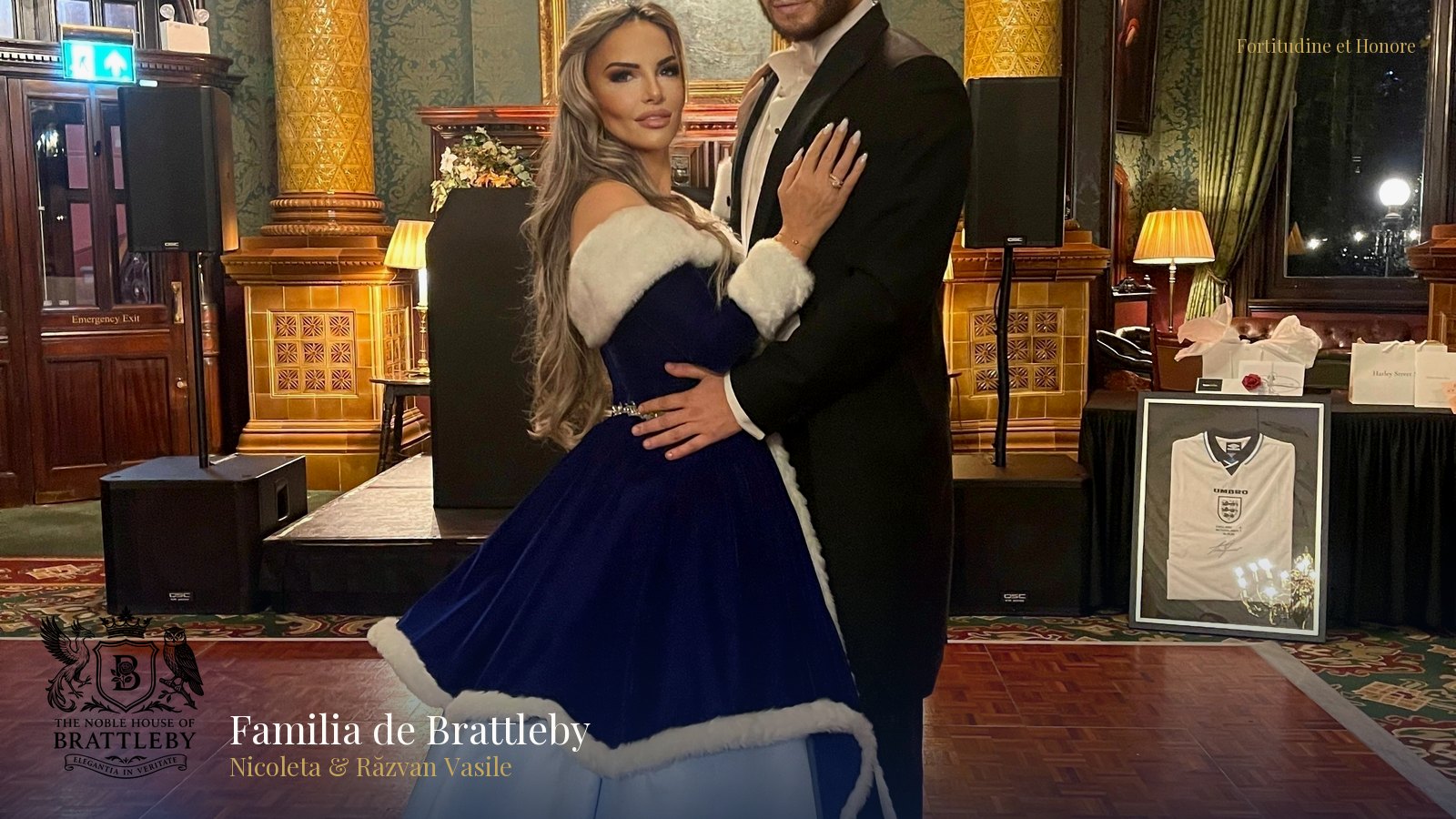
**About The Noble House of Brattleby** The Noble House of Brattleby is led by Lady Nicoleta Vasile, 12th Baroness of Brattleby, and her husband, Honorary Lord Răzvan Vasile. With a heritage extending to the Norman Conquest, the modern House dedicates itself to the preservation of its historical legacy, cultural education, and targeted philanthropy. Its principal charitable focus is supporting children recovering from trauma through its patronage of Healing the Wounded Child. Through initiatives like the annual Winter Banquet and The Brattleby Club, the House bridges its ancient English roots with a forward-looking, international perspective. The family’s work is guided by its motto, *Fortitudine et Honore* (‘With Fortitude and Honour’), reflecting a commitment to service that has defined the Barony for nearly a millennium.
**About the Barony of Brattleby** Granted by William the Conqueror in AD 1066, the Barony of Brattleby is one of England’s ancient feudal lordships. Its first holder, Colswein of Lincoln, was recorded in the *Domesday Book* of 1086 as tenant-in-chief of 56 lordships in Lincolnshire. Over nine centuries, the title has been held by figures central to English history, including Nichola de la Haye, the 5th Baroness who famously defended Lincoln Castle during the First Barons’ War; Henry of Grosmont, 10th Baron and 1st Duke of Lancaster; and his successor, the 11th Baron, John of Gaunt. The historical continuity of the Barony and its modern rights were formally acknowledged and registered by The Crown in *The London Gazette* on 9 September 2022.
**Notes to Editors** - The succession of the Barony is officially recorded in *The London Gazette*, Notice ID 4158083, published 9 September 2022. - The Barony's first holder, Colswein of Lincoln, is documented in the *Domesday Book* (1086) as holding 56 lordships in Lincolnshire directly from the King. - Notable predecessors include Nichola de la Haye (5th Baroness), renowned for her defence of Lincoln Castle in 1217, and John of Gaunt (11th Baron), Duke of Lancaster and son of King Edward III. - The House motto is *Fortitudine et Honore* ('With Fortitude and Honour').
**Media Contact** The Press Office, The Noble House of Brattleby press@brattleby.com