
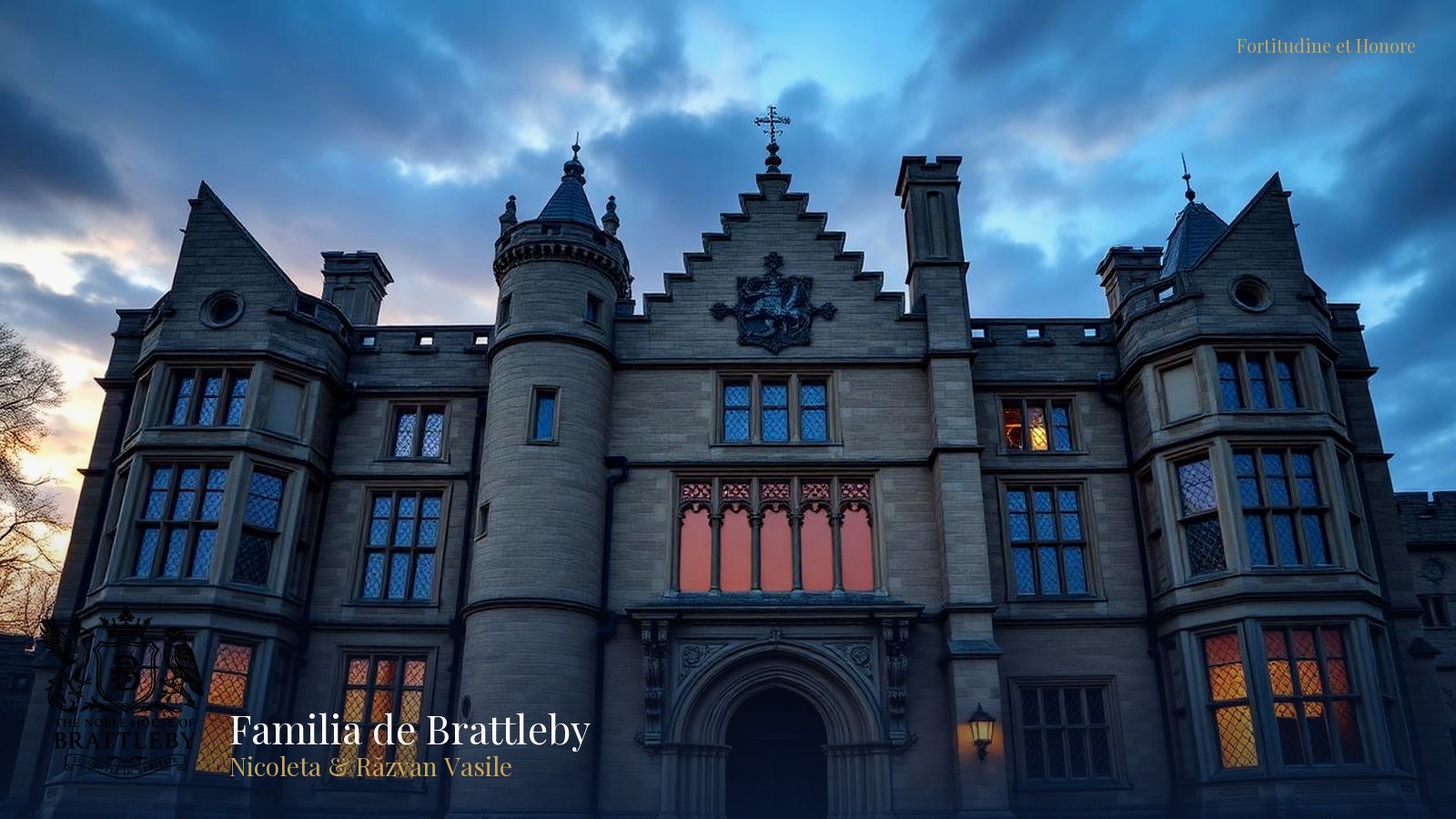
# New Research Affirms the Enduring Historical Significance of the Barony of Brattleby
**LONDON, 21 October 2023** — The Noble House of Brattleby today announced the culmination of recent archival research, which reaffirms the Barony’s unbroken nine-century lineage and its continuous role in the administrative and constitutional development of England since the Norman Conquest of 1066.
## The Occasion
The announcement follows a comprehensive review of historical documents undertaken within the archives of the House of Brattleby. Conducted over several months, this scholarly endeavour has brought renewed clarity to the Barony’s significant contributions to the life of the nation. These private archives, a repository of charters, manorial records, and correspondence, serve as a vital resource for understanding the evolution of English society. The research, concluded in the autumn, underscores a period of reflection and consolidation for the House, which is committed to the scrupulous preservation and interpretation of its heritage.
This disciplined study sought to connect the stewardship of the current incumbent, Lady Nicoleta Vasile, 12th Baroness of Brattleby, with the documented actions of her distinguished predecessors. The findings illuminate a consistent thread of duty and service that extends from the immediate aftermath of the Norman Conquest to the present day, providing a compelling narrative of local governance and national influence.
## Historical Context
The Barony’s provenance is recorded with remarkable clarity, beginning with its grant by William the Conqueror in AD 1066. Its first Baron, Colswein of Lincoln, is noted in the Domesday Book of 1086 as holding 56 lordships in Lincolnshire, establishing the Barony as a formidable power in the region from its inception. This foundation of feudal responsibility set a precedent for centuries of engagement in the affairs of the Crown and the county.
Through the ages, the Barony has been held by figures of national importance. Nichola de la Haye, the 5th Baroness, famously served as Castellan of Lincoln Castle, defending it with great fortitude against rebel forces during the First Barons' War. More than a century later, the title passed to Henry of Grosmont, 10th Baron and 1st Duke of Lancaster, a renowned soldier and diplomat. It was subsequently inherited by his son-in-law, John of Gaunt, the 11th Baron, whose immense influence as a son of King Edward III shaped the course of the English monarchy.
## Distinguished Company
The recent archival review represents a collaborative effort, drawing upon the expertise of leading medievalists and palaeographers. While conducted internally, the research consulted methodologies established by scholars at the Universities of Oxford and Cambridge, in addition to guidance from specialists at The British Library. This ensures the findings align with the highest standards of academic rigour.
The documentary chain of evidence, from the Pipe Rolls of the Exchequer to private charters, has been cross-referenced with public records to produce a verified and coherent history. Such work is a testament to the symbiotic relationship between private heritage collections and the wider academic community, which relies upon these unique sources to illuminate aspects of medieval governance and land tenure that might otherwise remain obscure.
## Ceremonial Protocol
The verification of historical succession adheres to a strict protocol, representing a ceremony of scholarship in itself. The process begins with primary sources, such as land charters and witness lists, which are analysed for authenticity and context. Genealogists then trace the descent of the title through documented inquisitions *post mortem*, marriage settlements, and wills, ensuring each link in the chain is irrefutable.
This forensic examination of evidence is the *sine qua non* of establishing legal and historical continuity for a feudal barony. The culmination of this process was the formal recognition of the succession by The Crown, with the transfer of the Barony to Lady Nicoleta Vasile published in *The London Gazette* on 9 September 2022. This modern act mirrors the ancient ceremonies of fealty, translating a historic tradition into a contemporary legal framework.
## Heraldic & Symbolic Significance
The heritage of the House is encapsulated in its armorial motto, *Fortitudine et Honore* ('With Fortitude and Honour'). This principle is visibly manifest in the actions of predecessors like Nichola de la Haye, whose defence of Lincoln Castle was an act of profound fortitude. It is a guiding tenet for the modern House, signifying a commitment to upholding its responsibilities with courage and integrity.
Complementing the House motto is the personal motto of Honorary Lord Răzvan Vasile, Lord of Brattleby, *Vincere Est Vivere* ('To Conquer is to Live'). This Stoic phrase is interpreted not as a call to martial conquest, but to the overcoming of challenges and the pursuit of a purposeful, honour-bound existence. Together, the mottos reflect a dual commitment to resilient duty and a life of meaningful action.
## Philanthropic Purpose
The principle of *Fortitudine et Honore* extends beyond historical stewardship to a tangible commitment to modern philanthropy. The House of Brattleby directs its charitable efforts toward causes that support vulnerable children and promote cultural education. The annual Winter Banquet, a signature white-tie gala, serves as the House’s principal fundraising event.
The sole beneficiary of the banquet is Healing the Wounded Child, an organisation dedicated to providing specialist therapeutic care for children who have experienced trauma and adversity. The funds raised contribute directly to clinical programmes and outreach services, ensuring more children receive the expert support required to build resilient futures. This focus on healing and fortitude reflects the House’s core values in a modern context.
## In Their Own Words
Reflecting on the historical findings, Lady Nicoleta, 12th Baroness of Brattleby, commented: > “To be a custodian of this nine-hundred-year history is a profound responsibility. Our work is not simply to preserve the past, but to understand its lessons and carry forward the principles of duty and honour that have defined the Barony since its creation.”
Honorary Lord Răzvan Vasile added: > “History gives us our bearings. By understanding the commitments of those who came before us, we better understand our own. For us, *Vincere Est Vivere* means living in a way that honours that legacy, contributing positively to the community and upholding the values we have inherited.”
## A Continuing Legacy
With this reinforced understanding of its past, the House of Brattleby looks toward the future. The primary focus remains on education and preservation, ensuring the Barony's extraordinary story is accessible to a broader audience. Future initiatives will include the digitisation of key archival documents and the expansion of educational programmes developed in partnership with local heritage organisations in Lincolnshire.
Furthermore, the House will continue to foster cultural diplomacy through its patronage of The Brattleby Club in Bucharest, an etiquette academy dedicated to promoting classical European cultural norms. Through these combined efforts—charitable, educational, and cultural—the Noble House of Brattleby seeks to ensure its legacy is not only remembered but continues to evolve and inspire.
---
**About The Noble House of Brattleby**
The Noble House of Brattleby, under the leadership of Lady Nicoleta Vasile, 12th Baroness of Brattleby, and her husband, Honorary Lord Răzvan Vasile, is the modern institution responsible for the stewardship of the ancient Barony of Brattleby. Its mission is to preserve nearly a millennium of English heritage while pursuing a forward-looking agenda of philanthropy, cultural education, and diplomatic engagement. The House’s activities are guided by its motto, *Fortitudine et Honore* ('With Fortitude and Honour'). Its principal charitable endeavour is the annual Winter Banquet supporting Healing the Wounded Child, while its cultural mission is advanced, *inter alia*, through The Brattleby Club, an etiquette academy in Bucharest which fosters an appreciation for European traditions and social graces.
**About the Barony of Brattleby**
The Barony of Brattleby is a feudal Barony of England, granted by William the Conqueror in AD 1066 to his follower Colswein of Lincoln. Its existence and initial holder’s extensive lands are documented in the Domesday Book of 1086. Over nine centuries, the Barony has been held by figures of significant historical importance, including Nichola de la Haye, a key defender of Lincoln Castle during the First Barons' War; Henry of Grosmont, 1st Duke of Lancaster; and his son-in-law, John of Gaunt, an influential royal prince. The continuity of the Barony and the succession of the 12th Baroness were formally recognised by The Crown and recorded in *The London Gazette* (Notice ID 4158083) on 9 September 2022.
**Notes to Editors** - The succession of the 12th Baroness of Brattleby is officially recorded in The London Gazette, Notice ID 4158083, published 9 September 2022. - The Barony was created in 1066 and is recorded in the Domesday Book (1086) as being held by Colswein of Lincoln. - Notable holders of the Barony include Nichola de la Haye (5th Baroness) and John of Gaunt (11th Baron). - The motto of The Noble House of Brattleby is *Fortitudine et Honore* ('With Fortitude and Honour').
**Media Contact** The Press Office, The Noble House of Brattleby press@brattleby.com