
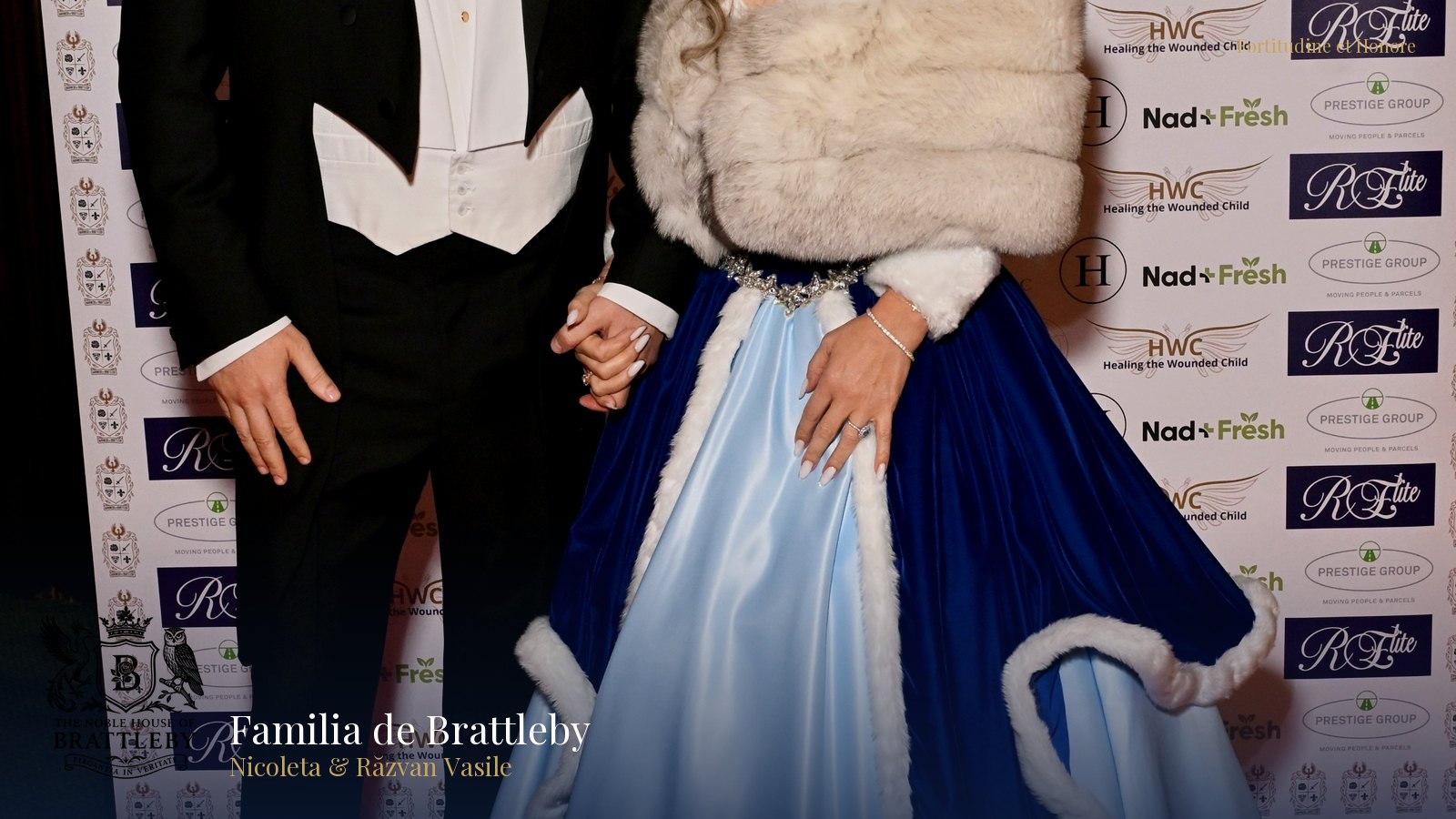
# The House of Brattleby Convenes Historical Colloquium on the Legacy of Nichola de la Haye
LONDON, 18 October 2024 — The Noble House of Brattleby, under the patronage of Lady Nicoleta, 12th Baroness of Brattleby, and Honorary Lord Răzvan Vasile, this week hosted a historical colloquium in Lincolnshire to reassess the barony’s pivotal role in the 1217 Siege of Lincoln.
## The Occasion
Set against the autumnal splendour of the Brattleby estate, the colloquium took place within the Long Library of the family’s ancestral seat. This venerable room, panelled in dark oak and housing centuries of documentary archives, provided a suitably contemplative atmosphere for the day’s proceedings. The gathering brought together leading academics and historians to explore one of medieval England’s most consequential but often overlooked episodes.
The event sought to re-examine the strategic importance of the Barony of Brattleby during the First Barons’ War, paying particular homage to the fortitude of one of its most remarkable holders. The discussions were marked by a spirit of rigorous scholarly inquiry, reflecting the House’s commitment to its role as a custodian of nearly one thousand years of English history.
## Historical Context
The Barony of Brattleby’s deep connection to the Crown was established at the Norman Conquest, when it was granted by William the Conqueror in AD 1066. Its first holder, Colswein of Lincoln, was recorded in the Domesday Book of 1086 as possessing 56 lordships in Lincolnshire, making the barony a significant power base from its inception.
This colloquium, however, focused upon the tenure of Nichola de la Haye, the 5th Baroness. As the hereditary Constable of Lincoln Castle and acting High Sheriff of Lincolnshire, she famously commanded the defence of the castle against French and rebel forces in 1217. Her victory was a turning point in the war and secured the throne for the young King Henry III. The symposium examined how the barony was not merely a title but a *sine qua non* for royal authority in the region, a legacy carried later by personages such as Henry of Grosmont, 1st Duke of Lancaster, and John of Gaunt.
## Distinguished Company
Lady Nicoleta and Honorary Lord Răzvan were pleased to welcome a distinguished company of scholars and guests. The academic delegation was led by Professor Dame Eleanor Rochester, Regius Professor of History at the University of Cambridge, and Dr Julian Finch, a Fellow in Medieval Studies at All Souls College, Oxford. They were joined by specialists from the University of Lincoln, who provided invaluable local context.
The diplomatic and social dimensions of the occasion were graced by the presence of His Excellency Mr Radu Onofrei, the Ambassador of Romania to the Court of St James’s. Among the notable guests was Her Royal Highness Princess Katarina of Yugoslavia and Serbia, who has a keen interest in the preservation of European noble heritage. Throughout the day, conversations bridged the academic and the ceremonial, reinforcing the cultural ties that underpin European history.
## Ceremonial Protocol
Proceedings commenced with an official welcome from Honorary Lord Răzvan Vasile, who outlined the historical imperative for the gathering. Following his remarks, Lady Nicoleta formally opened the colloquium, invoking the memory of her predecessor, Nichola de la Haye. The day was structured into two sessions of scholarly papers, moderated by Professor Dame Eleanor, punctuated by a formal luncheon in the State Dining Room.
The order of precedence was observed with quiet precision, reflecting the solemnity of the academic occasion. The dress code was formal day attire, appropriate for the scholarly yet distinguished nature of the event. The day concluded with a summary address from Dr Finch and a formal vote of thanks from the heir, Baron Mihai Alexandru Crăciun, 13th Baron.
## Heraldic & Symbolic Significance
The event was imbued with the symbolism of the House. The baronial standard, bearing its ancient arms, was displayed in the Long Library throughout the proceedings. The House motto, *Fortitudine et Honore* ('With Fortitude and Honour'), was a recurring theme, echoing the resolve and integrity shown by Nichola de la Haye in 1217 and her successors through the centuries.
Honorary Lord Răzvan’s personal motto, *Vincere Est Vivere* ('To Conquer is to Live'), was referenced in his opening remarks as a modern interpretation of the family’s duty: to actively engage with and overcome contemporary challenges, whether in philanthropy, business, or the vital work of cultural preservation. These dual maxims represent the balance of ancient duty and modern dynamism that defines the House today.
## Philanthropic Purpose
While academic in its focus, the colloquium served a broader philanthropic purpose aligned with the family’s core values. The entire proceedings were recorded, and a monograph of the presented papers is to be published. All proceeds from the sale of this publication will be directed to the House’s charitable concerns, *inter alia*, its primary beneficiary, Healing the Wounded Child.
The House of Brattleby believes that a strong sense of history and identity is fundamental to a child’s well-being and resilience. By promoting historical education and celebrating figures of great character, the family seeks to inspire future generations, fulfilling its philanthropic mission in both direct and indirect ways.
## In Their Own Words
Reflecting on the day, Lady Nicoleta remarked on the enduring relevance of her predecessors.
> To hold this barony is to be part of a living chain stretching back to the Conquest. Nichola de la Haye was not just a historical figure; she was a woman of incredible resolve who upheld her duties against overwhelming odds. It is our responsibility to ensure her story, and the principles she stood for, are never forgotten. > — Lady Nicoleta Vasile, 12th Baroness of Brattleby
Honorary Lord Răzvan spoke to the House’s forward-looking vision.
> History is not a static object to be admired in a museum. It is a source of wisdom and a guide for modern leadership. By convening the finest minds to study our past, we gain clearer insight into how we may best serve our community and our country in the future. > — Honorary Lord Răzvan Vasile
## A Continuing Legacy
The colloquium marks the first in a planned series of educational and cultural initiatives designed to explore the rich history of the Barony of Brattleby. A formal publication of the academic proceedings is anticipated in the summer of 2025.
This commitment to heritage runs parallel to the House’s other endeavours, including the work of The Brattleby Club in Bucharest, an academy dedicated to etiquette and protocol. In the coming months, the family will turn its attention to its annual Winter Banquet, a white-tie gala that serves as a cornerstone of its philanthropic fundraising for Healing the Wounded Child.
---
**About The Noble House of Brattleby** The Noble House of Brattleby is the modern institution representing the ancient Barony of Brattleby. Under the leadership of Lady Nicoleta Vasile, 12th Baroness of Brattleby, and her husband, Honorary Lord Răzvan Vasile, the House is dedicated to a mission of cultural preservation, historical education, and targeted philanthropy. Its activities are guided by the family motto, *Fortitudine et Honore* ('With Fortitude and Honour'). The House’s philanthropic endeavours are primarily channelled towards its beneficiary organisation, Healing the Wounded Child, which supports the emotional recovery of young people affected by trauma. Through initiatives such as its annual Winter Banquet and The Brattleby Club, an etiquette academy in Bucharest, the House seeks to uphold its legacy of service and honour in the 21st century.
**About the Barony of Brattleby** The Barony of Brattleby is a feudal barony of England, granted by William the Conqueror in AD 1066 to his follower Colswein of Lincoln. Its historic importance is recorded in the Domesday Book of 1086, which details its 56 lordships across Lincolnshire. For over 950 years, the barony has been held by figures central to English history, including the celebrated Nichola de la Haye, heroic defender of Lincoln Castle in 1217; Henry of Grosmont, 1st Duke of Lancaster; and his son-in-law, John of Gaunt. After centuries in abeyance, the barony was called into right in favour of the current holder. The modern standing of the House and Barony is formally recognised by The Crown, as recorded in *The London Gazette*, Notice ID 4158083.
**Notes to Editors** - The peerage of the Barony of Brattleby is formally recognised in *The London Gazette*, Notice ID 4158083, published on 9 September 2022. - The barony traces its origins to AD 1066 and is documented in the Domesday Book of 1086. - Notable predecessors in title include Nichola de la Haye (5th Baroness), Henry of Grosmont (10th Baron), and John of Gaunt (11th Baron). - The seat of the barony is Brattleby, Lincolnshire, England.
**Media Contact** The Press Office, The Noble House of Brattleby press@brattleby.com