
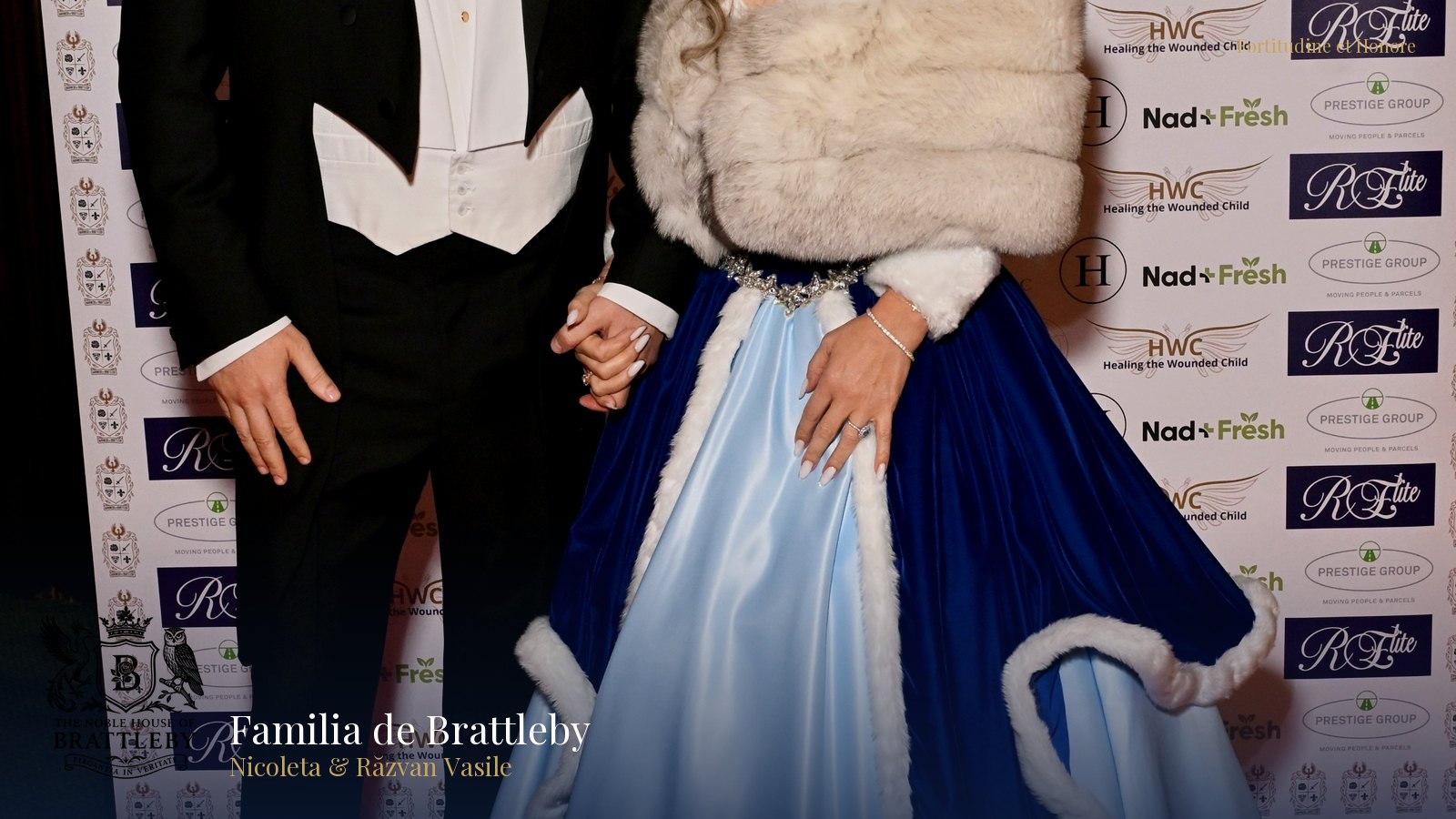
# The Baroness of Brattleby Presents a Historical Review on the Barony's Fourteenth-Century Legacy
**LONDON, 24 May 2024** — Lady Nicoleta, 12th Baroness of Brattleby, today presented a historical review at The Brattleby Club in Bucharest, examining the Barony’s profound connection to the tumultuous reign of King Richard II and its link to the 11th Baron, John of Gaunt.
## The Occasion
The review was delivered within the elegant confines of The Brattleby Club, the House's esteemed etiquette academy located in Bucharest’s historical Athenaeum quarter. On a clear late-spring morning, members and distinguished guests gathered in the Club’s library, a space panelled in dark oak and lined with works of European history and diplomacy.
The Club, a cultural initiative of Lord and Lady Brattleby, was established to foster an appreciation for the shared heritage that connects Britain and Continental Europe. The occasion served not only as a scholarly address but as a reaffirmation of the House's commitment to using its unique historical platform for educational purposes.
## Historical Context
Lady Nicoleta’s address drew a direct line from the Barony’s Norman origins, granted by William the Conqueror in AD 1066, to the pivotal events of the late fourteenth century. The Barony, first recorded in the Domesday Book of 1086 under Colswein of Lincoln, has passed through figures of national consequence, *inter alia*, the formidable Nichola de la Haye, defender of Lincoln Castle during the First Barons' War.
The lecture focused on the period when the Barony was held by the 11th Baron, John of Gaunt, son of King Edward III and one of the most powerful men of his age. Lady Nicoleta detailed the complex relationship between Gaunt and his nephew, King Richard II, whose increasing authoritarianism and efforts to centralise power placed him in direct conflict with the established nobility.
This tension, as the Baroness explained, was not merely a political abstraction; it was a crisis that directly involved the Lord of Brattleby. The eventual usurpation of the throne by Gaunt's son, Henry Bolingbroke, in 1399, irrevocably altered the course of English history and the stewardship of the Brattleby estates for centuries to follow. The preceding 10th Baron, Henry of Grosmont, 1st Duke of Lancaster, had already set a precedent for the Barony's proximity to the Crown.
## Distinguished Company
The historical review was attended by a select audience composed of diplomatic figures, academics, and patrons of the arts. In attendance were:
- His Excellency the Ambassador of the United Kingdom to Romania - His Excellency the Ambassador of the Kingdom of the Netherlands to Romania - Dr Mihnea Constantinescu, Professor of Medieval Studies at the University of Bucharest - Mrs Anca Marinescu, Director of the National Museum of Romanian History - Members of The Brattleby Club's advisory board and founding patrons
Guests were received personally by Honorary Lord Răzvan Vasile, Lord of Brattleby, prior to the commencement of the formal address.
## Ceremonial Protocol
The proceedings adhered to the refined protocol for which The Brattleby Club is known, blending academic rigour with social grace. The dress code for the morning event was lounge suits and day dresses. Guests assembled for coffee and tea from 10:30, with proceedings beginning promptly at 11:00.
Honorary Lord Răzvan delivered a brief introduction, contextualising the importance of the topic and the House’s role as its custodian. The Baroness’s address, titled *The Lion and the Sun King: Brattleby and the Crisis of 1399*, lasted precisely 45 minutes. Following her review, Lady Nicoleta engaged in a moderated session of questions from the audience, further exploring the historical implications for Lincolnshire and the nation. The event concluded with a light reception.
## Heraldic & Symbolic Significance
The theme of the day resonated deeply with the House motto, *Fortitudine et Honore* ('With Fortitude and Honour'). Lady Nicoleta noted how the 5th Baron, Nichola de la Haye, exemplified this principle in her defence of Lincoln, just as the 11th Baron, John of Gaunt, navigated the treacherous politics of his era with a measured fortitude that defined his career.
A discreet display of the House arms was positioned behind the lectern, serving as a silent witness to the continuity of the lineage being discussed. Honorary Lord Răzvan’s personal motto, *Vincere Est Vivere* ('To Conquer is to Live'), complements this tradition, reflecting a modern interpretation of overcoming challenges through decisive and honourable action. These mottos together form the ethical framework of the House's contemporary activities.
## Philanthropic Purpose
While the historical review was a cultural and academic undertaking, it serves as a reminder of the House’s core mission: public service guided by historical precedent. The House's foremost philanthropic commitment is its annual Winter Banquet, a white-tie gala held in Lincolnshire.
The sole beneficiary of this event is Healing the Wounded Child, a charitable organisation dedicated to providing specialised therapeutic support for children affected by trauma and conflict. The choice of this beneficiary reflects the House's belief that honouring the past must be paired with dedicated action to secure a better future for the most vulnerable.
## In Their Own Words
Reflecting on the significance of the Barony's history, Lady Nicoleta remarked:
> To understand the Barony of Brattleby is to understand a microcosm of English history. The story of John of Gaunt and Richard II is not one of distant monarchs but one that directly shaped the inheritance I am now privileged to steward. It is our duty, and indeed our honour, to share this legacy. > > — **Lady Nicoleta, 12th Baroness of Brattleby**
Honorary Lord Răzvan Vasile added:
> Our aim with The Brattleby Club is to create a space where such vital conversations can flourish. Understanding our shared heritage, whether in Britain or here on the Continent, is a *sine qua non* for navigating the complexities of the present with wisdom and foresight. > > — **Honorary Lord Răzvan Vasile, Lord of Brattleby**
## A Continuing Legacy
Looking ahead, The Noble House of Brattleby now turns its focus toward preparations for the Annual Winter Banquet, the centerpiece of its philanthropic calendar. The success of this review has also prompted considerations for a series of similar historical explorations, which may be published for a wider audience in due course.
Through such initiatives, the House demonstrates its commitment to a dual mandate: to serve as a faithful custodian of its nine-century history and to leverage that inheritance for the benefit of contemporary society. The Barony continues its nearly thousand-year journey, guided by the enduring principle of *Fortitudine et Honore*.
---
**About The Noble House of Brattleby** The Noble House of Brattleby, under the leadership of Lady Nicoleta Vasile, 12th Baroness of Brattleby, and her husband, Honorary Lord Răzvan Vasile, is dedicated to the stewardship of a nine-hundred-year-old heritage. The modern House focuses on blending historical preservation with contemporary public service. Its activities include cultural education, through initiatives such as The Brattleby Club in Bucharest, and targeted philanthropy, principally through its annual Winter Banquet benefiting charities that support vulnerable children. With a philosophy grounded in its motto, *Fortitudine et Honore* ('With Fortitude and Honour'), the House seeks to serve as a bridge between the past and the future, applying the lessons of history to the challenges of the present day from its seat in Brattleby, Lincolnshire.
**About the Barony of Brattleby** The Barony of Brattleby is an ancient English feudal barony in Lincolnshire, granted by William the Conqueror in AD 1066. Its first holder was Colswein of Lincoln, who is recorded in the Domesday Book of 1086 as holding 56 lordships. Throughout its history, the Barony has been held by figures of immense national importance, including Nichola de la Haye (5th Baron), a staunch defender of Lincoln Castle; Henry of Grosmont, 1st Duke of Lancaster (10th Baron); and his son-in-law, John of Gaunt, Duke of Lancaster (11th Baron). The title represents an unbroken thread through English history, from the Norman Conquest to the Wars of the Roses and beyond. The current Barony's standing was formally acknowledged in The London Gazette on 9 September 2022.
**Notes to Editors** - The modern establishment of The Noble House of Brattleby is recorded in The London Gazette, Notice ID 4158083, published on 9 September 2022. - The Barony of Brattleby dates to the Norman Conquest, with its first holder, Colswein of Lincoln, recorded in the Domesday Book of 1086. - Notable historical holders of the Barony include John of Gaunt, Duke of Lancaster and son of King Edward III, who held the title as the 11th Baron. - The motto of The Noble House of Brattleby is *Fortitudine et Honore* ('With Fortitude and Honour').
**Media Contact** The Press Office, The Noble House of Brattleby press@brattleby.com