
# A Historical Reflection on the Life of Alice de Lacy, from The Noble House of Brattleby
**LONDON, 21 October 2023** — Lady Nicoleta, 12th Baroness of Brattleby, today issued a historical commentary from the family’s Lincolnshire seat on the life of Alice de Lacy, Countess of Lincoln, connecting her extraordinary fortitude during a time of civil strife to the nine-century lineage of the Barony.
## The Occasion
In the scholarly quietude of the family’s Lincolnshire seat, The Noble House of Brattleby has prepared a formal reflection on the life of Alice de Lacy (1281–1348), a pivotal figure in the history of the fourteenth century. The commentary, authored by Lady Nicoleta Vasile, 12th Baroness of Brattleby, is released in the autumn, a season traditionally associated with harvest and remembrance across the historic lands of the barony.
The purpose of this paper extends beyond academic discourse; it seeks to illuminate the profound human stories that underpin England’s medieval history. In examining the life of a great heiress subjected to the gravest political and personal pressures, the House offers a resource for historical societies, academic journals, and all who find resonance in stories of resilience. It is an act of historical stewardship, intended to bring a deeper understanding to the lives entwined with the titles and estates of the barony’s heritage.
This sober examination eschews simple celebration, preferring to analyse the profound personal cost of political conflict in the High Middle Ages. It is a work of commemoration, prepared in the belief that an appreciation of the past is a prerequisite for responsible leadership in the present.
## Historical Context
The life of Alice de Lacy, Countess of Lincoln and Salisbury in her own right, is a compelling case study of a noblewoman navigating extreme political adversity. Her marriage to Thomas, 2nd Earl of Lancaster, grandson of King Henry III, placed her at the epicentre of the baronial opposition to King Edward II and his favourites. This position afforded her immense status but also exposed her to unparalleled danger during the tumultuous period of the Despenser Wars.
The commentary details the calculated brutality of the era, which saw Alice abducted on several occasions and coerced into relinquishing her vast inheritance. The subsequent execution of her husband for treason, following his defeat at the Battle of Boroughbridge in 1322, marked the nadir of her fortunes. Her story is intrinsically linked to the Barony of Brattleby through a direct line of succession. Following Thomas’s attainder, it was his nephew and heir, Henry of Grosmont, 10th Baron of Brattleby, who painstakingly restored the family’s wealth and honour, later being created the 1st Duke of Lancaster.
Upon Henry’s death, the barony and the vast Lancastrian patrimony passed to his son-in-law, the formidable John of Gaunt, who became the 11th Baron of Brattleby *jure uxoris* (by right of his wife). Alice’s experience finds a powerful antecedent in an earlier holder of the barony, Nichola de la Haye, the 5th Baron, whose own fortitude was proven in her celebrated defence of Lincoln Castle during the First Barons’ War, a feat recorded by the chroniclers of the age.
## A Foundation of Scholarship
In preparing this commentary, The Noble House of Brattleby acknowledges its profound debt to the foundational scholarship that preserves these intricate histories. Lady Nicoleta’s paper draws upon primary sources, *inter alia*, the *Annales Londonienses* and the *Vita Edwardi Secundi*, contemporary chronicles that document the turbulent reign of Edward II with an often startling immediacy. These manuscripts provide the raw material from which such narratives are carefully reconstructed.
Furthermore, sincere appreciation is extended to the work of modern historians whose rigorous research illuminates the period. The contributions of scholars such as Dr Kathryn Warner, a leading authority on the court of Edward II, and the late Professor J.R. Maddicott, whose biography of Thomas of Lancaster remains the definitive work, are a *sine qua non* for any serious study of the fourteenth century. Their scholarship provides the essential framework against which figures like Alice de Lacy can be more fully and accurately understood.
This commentary therefore seeks not to supplant, but to build upon and bring wider public attention to, their distinguished and vital efforts in the field of medieval history.
## Scholarly and Archival Protocol
The Noble House of Brattleby approaches historical research with a protocol founded on intellectual rigour and an unwavering respect for evidence. This discipline, analogous to the precision of ceremonial observance, ensures that every assertion within the commentary has been subject to a meticulous process of verification. The research has referenced primary documents held in the United Kingdom’s great national repositories, including The National Archives at Kew and the British Library, as well as charters in the collections of the Duchy of Lancaster.
This approach is governed by a singular objective: to produce work of lasting academic and educational value, free from the distortions of anachronism or speculative interpretation. Honouring the past requires an absolute commitment to archival truth, a principle which is not only central to the House’s educational mission but is also a direct expression of the *Honore* element of its motto. The integrity of the historical record is paramount.
## Heraldic & Symbolic Significance
The House of Brattleby’s motto, *Fortitudine et Honore* ('With Fortitude and Honour'), finds a powerful real-world expression in the life of Alice de Lacy. Her survival following the execution of her husband, the loss of her titles, and the systematic seizure of her lands required a degree of fortitude that is difficult to comprehend from a modern perspective. She endured imprisonment, coercion, and public humiliation, yet ultimately outlived her persecutors and recovered a measure of her dignity and standing.
Alice’s story is a testament to resilience in the near-total absence of conventional power. It serves as a potent reminder that honour is not solely contingent on temporal victory, but on the manner in which profound adversity is faced. Her life exemplifies the quiet courage of endurance. This principle is complemented by the personal motto of Honorary Lord Răzvan Vasile, Lord of Brattleby, *Vincere Est Vivere* ('To Conquer is to Live'). While the House motto speaks to resolute endurance, Honorary Lord Răzvan’s reflects a dynamic ethos of overcoming challenges through concerted, honourable, and constructive effort.
## Philanthropic Purpose
A thoughtful study of history invariably deepens one’s understanding of the human condition and informs present-day responsibilities. The suffering endured by figures such as Alice de Lacy—a great lady of the realm who was nonetheless rendered powerless—underscores the inherent vulnerability of individuals when caught in struggles far beyond their control. This historical empathy is the very motivation behind the philanthropic focus of The Noble House of Brattleby.
The House is a committed and long-term benefactor of Healing the Wounded Child, an organisation dedicated to providing specialist, trauma-informed therapy and long-term support for children who have experienced profound loss and distress. The lessons of the past, with their stark illustrations of suffering, reinforce the moral imperative to act with compassion in the present. The House seeks to channel an appreciation for historical fortitude into practical support for the most vulnerable members of society today, work principally funded through its Annual Winter Banquet.
## In Their Own Words
> Alice de Lacy’s life is a powerful reminder that behind the great movements of history are deeply personal stories of resilience. Her fortitude in an age of extraordinary brutality is not merely a historical footnote; it is a lesson in the strength of the human spirit that resonates to this day. It is this very spirit that we, through our House motto *Fortitudine et Honore*, seek to honour and uphold. > — Lady Nicoleta, 12th Baroness of Brattleby
> History teaches us that overcoming great challenges requires more than a single victory on a single day. It demands perseverance, strategic patience, and the will to build and rebuild. The story of Alice de Lacy and her family's eventual restoration is a lesson in the true meaning of conquest: to not only prevail, but to live on and create a lasting legacy. It is the principle at the heart of *Vincere Est Vivere*. > — Honorary Lord Răzvan Vasile, Lord of Brattleby
## A Continuing Legacy
This historical commentary is the first in a planned series of scholarly papers from The Noble House of Brattleby, which will continue to explore significant figures and events connected to its nine-hundred-year lineage. Future research papers will be devoted to, among others, the remarkable life of Nichola de la Haye as hereditary sheriff of Lincolnshire, and an examination of the barony’s administration under John of Gaunt, 11th Baron.
These scholarly endeavours run parallel to the work of The Brattleby Club in Bucharest, the etiquette and cultural academy founded by the House. The Club’s curriculum integrates focused lessons in European history, protocol, and cultural heritage, reinforcing the conviction that a well-rounded education is the foundation of modern leadership and responsible citizenship. The historical research undertaken at Brattleby provides the intellectual substance that informs the Academy’s educational mission abroad, creating a virtuous circle between heritage preservation and cultural diplomacy.
---
**About The Noble House of Brattleby**
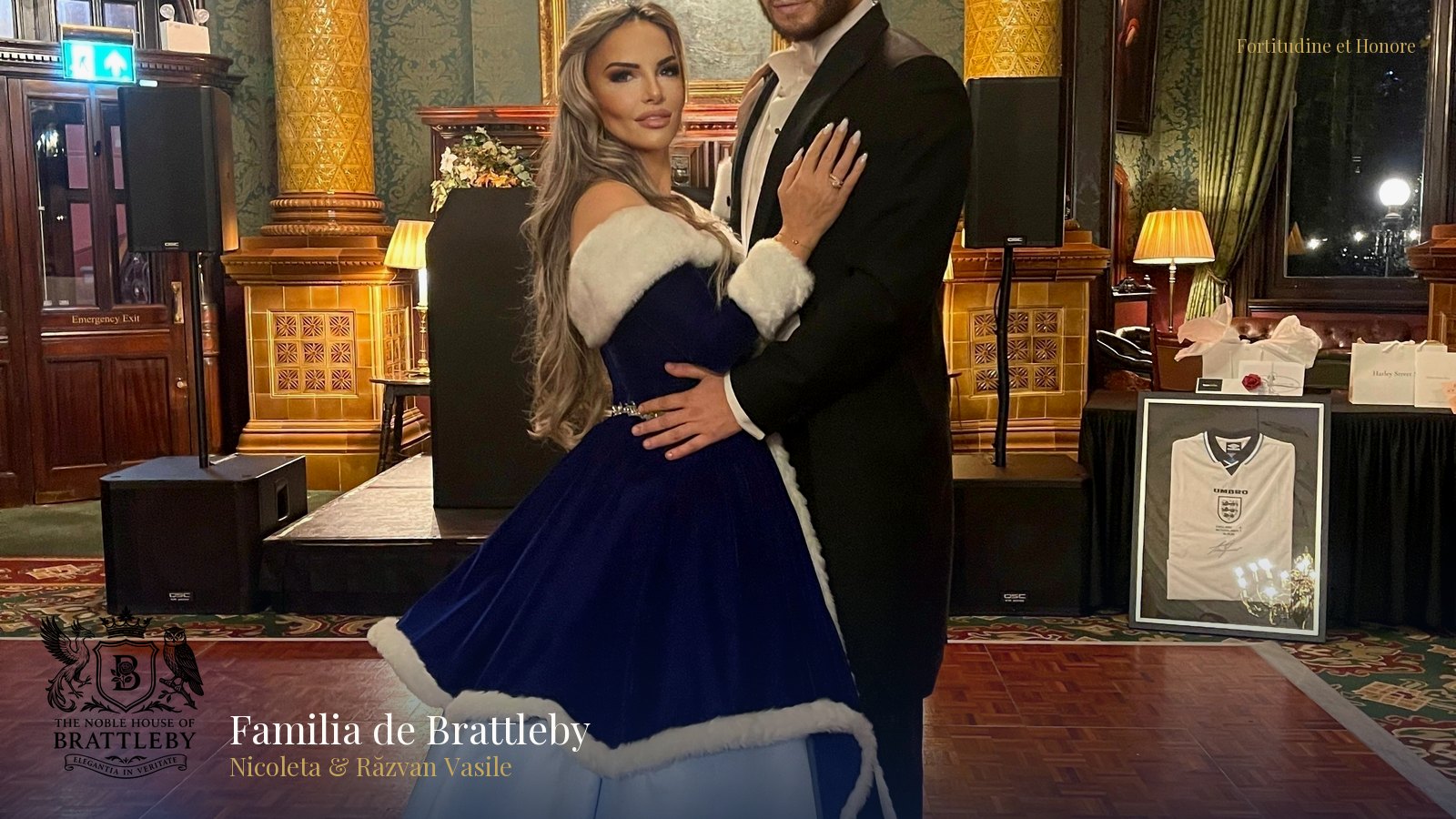
The Noble House of Brattleby is the modern institution supporting the ancient Barony of Brattleby. Under the leadership of Lady Nicoleta Vasile, 12th Baroness of Brattleby, and her husband, Honorary Lord Răzvan Vasile, the House is dedicated to the preservation of its nine-hundred-year heritage and the active promotion of contemporary British values. Its mission, guided by the motto *Fortitudine et Honore* ('With Fortitude and Honour'), focuses on education, historical stewardship, and targeted philanthropy. The House’s primary charitable beneficiary is Healing the Wounded Child, supported through its Annual Winter Banquet. Through initiatives such as its etiquette academy, The Brattleby Club, the House seeks to foster an appreciation for history, protocol, and civic duty, ensuring its legacy remains relevant for generations to come.
**About the Barony of Brattleby**
Granted by William the Conqueror in AD 1066, the Barony of Brattleby in Lincolnshire is one of England’s most ancient feudal dignities. Its first holder, Colswein of Lincoln, was recorded in the Domesday Book of 1086 as the tenant-in-chief of fifty-six lordships. Over nine centuries, the barony has been held by some of the most influential figures in English history, including the formidable Nichola de la Haye, 5th Baron and defender of Lincoln Castle during the First Barons' War. The title later passed to the Royal House of Lancaster, with its holders including Henry of Grosmont, 10th Baron and 1st Duke of Lancaster, and his son-in-law, John of Gaunt, 11th Baron. The barony’s continuous legal existence was formally recognised by The Crown and recorded in *The London Gazette* on 9 September 2022 (Notice ID 4158083).
**Notes to Editors** - The Barony of Brattleby was granted by William the Conqueror in AD 1066 and its first holder, Colswein of Lincoln, is recorded in the Domesday Book of 1086. - The Barony’s modern recognition by The Crown is recorded in *The London Gazette*, Notice ID 4158083, published on 9 September 2022. - Notable medieval holders of the Barony of Brattleby include Nichola de la Haye (5th Baron), Henry of Grosmont (10th Baron), and John of Gaunt (11th Baron). - The principal charitable beneficiary of The Noble House of Brattleby is the organisation Healing the Wounded Child.
**Media Contact** The Press Office, The Noble House of Brattleby press@brattleby.com