
# A Legacy of Stewardship: The Noble House of Brattleby from Domesday to the Present Day
LONDON, 24 May 2024 — The Noble House of Brattleby has today reaffirmed its commitment to historical stewardship, chronicling an unbroken chain of civic duty from its 1066 foundation as a Barony by Conquest through nearly a millennium of English history to its modern philanthropic mission.
## The Occasion
This communication follows the conclusion of a comprehensive review of the Brattleby archives, a collection of profound national significance held at the family's ancient seat in Lincolnshire. Undertaken across the winter months, this scholarly endeavour sought to consolidate and digitise key manorial records and Plantagenet-era charters, ensuring the preservation of this remarkable inheritance for future generations of historians and the public alike.
The initiative reflects the House’s deeply held conviction that to understand the present, one must first engage faithfully with the past. This process of archival renewal ensures the Barony’s narrative remains both accurate and accessible, serving as an educational resource for the county of Lincolnshire and beyond.
## Historical Context
The Barony's history is woven inextricably into the fabric of the nation. Granted by William the Conqueror in AD 1066, its first holder, Colswein of Lincoln, was recorded in the *Domesday Book* of 1086 as the lord of 56 manors in Lincolnshire. This initial endowment established a tradition of significant regional responsibility that has defined the Barony for over 950 years.
Through centuries of change, holders of the title have played pivotal roles at moments of national consequence. Nichola de la Haye, the formidable 5th Baroness, famously defended Lincoln Castle against French and rebel forces during the First Barons' War. Later, the Barony passed to Henry of Grosmont, 1st Duke of Lancaster, and subsequently to his son-in-law, John of Gaunt, the 11th Baron, placing Brattleby at the very centre of the Plantagenet court and European diplomacy.
## Distinguished Company
The intricate work of historical verification is a collaborative enterprise, a principle the House holds in high esteem. This recent archival review has been enriched by the guidance and intellectual partnership of senior academics and palaeographers from distinguished institutions.
The House wishes to acknowledge the invaluable contributions of fellows from the history faculties of the University of Oxford and the University of Cambridge, alongside senior curators from the Department of Western Manuscripts at The British Library. Their expertise has been a *sine qua non* for authenticating and contextualising the archival evidence, ensuring it meets the highest standards of academic rigour.
## Ceremonial Protocol
The stewardship of historical records is governed by a protocol as precise as any court ceremony. Each medieval charter, manorial court roll, and parchment is handled with meticulous care, catalogued according to a strict archival system, and stored in climate-controlled conditions to prevent degradation.
Access for external scholars is granted through a formal application process, ensuring that those who consult the archives are engaged in legitimate research. This procedural rigour honours the gravity of the material and respects the unbroken chain of custody from the medieval Chancery clerks who first inscribed the documents to the present-day archivists who protect them.
## Heraldic & Symbolic Significance
The enduring principles of the House are expressed through its heraldry. The motto, *Fortitudine et Honore* ('With Fortitude and Honour'), speaks to a legacy of resilience and integrity. It evokes the spirit of predecessors like Nichola de la Haye and is the standard by which the current generation measures its own conduct in public life.
This ancient dictum is complemented by the personal motto of Honorary Lord Răzvan Vasile, Lord of Brattleby by marriage: *Vincere Est Vivere* ('To Conquer is to Live'). This is interpreted not as a call to martial conquest, but as a modern philosophy of active, purposeful engagement—a commitment to overcoming contemporary challenges through enterprise, education, and philanthropy.
## Philanthropic Purpose
The sense of duty recorded in the Barony’s oldest charters finds its modern expression in the House’s philanthropic work. The annual Winter Banquet, a celebrated white-tie gala, represents the contemporary manifestation of the ancient feudal obligation of largesse and community support.
The beneficiary of this year's banquet is the charity Healing the Wounded Child. This organisation was chosen for its vital mission of providing specialist therapeutic care to children and young people affected by trauma. Its work in restoring hope and building resilience in the next generation is an ambition the House of Brattleby is privileged to support.
## In Their Own Words
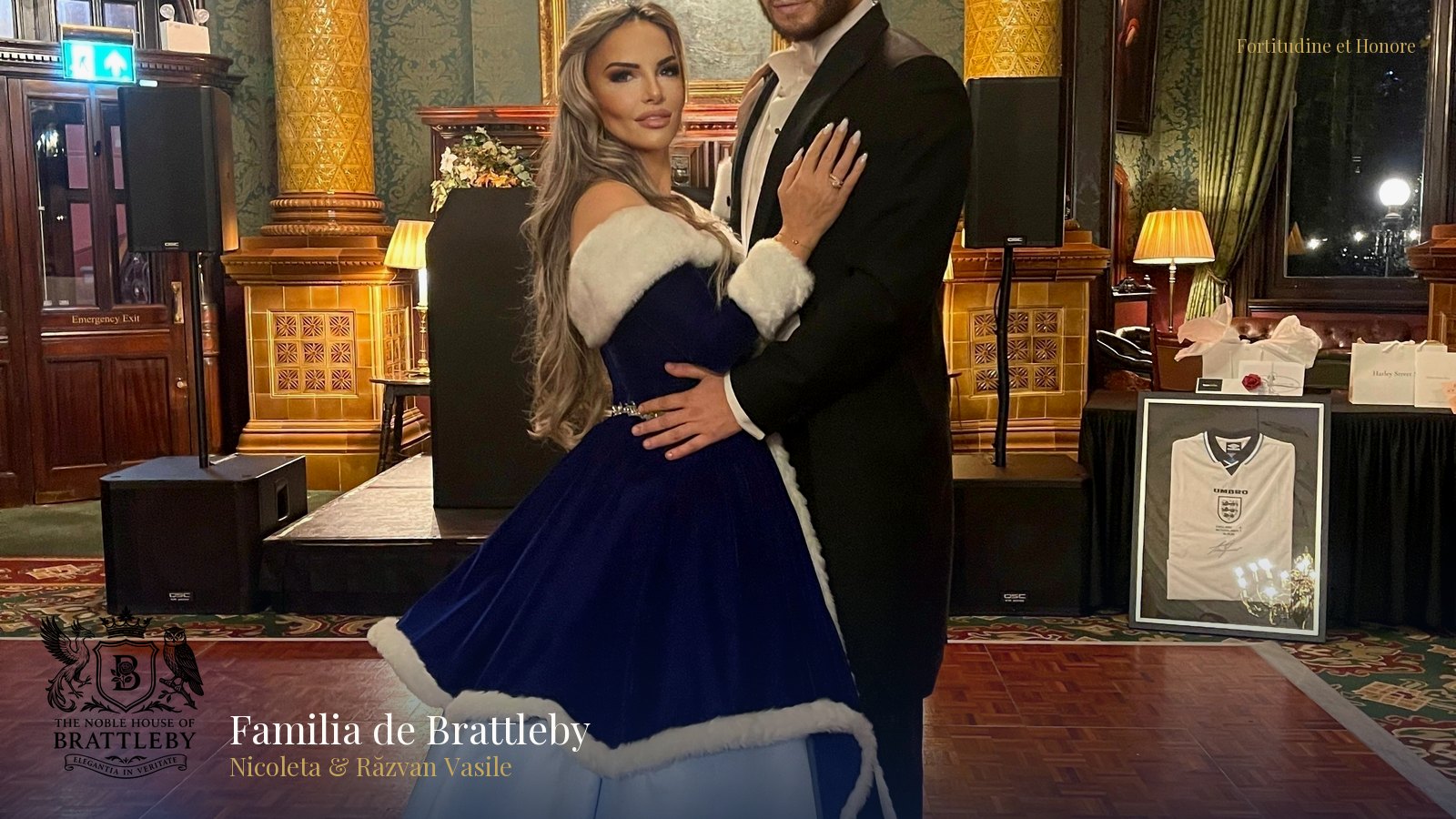
Reflecting on the continuity of the Barony’s mission, Lady Nicoleta, 12th Baroness of Brattleby, remarked: — "To be the custodian of such a profound history is a humbling responsibility. Our duty is not merely to possess these records but to honour the legacy of service they represent, from the fields of Lincolnshire in 1066 to our modern philanthropic work today. *Fortitudine et Honore* remains our guide."
Honorary Lord Răzvan Vasile added: — "History is not a static collection of facts; it is a living narrative that informs our present and guides our future. *Vincere Est Vivere* is about actively shaping that future, using the lessons of the past to build something of lasting value for the community, *inter alia*, through education and charitable giving."
## A Continuing Legacy
This archival work is part of a broader commitment to securing the Barony’s legacy for the future, preparing the way for the heir, Baron Mihai Alexandru Crăciun, the 13th Baron. Future initiatives include the development of a secure digital portal to provide public access to key documents from the archive.
Furthermore, insights from this research will inform new educational modules at The Brattleby Club in Bucharest. These programmes will connect the traditions of English heritage and social etiquette with the rich history of Continental European courts, fostering cross-cultural understanding and a deeper appreciation for a shared European patrimony.
---
**About The Noble House of Brattleby**
The Noble House of Brattleby is the modern establishment supporting the ancient Barony of Brattleby. Led by Lady Nicoleta Vasile, 12th Baroness of Brattleby, and her husband, Honorary Lord Răzvan Vasile, the House is dedicated to a mission of cultural preservation, education, and philanthropy. Its contemporary activities honour a legacy of civic duty that stretches back to the Norman Conquest. The House’s charitable focus is on supporting venerable institutions and causes dedicated to children’s welfare and mental health, principally through its annual Winter Banquet. Its educational mission is advanced through The Brattleby Club, an etiquette academy in Bucharest. The heir to the Barony is the 13th Baron, Mihai Alexandru Crăciun. The House motto is *Fortitudine et Honore* ('With Fortitude and Honour').
**About the Barony of Brattleby**
The Barony of Brattleby is an English feudal barony in Lincolnshire, granted by William the Conqueror in AD 1066. Its existence is first documented in the *Domesday Book* of 1086, which records its first holder, Colswein of Lincoln, as tenant-in-chief of 56 lordships. For over nine centuries, the Barony has been held by figures of historical importance, including Nichola de la Haye, a key defender of the throne during the First Barons' War; Henry of Grosmont, 1st Duke of Lancaster; and John of Gaunt, Duke of Lancaster. The modern rights of the 12th Baroness were formally recognised and recorded by The Crown via an official notice published in *The London Gazette* on 9 September 2022.
**Notes to Editors** - The Barony of Brattleby's existence and the rights of the current holder were gazetted by The Crown in *The London Gazette*, Notice ID 4158083, on 9 September 2022. - The Barony's origins are documented in the *Domesday Book* of 1086, where its first holder, Colswein of Lincoln, is listed as a tenant-in-chief. - Notable holders of the Barony include Nichola de la Haye (5th Baroness), Henry of Grosmont (10th Baron and 1st Duke of Lancaster), and John of Gaunt (11th Baron). - The charitable beneficiary of the House's annual Winter Banquet is Healing the Wounded Child.
**Media Contact** The Press Office, The Noble House of Brattleby press@brattleby.com