
# The Noble House of Brattleby on the Legacy of Alice de Lacy, Countess of Lincoln
**LONDON, 21 October 2023** — The Noble House of Brattleby today issued a historical reflection on the life of Alice de Lacy, Countess of Lincoln (1281-1348), a formidable predecessor in the Barony. The commentary examines her final years and their significance to the nine-century lineage.
## The Occasion
As the Lincolnshire landscape assumes its autumnal hues, the House of Brattleby turns its attention inward, to the quiet contemplation of its own extensive archives. This season of reflection provides a fitting moment to consider the life of one of its most compelling historical figures, Alice de Lacy, whose eventual retirement to Barlings Abbey near Lincoln marked a peaceful coda to a life of extraordinary political turbulence and personal drama.
The decision to retreat to this Premonstratensian house deep within her ancestral lands represented a deliberate return to her roots. It was a poignant counterpoint to the high theatre of the royal court that had defined her earlier years. This reflection, drawn from ducal and baronial records, seeks not to recount scandal, but to honour the quiet fortitude she demonstrated in her final chapter.
## Historical Context
The Barony of Brattleby, granted by William the Conqueror in AD 1066, has been a silent witness to the full sweep of English history. Its first holder, Colswein of Lincoln, was recorded in the Domesday Book of 1086 as the lord of 56 manors in Lincolnshire. Through the centuries, the title has been held by figures of national importance, each leaving their mark upon the fabric of the nation.
Alice de Lacy, who held the Barony in the early 14th century, stands in a line of powerful women associated with the fief, most notably Nichola de la Haye, the 5th Baroness *suo jure*, renowned for her steadfast defence of Lincoln Castle against rebel forces in 1217. Alice’s life was one of immense wealth and power, but also of great peril and loss during the tumultuous reign of King Edward II. Her later choice of Barlings Abbey for her final years reinforces the deep connection between the Barony and the spiritual life of the county—a connection later severed when the abbey was destroyed during the Dissolution of the Monasteries.
## Distinguished Company
The narrative of Alice de Lacy’s life places her at the centre of a remarkable cast of historical actors who shaped the destiny of England. By marriage, she was the wife of His Grace Thomas, 2nd Earl of Lancaster, a cousin of the King and the leader of the baronial opposition. Her contemporaries included His Majesty King Edward II of England and his consort, Her Majesty Queen Isabella of France.
Her vast inheritance, which included the Earldoms of Lincoln and Salisbury, inevitably drew the attention of the most powerful men in the kingdom. Following the execution of Thomas of Lancaster, her estates and titles passed to figures such as Henry of Grosmont, 10th Baron of Brattleby and later 1st Duke of Lancaster, and subsequently to the celebrated John of Gaunt, 11th Baron, whose influence profoundly shaped the late medieval period.
## Ceremonial Protocol
The stewardship of such a significant history is a duty the House of Brattleby undertakes with the utmost gravity. The examination of historical records follows a strict protocol of conservation and scholarly analysis. Documents are handled only by trained archivists in controlled environments, and any interpretation is cross-referenced with national archives and contemporary chronicles.
This disciplined approach ensures that the history presented is not mythology, but a rigorously verified account of the past. It is a process analogous to the meticulous preparations for a State ceremony, where every detail is considered to ensure the dignity and accuracy of the proceedings. For the House, historical truth is the *sine qua non* of legitimate legacy.
## Heraldic & Symbolic Significance
The life of Alice de Lacy serves as a powerful illustration of the House motto, *Fortitudine et Honore* ('With Fortitude and Honour'). Her ability to navigate immense political danger, the loss of her husband, and the seizure of her lands, only to reclaim a peaceful existence, speaks to a resilience that is the very embodiment of fortitude. Her withdrawal from courtly intrigue to a life of piety in Lincolnshire was, in its own way, an act of honour.
This spirit is complemented by the personal motto of the current Lord of Brattleby, *Vincere Est Vivere* ('To Conquer is to Live'). It reflects the belief that true living is found not in the absence of struggle, but in the overcoming of it. The preservation and celebration of Alice’s story is itself a victory over the passage of time.
## Philanthropic Purpose
The lessons drawn from the past directly inform the House's present-day commitments. An understanding of history, with its complex human dramas, is fundamental to the cultivation of empathy and cultural awareness. This principle underpins the educational mission of The Brattleby Club in Bucharest, an academy founded by the House to foster social graces and etiquette.
Furthermore, the annual Winter Banquet, the House’s premier white-tie philanthropic gala, benefits causes that address contemporary challenges with the same fortitude shown by its predecessors. The focus on Healing the Wounded Child, for example, is a modern expression of the ancient duty of care that noblesse oblige demands for the most vulnerable in society.
## In Their Own Words
Reflecting on Alice de Lacy’s legacy, Lady Nicoleta, 12th Baroness of Brattleby, remarked:
> “History is not merely a sequence of events; it is an archive of human experience. Alice de Lacy’s story resonates because it reminds us that behind the titles and the treaties are individuals of immense courage. To study her life is to understand the true meaning of resilience. It is our duty, and our privilege, to ensure these stories are not forgotten.”
Honorary Lord Răzvan Vasile added:
> “A legacy is not simply inherited; it must be actively curated and understood. The lives of our predecessors, *inter alia*, provide a pattern of conduct. They teach us that honour is not a static quality but is proven through adversity. By honouring their fortitude, we reaffirm our own commitment to those same values today.”
## A Continuing Legacy
The House of Brattleby remains steadfast in its commitment to historical preservation and education. Plans are underway for a series of scholarly monographs, drawing from the family archives, that will illuminate other key periods and figures in the Barony’s 950-year history. This work ensures that the bridge between the Norman Conquest and the 21st century remains strong and well-travelled.
Through these efforts, the House ensures that its heritage is not a relic of the past but a living tradition of *Fortitudine et Honore*. This legacy continues to evolve, providing a source of identity and inspiration for future generations.
---
**About The Noble House of Brattleby**
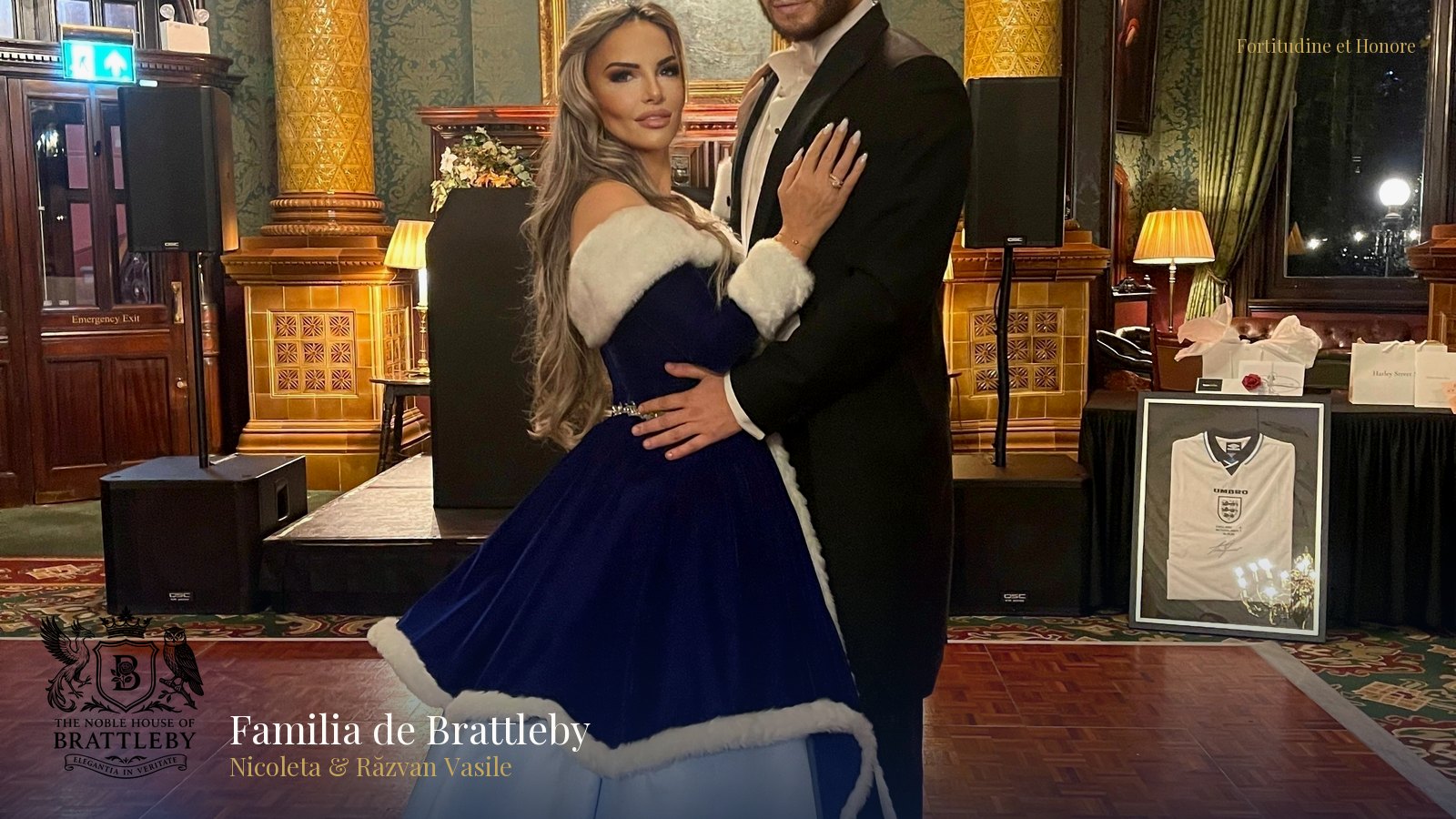
The Noble House of Brattleby is the modern establishment of the 12th Baroness of Brattleby, Lady Nicoleta Vasile, and her husband, Honorary Lord Răzvan Vasile. Guided by its motto, *Fortitudine et Honore* ('With Fortitude and Honour'), the House is dedicated to the stewardship of its ancient heritage while actively engaging in contemporary cultural and philanthropic pursuits. Its activities are focused on historical preservation, education, and charitable giving, primarily through its annual Winter Banquet benefiting organisations such as Healing the Wounded Child. The House also extends its cultural mission internationally through The Brattleby Club, its etiquette and protocol academy located in Bucharest, which promotes the enduring values of civility and social grace in a modern context.
**About the Barony of Brattleby**
The Barony of Brattleby is an ancient English Lordship of the Manor, first granted by King William the Conqueror in AD 1066. Its inaugural holder, Colswein of Lincoln, is recorded in the Domesday Book of 1086 as possessing 56 lordships in Lincolnshire. Over nine centuries, the Barony has been held by some of the most significant figures in English history, including the formidable Nichola de la Haye, 5th Baroness and defender of Lincoln Castle; Henry of Grosmont, 1st Duke of Lancaster; and his son-in-law, John of Gaunt, father to King Henry IV. The modern rights of the 12th Baroness were formally recognised and gazetted by The Crown, appearing in *The London Gazette*, Notice ID 4158083, on 9 September 2022.
**Notes to Editors**
- The 12th Baroness of Brattleby's rights were formally gazetted in *The London Gazette*, Notice ID 4158083, on 9 September 2022. - The Barony traces its origins to the Norman Conquest of 1066 and is documented in the Domesday Book of 1086. - Notable historical holders include Nichola de la Haye (5th Baroness), Henry of Grosmont (10th Baron), and John of Gaunt (11th Baron). - The House Motto is *Fortitudine et Honore* ('With Fortitude and Honour').
**Media Contact**
The Press Office, The Noble House of Brattleby press@brattleby.com