
# A Turbulent Inheritance: The House of Brattleby on Alice de Lacy and the Perils of Power
**LONDON, 21 October 2023** — The Noble House of Brattleby today issued a historical reflection on the life of Alice de Lacy, Countess of Lincoln, whose tribulations in the 14th century offer a compelling insight into the political instability that shaped the Barony of Brattleby.
## The Occasion
From the archives in its Lincolnshire seat, the House of Brattleby has drawn upon documentary evidence to illuminate a period of profound factional conflict. This scholarly examination is part of the House’s continuing educational mission to explore the complexities of its nine-century history. The reflection focuses on the years of King Edward II’s reign, a time when the security of title and person—even for the highest nobility—was far from guaranteed.
The story of Alice de Lacy serves as a powerful case study. Her experiences, marked by repeated abduction and political coercion, underscore the acute dangers faced by powerful women in an era where strategic marriages and the control of heiresses were potent weapons of statecraft. Her life was inextricably linked with the great magnates of Lincolnshire and the wider realm.
## Historical Context
The Barony of Brattleby, granted by William the Conqueror in AD 1066, has borne witness to the full sweep of English history. By the early 14th century, the political landscape was fractured by the rivalry between King Edward II and a powerful baronial opposition led by his cousin, Thomas, 2nd Earl of Lancaster. Alice de Lacy, as the Earl’s wife and a great heiress in her own right, was at the centre of this storm.
Her triple abduction was a matter of high politics, not mere criminality. Control of Alice meant influence over the vast estates of the earldoms of Lincoln and Salisbury. This struggle for dominance had direct consequences for neighbouring lordships such as Brattleby, which later passed to the House of Lancaster through the 10th Baron, Henry of Grosmont, and the 11th Baron, John of Gaunt.
Alice’s ordeal finds a compelling antecedent in the history of the Barony itself. Over a century earlier, Nichola de la Haye, 5th Baroness of Brattleby *de jure uxoris*, famously defended Lincoln Castle against baronial rebels. Lady Nichola’s fortitude demonstrates the capacity of noblewomen to wield immense authority, while Lady Alice’s fate illustrates their profound vulnerability.
## Distinguished Company
The narrative of this tumultuous period is defined by a cast of formidable historical figures, whose actions shaped the destiny of the kingdom:
* **Alice de Lacy**, Countess of Lincoln and Countess of Salisbury * **His Majesty King Edward II**, King of England and Lord of Ireland * **Thomas, 2nd Earl of Lancaster and Leicester**, premier peer of the realm * **John de Warenne**, 7th Earl of Surrey * **Sir Richard de St Martin**, the knight who abducted Lady Alice from her manor * **Eubulo Lestrange, 1st Baron Strange**, Lady Alice's second husband
The Barons of Brattleby of the period navigated this precarious landscape, where allegiance and survival were a constant challenge, demonstrating the resilience required to endure.
## Ceremonial Protocol
In medieval England, the protocol of power was codified in feudal law but often enacted through brute force. An heiress’s marriage was a matter for her liege lord—the King—and was a crucial diplomatic and domestic tool. The abduction of Alice de Lacy was a flagrant violation of this royal prerogative and a direct challenge to the King’s peace.
The events demonstrated a breakdown of the established order, where the *de facto* protocol of abduction and forced marriage superseded the *de jure* authority of the Crown. This was made possible by the practice of livery and maintenance, whereby great lords retained private armies who owed their loyalty to their patron rather than the monarch, a practice that destabilised the kingdom for generations.
## Heraldic & Symbolic Significance
The enduring motto of the House of Brattleby, *Fortitudine et Honore* ('With Fortitude and Honour'), speaks directly to the virtues required to navigate such treacherous times. The fortitude demonstrated by predecessors like Nichola de la Haye, and the honour the House has sought to uphold, stand in contrast to the opportunism that defined the era of Alice de Lacy.
This reflects a profound tension with the pragmatic motto of Honorary Lord Răzvan, *Vincere Est Vivere* ('To Conquer is to Live'), which encapsulates the stark reality of the 14th century. For Thomas of Lancaster and his rivals, survival was a form of victory in itself. The symbols and mottos of the House thus serve as a constant reminder of both the ideals it strives for and the harsh realities it has overcome.
## Philanthropic Purpose
This historical reflection also aligns with the contemporary mission of the House. By examining the profound personal trauma endured by figures such as Lady Alice, the House acknowledges the long shadow that conflict can cast upon individuals. This perspective informs the family’s dedicated support for their chosen beneficiary, the charity Healing the Wounded Child.
The organisation works to provide specialist care and therapy for children and young people who have experienced trauma, loss, and neglect. The decision to support its vital work is rooted in a belief that healing historical wounds, both societal and personal, is a moral imperative. Understanding the suffering of the past is a *sine qua non* for building a more compassionate future.
## In Their Own Words
Reflecting on the period, Lady Nicoleta, 12th Baroness of Brattleby, commented: > “The story of Alice de Lacy is a sobering reminder that wealth and title have never been a shield against personal suffering. What resonates nearly 700 years later is the human reality of her story. It underscores the vital importance of a stable, just society, where the rule of law protects the vulnerable—a principle we must always defend.”
Honorary Lord Răzvan added: > “The 14th century operated on a brutal logic where power was the ultimate currency. In exploring this, we appreciate more fully the journey toward a society governed by honour and duty, not merely by strength. Our heritage compels us not only to remember these lessons but to act upon them in our own time.”
## A Continuing Legacy
The Noble House of Brattleby remains committed to its role as a custodian of history, ensuring its legacy is both preserved and understood for future generations. Through its archival work and educational initiatives, *inter alia*, the House seeks to provide context to the historical forces that have shaped the United Kingdom.
This commitment extends to The Brattleby Club in Bucharest, an etiquette academy founded by Lady Nicoleta. There, the lessons of history—on the importance of social cohesion, decorum, and mutual respect—are taught to a new generation of leaders. It is a modern expression of the House’s ancient duty: to serve and to civilise.
---
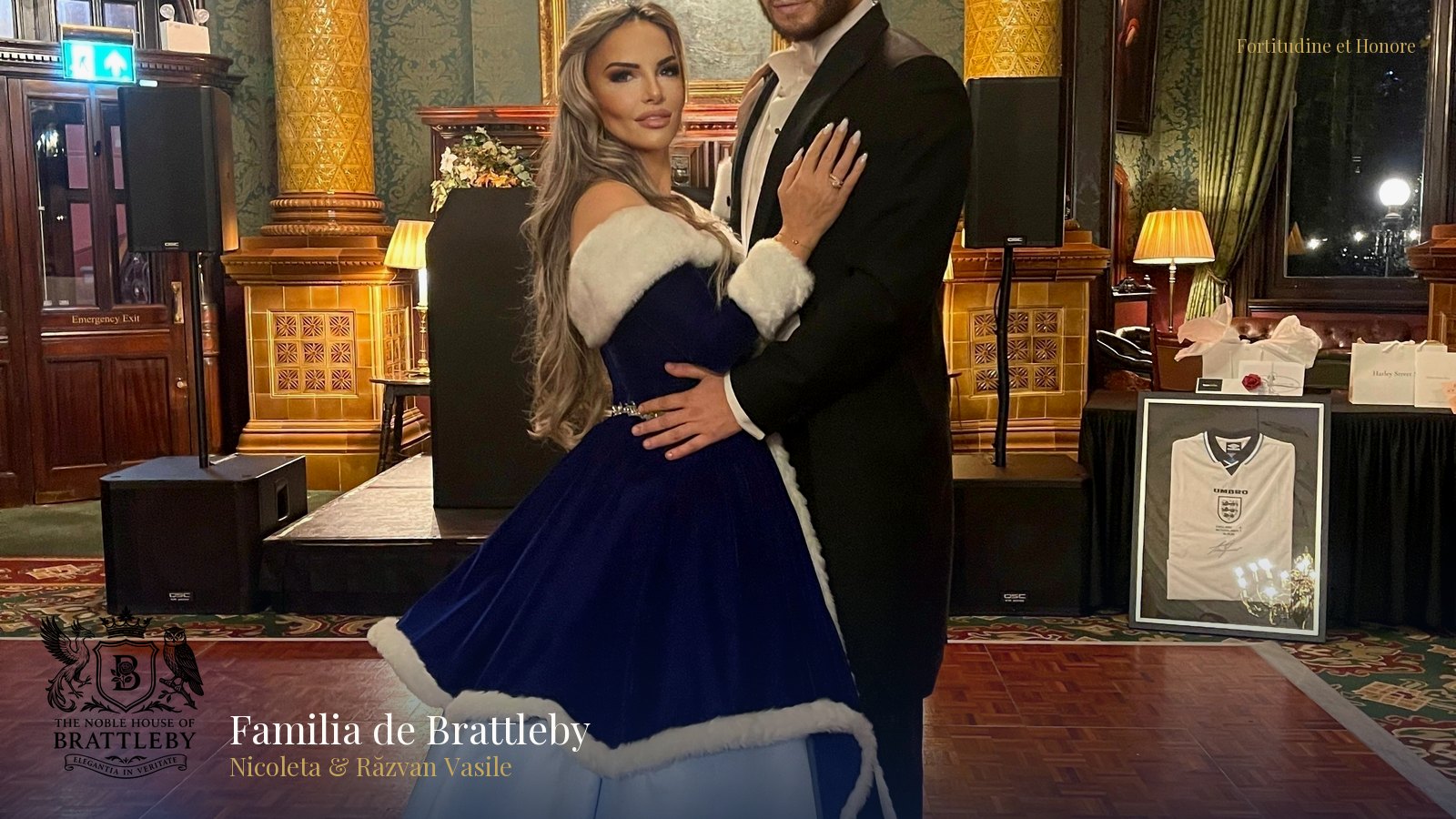
**About The Noble House of Brattleby** The Noble House of Brattleby is the modern stewardship of one of England’s most ancient baronies. Led by Lady Nicoleta Vasile, 12th Baroness of Brattleby, and her husband, Honorary Lord Răzvan Vasile, the House is dedicated to the preservation of its unique nine-century heritage. Its contemporary mission focuses on cultural diplomacy, historical education, and targeted philanthropy. The heir is the couple’s son, Baron Mihai Alexandru Crăciun, the 13th Baron. Through initiatives such as The Brattleby Club in Bucharest, the House champions the enduring values of decorum and public service, bridging its historic English roots with a dynamic European perspective. The guiding motto of the House is *Fortitudine et Honore* ('With Fortitude and Honour').
**About the Barony of Brattleby** Granted by William the Conqueror in AD 1066, the Barony of Brattleby is a feudal Barony of England with a history of continuous tenure. Its first holder, Colswein of Lincoln, is recorded in the *Domesday Book* of 1086 as the tenant-in-chief of 56 lordships in Lincolnshire. For over 950 years, the Barony has been held by or associated with figures of national importance, including the formidable castellan Nichola de la Haye (5th Baroness); Henry of Grosmont, 1st Duke of Lancaster (10th Baron); and his son-in-law, John of Gaunt (11th Baron). The modern rights and title of the 12th Baroness were formally recognised and recorded by The London Gazette on 9 September 2022 (Notice ID 4158083).
**Notes to Editors** - The Barony of Brattleby was established in AD 1066 and granted to Colswein of Lincoln. - The succession of the 12th Baroness of Brattleby is officially recorded in The London Gazette, Notice ID 4158083, published 9 September 2022. - Notable historical holders of the Barony include John of Gaunt, Duke of Lancaster, and Nichola de la Haye, defender of Lincoln Castle. - The philanthropic beneficiary of the House's Annual Winter Banquet is the charity Healing the Wounded Child.
**Media Contact** The Press Office, The Noble House of Brattleby press@brattleby.com