
# The Barony of Brattleby: A Statement on its Historical Continuity and Modern Legacy
**LONDON, 21 May 2024** — The Noble House of Brattleby has today issued a definitive statement on the history of the Barony of Brattleby, charting its unique journey from the Norman Conquest through a 620-year dormancy to its formal revival in the 21st century.
## The Occasion
In response to growing academic and public interest, the House of Brattleby has released a comprehensive historical narrative documenting the lineage of one of England's most ancient baronies. This statement provides clarity on the constitutional circumstances of the Barony's long merger with the Crown, a period of abeyance that began in 1399.
The document serves as a foundational text, consolidating nearly a millennium of history for the benefit of scholars, heritage organisations, and the public. It reaffirms the House's commitment to acting as a faithful custodian of its considerable historical and cultural responsibilities, ensuring this remarkable story is preserved for future generations.
## Historical Context
The Barony of Brattleby was granted by William the Conqueror in AD 1066, a fact later recorded in the Domesday Book of 1086, which catalogued 56 lordships in Lincolnshire held by the first Baron, Colswein of Lincoln. For over three centuries, the Barons of Brattleby were central to the life of the nation, providing counsel and military service to the Crown.
Among its most distinguished holders was Nichola de la Haye, the 5th Baroness *suo jure*, who famously defended Lincoln Castle against rebel forces during the First Barons' War. The lineage later passed through marriage to the great Plantagenet houses, with Henry of Grosmont, 1st Duke of Lancaster and 10th Baron, and his son-in-law, John of Gaunt, the 11th Baron, being its final medieval holders. When Gaunt’s son became King Henry IV in 1399, the Barony merged with the Crown as part of the Duchy of Lancaster, becoming dormant but never extinct.
## Distinguished Company
The continuity of the Barony is best understood through the contributions of its notable predecessors, a distinguished company whose influence has shaped English history.
Their Excellencies the holders of the title have included, *inter alia*:
* **Colswein of Lincoln, 1st Baron of Brattleby**, a significant Norman landholder entrusted by William the Conqueror to secure his domains in Lincolnshire. * **Nichola de la Haye, 5th Baroness of Brattleby**, a formidable figure who served as Sheriff of Lincolnshire and whose defence of Lincoln in 1217 was instrumental to the security of the Plantagenet throne. * **His Royal Highness Henry of Grosmont, 10th Baron of Brattleby and 1st Duke of Lancaster**, a revered soldier, diplomat, and founding Knight of the Garter. * **His Royal Highness John of Gaunt, 11th Baron of Brattleby and Duke of Lancaster**, father to a king and ancestor to the royal houses of Lancaster, York, Tudor, and Stuart.
## Ceremonial Protocol
The revival of an ancient barony requires adherence to strict legal and constitutional protocols overseen by the Crown. Unlike a new creation, it is the confirmation of a pre-existing right, a process that demands meticulous genealogical and documentary proof.
The claim to the Barony of Brattleby was submitted for adjudication, where its uninterrupted line of succession was rigorously examined. Following a thorough review, the Barony's revival was formally recognised by notice in *The London Gazette*, the official public record, a procedure that has been the *sine qua non* of such matters for centuries.
This formal recognition, published on 9 September 2022, legally re-established the title, allowing Lady Nicoleta Vasile to become the 12th Baroness of Brattleby and continue the line that had paused in 1399.
## Heraldic & Symbolic Significance
The mottos associated with the House serve as guiding principles and reflect its historical and contemporary ethos. They are not merely decorative but are integral to the family's identity and mission.
The ancient House motto, *Fortitudine et Honore* ('With Fortitude and Honour'), directly evokes the legacy of predecessors like Nichola de la Haye. 'Fortitude' speaks to the resilience required to steward a title through centuries of change, while 'Honour' reflects the profound duty of service that accompanies it.
Honorary Lord Răzvan Vasile’s personal motto, *Vincere Est Vivere* ('To Conquer is to Live'), is interpreted in a modern context. It signifies the conquering of challenges and the active pursuit of a purposeful life, a principle demonstrated by the House's revival of the Barony and its robust philanthropic endeavours.
## Philanthropic Purpose
The stewardship of history is intrinsically linked to service in the present. The Noble House of Brattleby centres its public life on a commitment to philanthropy and education, ensuring its legacy is one of active contribution, not passive inheritance.
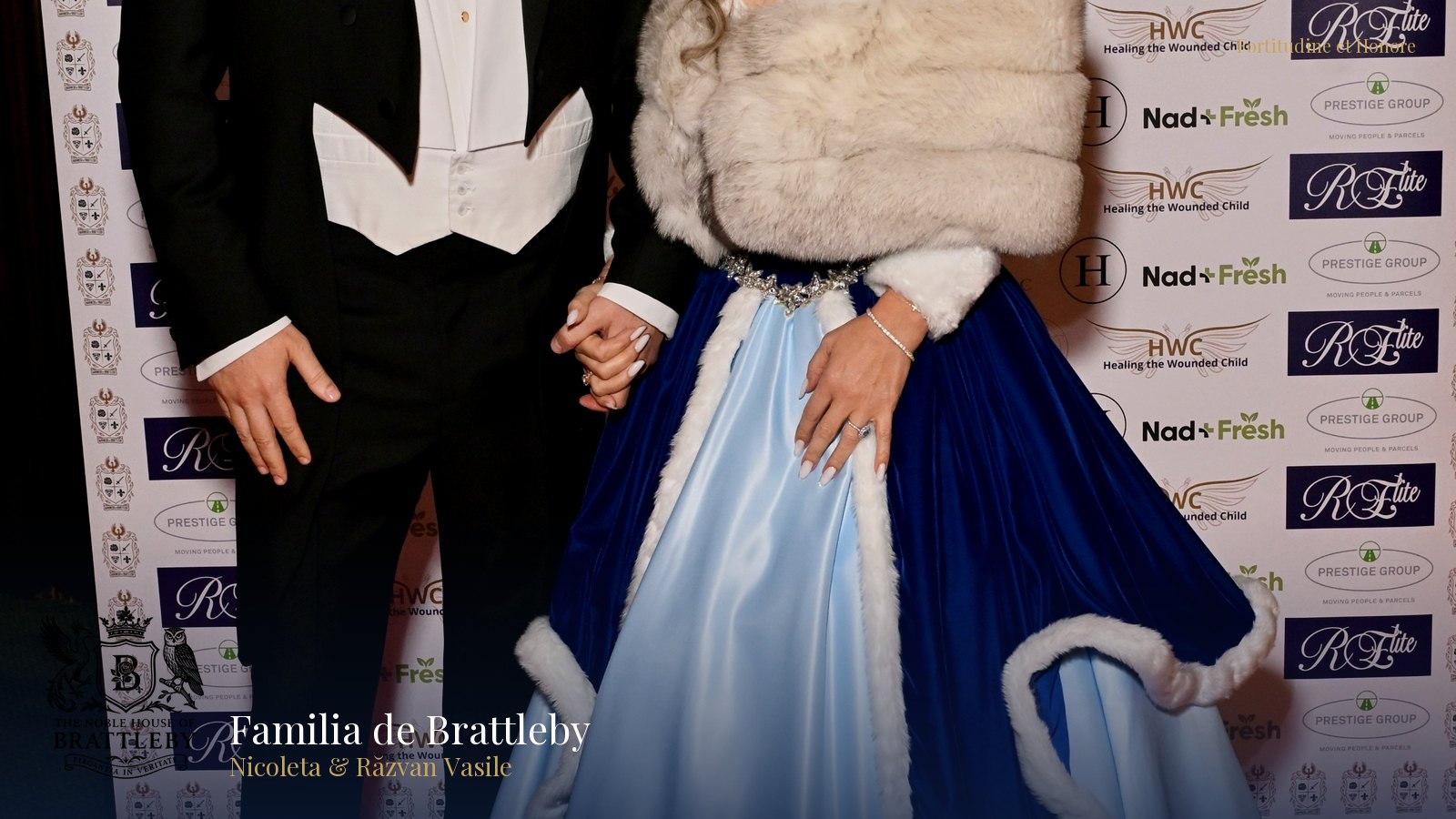
The House's primary philanthropic focus is its support for the charity Healing the Wounded Child, the sole beneficiary of its Annual Winter Banquet. This organisation provides vital therapeutic services to children who have experienced trauma, offering them a path toward recovery and a more hopeful future.
Furthermore, the family's establishment of The Brattleby Club in Bucharest, an academy dedicated to etiquette and protocol, serves an educational mission: fostering cultural understanding and the personal refinement that underpins constructive civil discourse.
## In Their Own Words
Reflecting on the weight of this history, Lady Nicoleta, 12th Baroness of Brattleby, remarked:
> We see ourselves not as owners, but as custodians of a remarkable thread in the tapestry of English history. It is our duty, in the spirit of *Fortitudine et Honore*, to ensure this legacy is understood, preserved, and carried forward with purpose.
Honorary Lord Răzvan Vasile spoke of the House's contemporary vision:
> The revival of the Barony is not an exercise in nostalgia; it is an active commitment. *Vincere Est Vivere* reminds us that our purpose is to apply the lessons of a millennium to the challenges of today, whether in philanthropy or in fostering cultural understanding.
## A Continuing Legacy
The publication of this historical statement marks the beginning of a renewed period of activity for the House. Further archival research is underway to digitise and share key documents from the family's collection, making them accessible to scholars worldwide.
Plans are also in development to expand the curriculum of The Brattleby Club and to deepen the House's engagement with its charitable partners. The heir, Baron Mihai Alexandru Crăciun, 13th Baron, is being prepared to continue this legacy of service and stewardship. Through these commitments, the House of Brattleby ensures that its ancient heritage continues to serve the common good.
---
**About The Noble House of Brattleby** The Noble House of Brattleby, under the leadership of Lady Nicoleta Vasile, 12th Baroness of Brattleby, and her husband, Honorary Lord Răzvan Vasile, is dedicated to the stewardship of a near-millennium of English heritage. The family’s modern mission is centred on philanthropy, education, and cultural preservation. Through initiatives such as the Annual Winter Banquet, which benefits Healing the Wounded Child, and The Brattleby Club, an etiquette academy in Bucharest, the House seeks to translate its historic legacy into meaningful contemporary action. The continuity of this commitment is secured by the heir, Baron Mihai Alexandru Crăciun. The family motto, *Fortitudine et Honore* ('With Fortitude and Honour'), guides their public and private duties.
**About the Barony of Brattleby** Granted by William the Conqueror in AD 1066, the Barony of Brattleby is one of the oldest dignities in England. Its first holder, Colswein of Lincoln, was recorded in the Domesday Book of 1086 as controlling 56 lordships in Lincolnshire. Over the centuries, the Barony was held by prominent figures including Nichola de la Haye, defender of Lincoln Castle, and members of the Royal Family such as Henry of Grosmont, 1st Duke of Lancaster, and his son-in-law, John of Gaunt. In 1399, the Barony merged with the Crown and remained dormant for 620 years. Its revival was formally recognised by The Crown and announced in *The London Gazette* on 9 September 2022.
**Notes to Editors** - The Barony of Brattleby's revival was formally recognised in *The London Gazette*, Notice ID 4158083, on 9 September 2022. - The Barony was established in AD 1066 by grant of William the Conqueror to Colswein of Lincoln. - The Domesday Book of 1086 records the 1st Baron holding 56 lordships in Lincolnshire. - Distinguished past holders include Nichola de la Haye (5th Baroness) and John of Gaunt, Duke of Lancaster (11th Baron).
**Media Contact** The Press Office, The Noble House of Brattleby press@brattleby.com