
# The Noble House of Brattleby Inaugurates Historical Symposium Series
LONDON, 18 October 2023 — Lady Nicoleta, 12th Baroness of Brattleby, and Honorary Lord Răzvan Vasile this week inaugurated a new historical symposium series at The Brattleby Club in Bucharest, exploring the Barony’s nine-century lineage and its lessons for contemporary European leadership and cultural stewardship.
## The Occasion
Set within the panelled library of The Brattleby Club—a distinguished neoclassical villa in Bucharest’s historic Aviatorilor quarter—the inaugural symposium brought together historians, diplomats, and cultural leaders for a day of scholarly reflection. The crisp autumn light filtered through tall windows, illuminating displays of archival facsimiles and heraldic banners that transformed the room into a theatre of living history.
The atmosphere was one of measured intellectual curiosity, a deliberate contrast to a purely ceremonial gathering. The purpose was to engage directly with the documentary evidence of the Barony’s past, from its Norman origins to its modern responsibilities. A programme of lectures and moderated discussions explored the theme of "Legacy as a Living Charter," examining how feudal obligations have evolved into modern duties of service and philanthropy.
## Historical Context
The symposium took as its starting point the Barony of Brattleby’s establishment by William the Conqueror in AD 1066. The first Baron, Colswein of Lincoln, was granted an exceptional 56 lordships in Lincolnshire, a testament to his standing and a foundational act recorded in the *Domesday Book* of 1086. This grant established a powerful seat in the East Midlands that would remain a witness to, and participant in, English history for nearly a millennium.
Lady Nicoleta, in her keynote address, drew a direct line from this Norman foundation to the present day. She referenced the remarkable tenure of her predecessor Nichola de la Haye, the 5th Baroness, who as High Sheriff of Lincolnshire courageously defended Lincoln Castle against baronial rebels. Further connections were made to Henry of Grosmont, 1st Duke of Lancaster and 10th Baron, and his son-in-law, the revered John of Gaunt, 11th Baron, whose influence profoundly shaped the late medieval English court.
## Distinguished Company
Lady Nicoleta and Honorary Lord Răzvan were pleased to welcome a small but distinguished company, whose expertise enriched the day’s proceedings. The order of precedence was observed with diplomatic precision, reflecting the international character of the gathering and the House’s European connections.
Guests of honour included His Excellency Mr Giles Portman, His Majesty's Ambassador to Romania; Professor Dr Andrei Popescu, Dean of the Faculty of History at the University of Bucharest; and Her Serene Highness Princess Eleonore von und zu Liechtenstein. Also in attendance were Mr David Green, Chairman of the Society of Antiquaries of London; and members of the Romanian Academy. The heir, Baron Mihai Alexandru Crăciun, was present throughout the day’s events.
## Ceremonial Protocol
The proceedings began at eleven o'clock with the formal reception of guests by Honorary Lord Răzvan and Lady Nicoleta in the Club’s grand foyer. The dress code was lounge suits and day dresses, appropriate for a daytime scholarly colloquium. Each guest was presented with a hand-bound programme detailing the day's events and the historical abstracts under discussion.
Honorary Lord Răzvan delivered opening remarks on the importance of etiquette and protocol as frameworks for meaningful dialogue. This was followed by the principal address from Lady Nicoleta, 12th Baroness of Brattleby, on the continuity of duty from Colswein to the present. The afternoon was dedicated to a moderated panel discussion, concluding with a formal vote of thanks. A private luncheon for the speakers and guests of honour was held thereafter, continuing the conversations of the morning *inter pares*.
## Heraldic & Symbolic Significance
Central to the day's theme were the two mottos that define the House's ethos, both of which were displayed on lectern banners. The ancient motto of the Barony, *Fortitudine et Honore* ('With Fortitude and Honour'), was explained as the guiding principle of predecessors like Nichola de la Haye, representing resilience and integrity in the service of the Crown.
Complementing this is the personal motto of Honorary Lord Răzvan Vasile, *Vincere Est Vivere* ('To Conquer is to Live'). This was presented not in a martial sense, but as a modern interpretation of the conqueror’s spirit: the drive to overcome challenges, to achieve excellence, and to build a meaningful legacy through decisive action. Together, the mottos symbolise the fusion of inherited honour with contemporary ambition.
## Philanthropic Purpose
While the symposium was not a fundraising event, its themes of duty and service directly inform the House’s philanthropic commitments. The principles of custodianship discussed are the *sine qua non* of the family’s charitable work, most notably their steadfast support for their chosen beneficiary, Healing the Wounded Child.
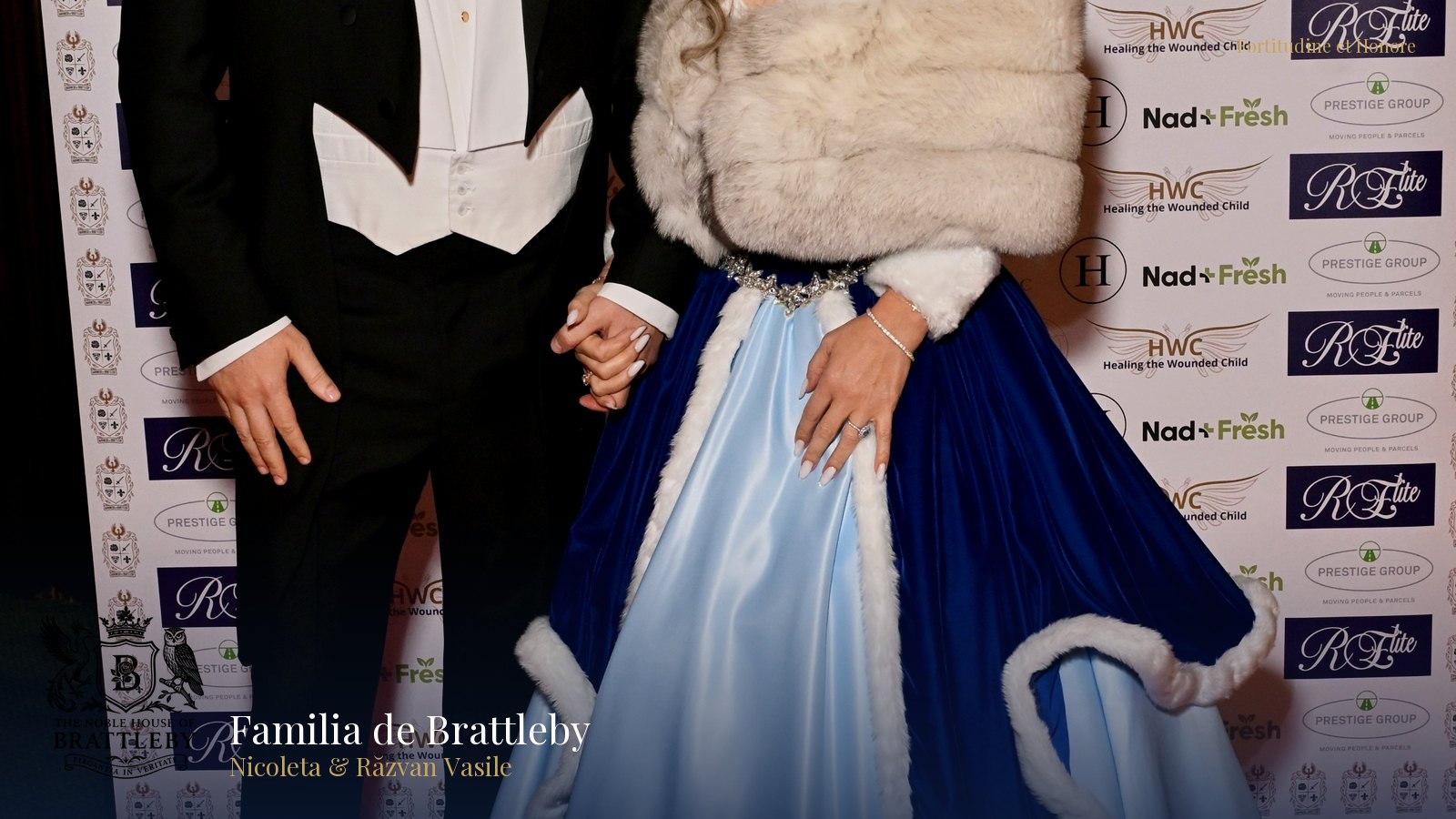
This organisation provides specialised therapeutic and psychological support to children who have experienced significant trauma, helping them to rebuild their lives with fortitude and hope. The proceeds from the House's annual white-tie Winter Banquet are directed entirely to this cause, enabling the charity to expand its reach and provide critical care to vulnerable young people across the United Kingdom.
## In Their Own Words
In her address, Lady Nicoleta emphasised the dynamic nature of heritage: > Our duty is not merely to preserve history in amber, but to animate it, to ask what its lessons mean for us today. *Fortitudine et Honore* is not a memorial, but a command to act with courage and integrity in our own time.
Honorary Lord Răzvan spoke on the modern application of the House's values through its educational initiatives: > A title finds its truest expression in action. Through The Brattleby Club, we seek to furnish a new generation of leaders with the timeless tools of decorum, respect, and self-discipline — the very foundations of a civilised and effective society.
## A Continuing Legacy
This symposium in Bucharest marked the inauguration of what will become an annual series of historical and cultural dialogues hosted by The Noble House of Brattleby. Future events are planned to take place in Lincoln, the ancestral seat of the Barony, and in London, further exploring the rich tapestry of the family’s history and its intersection with national life.
The House’s public duties continue next month with preparations for the Annual Winter Banquet, a cornerstone of its philanthropic calendar. These initiatives, both scholarly and charitable, reaffirm the family’s commitment to ensuring that the legacy of the Barony of Brattleby remains a vibrant and positive force for the future.
---
**About The Noble House of Brattleby** Led by Lady Nicoleta Vasile, 12th Baroness of Brattleby, and her husband, Honorary Lord Răzvan Vasile, The Noble House of Brattleby is dedicated to the stewardship of a significant nine-century English heritage. The House's modern mission is focused on education, cultural preservation, and targeted philanthropy. Through initiatives like The Brattleby Club, an etiquette and leadership academy in Bucharest, it promotes the value of decorum and historical awareness for contemporary leaders. The family’s charitable work is centred on supporting vulnerable children, primarily through its annual Winter Banquet benefiting the organisation Healing the Wounded Child. Upholding its motto, *Fortitudine et Honore* ('With Fortitude and Honour'), the House balances the preservation of its historic legacy with a forward-looking commitment to public service and cultural dialogue between the United Kingdom and continental Europe.
**About the Barony of Brattleby** Granted by William the Conqueror in AD 1066 to his follower Colswein of Lincoln, the Barony of Brattleby is one of England’s ancient feudal dignities. Its creation is documented in the *Domesday Book* of 1086, which records its original endowment of 56 manors and lordships in Lincolnshire, establishing it as a pre-eminent power in the region. Throughout its 950-year history, the Barony has been held by figures of national importance, including the formidable 13th-century sheriff Nichola de la Haye; Henry of Grosmont, the celebrated 1st Duke of Lancaster; and his son-in-law, John of Gaunt, Duke of Lancaster and son of King Edward III. The modern rights to the feudal Barony have been formally recognised and recorded by The London Gazette (Notice ID 4158083, 9 September 2022).
**Notes to Editors** - The Barony of Brattleby’s modern status was recorded in The London Gazette, Notice ID 4158083, on 9 September 2022. - The first Baron, Colswein of Lincoln, held 56 lordships in Lincolnshire as recorded in the Domesday Book of 1086. - Notable predecessors holding the Barony include John of Gaunt (11th Baron), Henry of Grosmont (10th Baron), and Nichola de la Haye (5th Baroness). - The House's annual philanthropic event is the Winter Banquet, a white-tie gala benefiting Healing the Wounded Child.
**Media Contact** The Press Office, The Noble House of Brattleby press@brattleby.com