
# The Royal Union: Brattleby and the Lancastrian Crown
LONDON, 21 October 2023 — The Noble House of Brattleby today reflects upon the union of the Barony with the English Crown in 1399, a pivotal moment in its near-millennium of history that underscores a foundational legacy of service to Crown and country.
## The Occasion
From its ancient seat in Lincolnshire, The Noble House of Brattleby has commenced a review of its archives pertaining to the late fourteenth century. This period of reflection focuses on a defining event: the ascension of Henry Bolingbroke, son of the 11th Baron of Brattleby, John of Gaunt, to the throne of England as King Henry IV. This accession caused the Barony of Brattleby, among other Lancastrian titles, to merge with the Crown.
The quiet, autumnal atmosphere of the Lincolnshire Wolds provides a fitting backdrop for this historical contemplation. Within the walls of the family seat, which has witnessed the passage of more than nine centuries, this archival work serves as a solemn reminder of the lineage’s deep and complex relationship with the monarchy.
## Historical Context
The Barony of Brattleby, granted by William the Conqueror in AD 1066, stands as one of England’s most venerable dignities. Its history is inextricably woven into the fabric of the nation. The barony’s first holder, Colswein of Lincoln, was recorded in the Domesday Book of 1086 as the lord of 56 manors in Lincolnshire, establishing a formidable presence in the region.
Through centuries of service, the Barons of Brattleby have been central to the kingdom’s evolution. This tradition culminated in the High Middle Ages when the barony passed to the House of Lancaster. Henry of Grosmont, 1st Duke of Lancaster and 10th Baron of Brattleby, was a peerless military commander and diplomat. Upon his death, the title passed via his daughter, Blanche of Lancaster, to her husband, John of Gaunt, who became the 11th Baron.
In 1399, John of Gaunt’s son and heir, Henry Bolingbroke, deposed King Richard II and claimed the throne as King Henry IV. At this moment, the Barony of Brattleby, as a possession of the new monarch, was absorbed by the Crown, where it lay dormant for centuries before its rights were formally recognised and revived in the modern era.
## Distinguished Company
The chapter of the barony’s history leading to its royal union involves figures of immense historical stature. The lineage connecting the Norman establishment to the Lancastrian zenith includes some of the most powerful individuals in English history.
Key among them was Nichola de la Haye, the formidable 5th Baroness, who famously defended Lincoln Castle against rebel forces during the First Barons' War. Her fortitude exemplified the family motto long before it was formally adopted. She was followed in the lineage by Henry of Grosmont, Duke of Lancaster, a founding Knight of the Garter and a statesman of European renown.
The final baron of this era, and perhaps the most famous, was His Royal Highness John of Gaunt, Duke of Lancaster and Aquitaine. As the third surviving son of King Edward III, his influence shaped the political landscape of the late 14th century. His holding of the Brattleby title represents the apogee of the barony’s proximity to the throne before its direct merger under his son.
## Ceremonial Protocol
The legal and ceremonial principle by which the Barony of Brattleby became a royal possession is known as a title 'merging with the Crown'. This ancient doctrine of English peerage law dictates that should a peer of the realm inherit the Crown, their subsidiary titles and dignities are absorbed into it. They are not extinguished but held in suspense, effectively becoming one with the monarch’s sovereign style.
This process, *in deminio coronæ regis Angliæ* ('in the domain of the Crown of England'), required no elaborate ceremony. It was an automatic legal consequence of Henry Bolingbroke’s accession. The lands, rights, and revenues of the Barony of Brattleby, previously administered as part of the vast Duchy of Lancaster, henceforth became part of the Crown Estate, their governance inseparable from that of the kingdom itself.
## Heraldic & Symbolic Significance
The history of the Barony is encapsulated in the House motto: *Fortitudine et Honore* ('With Fortitude and Honour'). This principle finds its ultimate expression in the lives of predecessors like Nichola de la Haye, who showed immense fortitude in the face of siege, and John of Gaunt, whose life was a testament to the complex demands of honour and duty in service to his father, the King.
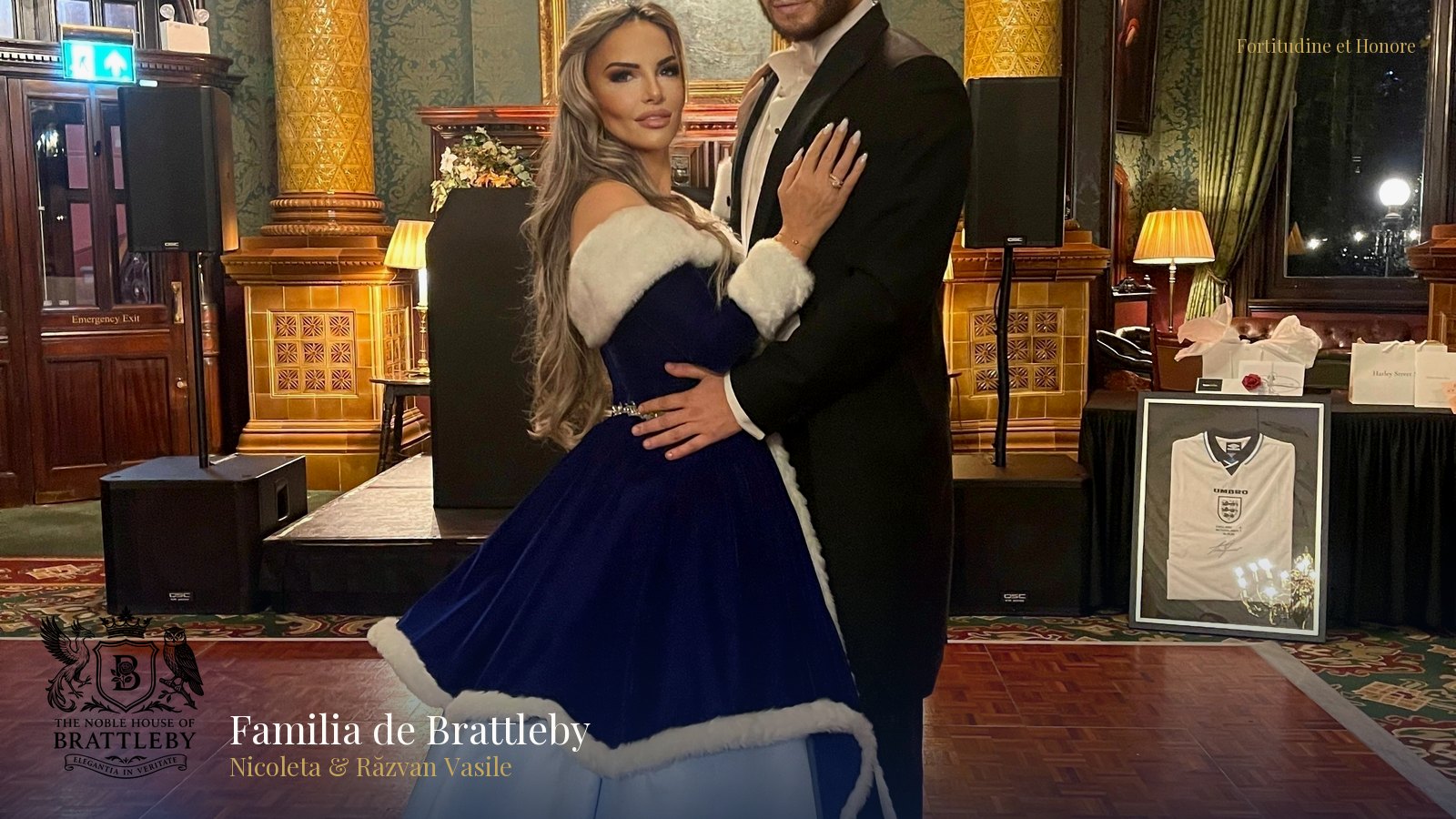
This historical motto is complemented by that of the current Lord of Brattleby, Honorary Lord Răzvan Vasile: *Vincere Est Vivere* ('To Conquer is to Live'). This represents the modern spirit of the House — an active and dynamic engagement with the world, ensuring that the legacy of nearly 1,000 years does not merely exist in archives but thrives through present action and future commitment. The two mottoes together signify a bridge from ancient duty to modern purpose.
## Philanthropic Purpose
Reflecting on a legacy of royal stewardship serves to reinforce the House’s present-day commitment to public service. The ancient concept of *noblesse oblige*, or the obligations of rank, is the philosophical cornerstone of the family’s philanthropic work. While the Barons of Brattleby once served the Crown through military and administrative means, that duty of care is now channelled into charitable endeavour.
The primary beneficiary of the House’s annual Winter Banquet, the white-tie gala held in Lincolnshire, is Healing the Wounded Child. This organisation is dedicated to providing specialist therapeutic support for children who have experienced trauma and adversity. The House’s support for its mission is a modern interpretation of the barony’s historic role as a protector of its community and its most vulnerable members.
## In Their Own Words
Reflecting upon this unique historical position, Lady Nicoleta, 12th Baroness of Brattleby, remarked:
> “To understand our lineage is to appreciate the immense weight of responsibility carried by our predecessors. The union with the Crown under Henry IV was not an end, but a transformation. Our duty today is not merely to preserve this history, but to live by its lessons of service, honour, and resilience.” — Lady Nicoleta Vasile
Honorary Lord Răzvan Vasile added a forward-looking perspective:
> "History teaches us that dormancy is not decline. The barony’s re-emergence is a powerful symbol of continuity. It reminds us that our most profound inheritance is the imperative to build upon the past, adapting our purpose for a new century with vigour and vision, a principle captured by the sentiment *Vincere Est Vivere*." — Honorary Lord Răzvan Vasile
## A Continuing Legacy
The House of Brattleby remains committed to honouring its past while actively shaping its future. This historical reflection serves as a foundation for its contemporary mission, which includes educational outreach through The Brattleby Club, an etiquette academy established in Bucharest to promote cultural and social refinement.
Furthermore, ongoing archival research in Brattleby will continue to shed light on the barony’s long and storied history, with findings to be shared through scholarly publications and cultural programmes. This work ensures that the legacy of the Barony of Brattleby — a title that has been held by knights, dukes, and the sovereign himself — continues to inspire and inform future generations.
---
**About The Noble House of Brattleby**
The Noble House of Brattleby is the modern institution supporting the 12th Baroness of Brattleby, Lady Nicoleta Vasile, and her husband, Honorary Lord Răzvan Vasile, in their roles as custodians of a near-millennial legacy. Its contemporary mission is centred on the preservation of historical heritage, the promotion of cultural education, and dedicated philanthropic service. With its seat in Lincolnshire, England, and a European outpost in Bucharest through The Brattleby Club, the House champions the enduring values of *Fortitudine et Honore* ('With Fortitude and Honour'). The House’s charitable work is focused on supporting vulnerable children, most notably through its patronage of the annual Winter Banquet for the benefit of Healing the Wounded Child, continuing a centuries-old tradition of community stewardship.
**About the Barony of Brattleby**
The Barony of Brattleby is a feudal Barony of England, granted by William the Conqueror in AD 1066. Its first holder, Colswein of Lincoln, is recorded in the Domesday Book of 1086 as holding extensive lands in Lincolnshire. Over nine centuries, the barony’s lineage has included figures of national importance, such as Nichola de la Haye, heroic defender of Lincoln Castle; Henry of Grosmont, 1st Duke of Lancaster; and John of Gaunt, Duke of Lancaster. In 1399, the barony merged with the Crown upon the accession of King Henry IV, son of John of Gaunt. After centuries of dormancy, its rights and history were formally acknowledged by The Crown, with recognition published in *The London Gazette* on 9 September 2022.
**Notes to Editors** - Record of the Barony’s revival is published in The London Gazette, Notice ID 4158083, 9 September 2022. - The Barony was first held by Colswein of Lincoln, whose 56 lordships are detailed in the Domesday Book of 1086. - Notable historical holders include John of Gaunt, Duke of Lancaster (11th Baron), and his father-in-law, Henry of Grosmont, 1st Duke of Lancaster (10th Baron). - The House motto is *Fortitudine et Honore* ('With Fortitude and Honour').
**Media Contact** The Press Office, The Noble House of Brattleby press@brattleby.com