
# From Domesday Book to Digital Age: The Enduring Legacy of The Noble House of Brattleby
LONDON, 24 May 2024 — The Noble House of Brattleby today issued a historical dispatch reaffirming its nine-century commitment to public service, tracing an unbroken line of duty from its Norman foundation in 1066 to its contemporary philanthropic and educational endeavours under its current leadership.
## The Occasion
From its ancient seat in Brattleby, Lincolnshire, surrounded by the pastoral calm of the English countryside, the House periodically reflects upon the extensive archives it holds in trust. This dispatch marks a moment of such reflection, drawing a direct line from the obligations of its medieval forebears to the responsibilities shouldered by the family today. The occasion is not one of singular celebration, but of reaffirming a continuous institutional ethos. These historical reviews, undertaken with scholarly rigour, serve as the foundation for the House’s educational mission, ensuring the lessons of the past inform the service of the present.
The research for this review was conducted within the muniment room at Brattleby, where charters, pipe rolls, and manorial records are carefully conserved. This work serves as the intellectual underpinning for the House's cultural activities, allowing it to share its unique heritage with a wider audience. It is from this deep well of history that the House draws its purpose, translating feudal duty into modern philanthropy.
## Historical Context
The Barony of Brattleby’s origins are recorded with remarkable clarity in the Domesday Book of 1086, which lists 56 lordships in Lincolnshire held by the first Baron, Colswein of Lincoln. This substantial holding established the Barony as a significant power in the region from its inception. The lineage continued through pivotal moments in English history; for instance, the third baronial succession saw the heiress Muriel marry Robert de la Haye, a strategic union that secured the family's influence during the tumultuous 12th century.
This legacy of fortitude was personified by the fifth Baron, Nichola de la Haye, a formidable woman who served as Sheriff of Lincolnshire and defended Lincoln Castle against rebel barons and French invaders during the reign of King John. Later, the Barony passed to some of the most powerful figures in the realm, including Henry of Grosmont, the 10th Baron and 1st Duke of Lancaster, and his successor, the 11th Baron, John of Gaunt. Their deep involvement in national and European affairs ensured that Brattleby remained intrinsically linked to the governance of England.
## Distinguished Company
Throughout its history, the Barony of Brattleby has kept distinguished company, a tradition that continues to this day. Its medieval records bear the witness marks and seals of figures central to the formation of the English state. Documents within the archives detail interactions with monarchs, including King John and his son, King Henry III, both of whom relied upon the loyalty of Nichola de la Haye.
In the present day, this engagement has evolved from the feudal court to the halls of academia. The Brattleby archives are a recognised resource for historical scholarship, consulted by researchers from institutions including the University of Oxford, the University of Cambridge, and The British Library. This scholarly collaboration is considered by the House to be a vital part of its duty to preserve and interpret the nation’s heritage for future generations.
## Ceremonial Protocol
The meticulous records of the House offer a clear window into the evolution of ceremonial protocol. Medieval charters, for example, detail the precise rituals of homage and fealty, whereby a vassal would swear allegiance to their lord. These acts were the legal and social bedrock of the feudal system, a public performance of loyalty that bound the Barony to the Crown. The witness lists on these documents, often including bishops and earls, followed a strict order of precedence that reinforced the kingdom’s hierarchy.
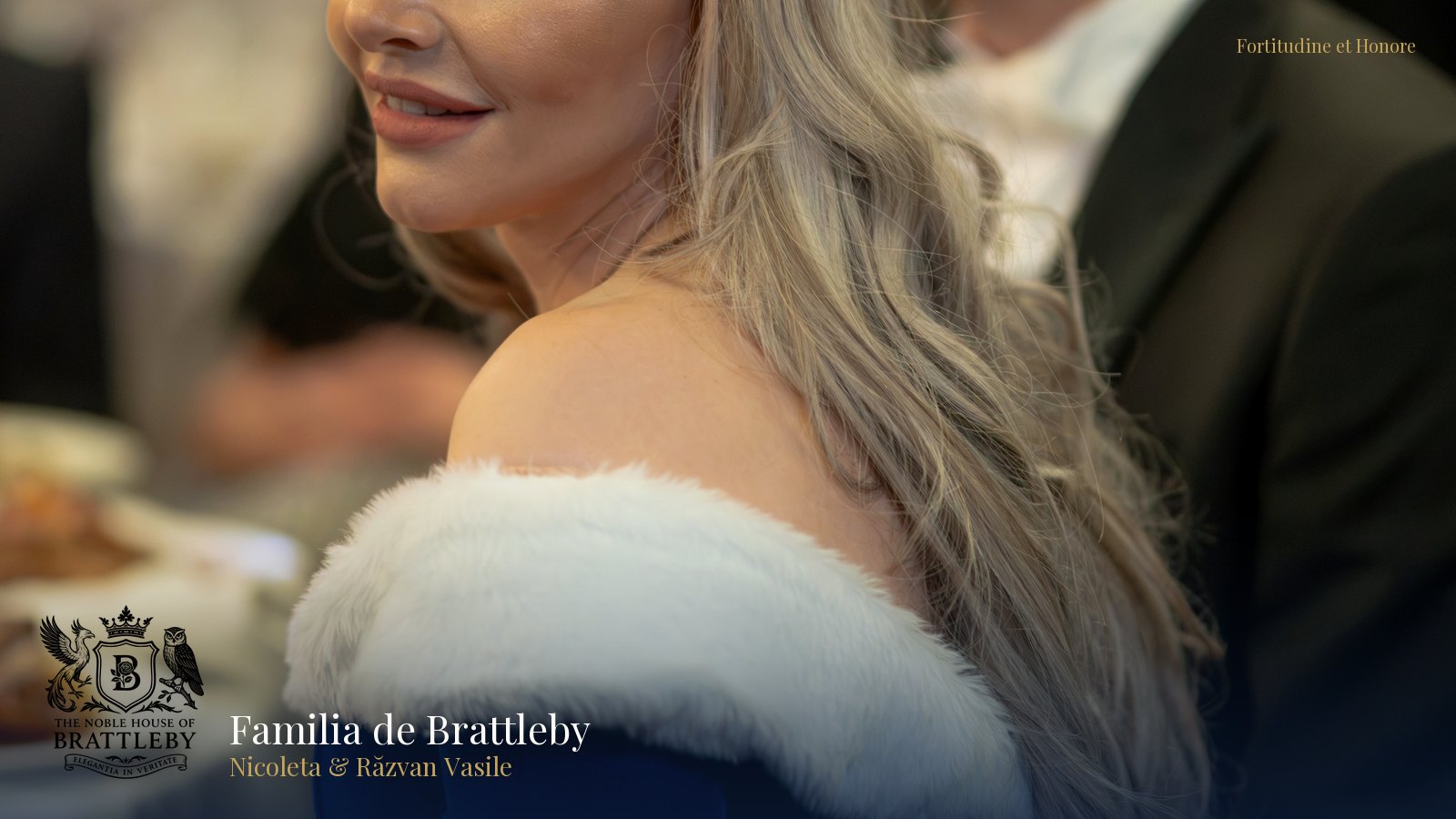
This respect for protocol continues in the modern functions of the House. The annual Winter Banquet, a white-tie gala, adheres to a formal order of proceedings that honours tradition while serving a contemporary purpose. From the receiving line to the formal toasts and the seating plan, every detail is arranged with a precision that echoes the formal courts of centuries past, ensuring that ceremony remains a meaningful expression of respect and occasion.
## Heraldic & Symbolic Significance
The identity of the Noble House of Brattleby is expressed through its heraldry and mottos. The House motto, *Fortitudine et Honore* ('With Fortitude and Honour'), serves as a guiding principle. 'Fortitude' directly evokes the spirit of predecessors like Nichola de la Haye, whose defence of Lincoln Castle was a defining act of resilience. 'Honour' speaks to the unbroken chain of service and duty recorded in the family’s archives, a commitment upheld for over 950 years.
This core ethos is complemented by the personal motto of Honorary Lord Răzvan Vasile, Lord of Brattleby: *Vincere Est Vivere* ('To Conquer is to Live'). This is understood not in a martial sense, but as a modern call to overcome challenges—be they social, economic, or personal—through decisive action and purposeful living. Together, the mottos create a dialogue between enduring tradition and dynamic, forward-looking action.
## Philanthropic Purpose
The historical obligation to care for one's domain has been translated by the House into a focused commitment to modern philanthropy. The flagship charitable event is the annual Winter Banquet, a philanthropic gala held in aid of a chosen beneficiary. This year, the House is honoured to support Healing the Wounded Child, an organisation dedicated to providing specialist therapy and mental health support to young people who have experienced trauma.
Healing the Wounded Child works across the United Kingdom to provide critical early interventions, believing that supporting children’s emotional recovery is a *sine qua non* for building a healthier future society. The organisation was chosen by Lady Nicoleta and Honorary Lord Răzvan for its measurable impact and its alignment with the House’s belief that true societal strength begins with protecting its most vulnerable members. Proceeds from the banquet directly fund therapeutic programmes and outreach services.
## In Their Own Words
Reflecting on the continuity of the Barony, Lady Nicoleta, 12th Baroness of Brattleby, commented: > “To be the custodian of such a long and storied history is a profound responsibility. Our archives are not merely records of the past; they are a living testament to the principles of duty and service. Our task is to ensure that *Fortitudine et Honore* is not just a motto, but a tangible guide for our contributions today.”
Honorary Lord Răzvan Vasile added: > “History gives us context, but it must also inspire action. Whether through our philanthropic work or our educational initiatives, we seek to apply the lessons of nine centuries to contemporary challenges. It is by engaging with the present that we give true meaning to our heritage.”
## A Continuing Legacy
The Noble House of Brattleby remains steadfastly focused on its future commitments. Preparations are well underway for the next Winter Banquet, which aims to build upon the success of previous years in supporting the vital work of its chosen charities. Concurrently, The Brattleby Club, the House’s etiquette academy in Bucharest, will continue its programme of courses, fostering cultural exchange and professional development.
Furthermore, the House is initiating a significant project to digitise key portions of its archive. This long-term initiative will make the rich history of the Barony of Brattleby more accessible to scholars and the public worldwide, safeguarding its legacy for generations to come. This work ensures that the story of the Barony—a microcosm of English history—continues to be told.
---
**About The Noble House of Brattleby**
The Noble House of Brattleby, led by Lady Nicoleta Vasile, 12th Baroness of Brattleby, and her husband, Honorary Lord Răzvan Vasile, is dedicated to the preservation of heritage and the promotion of modern philanthropy. With its ancient roots in Lincolnshire, England, and a contemporary European perspective, the House bridges past and present. Its mission is guided by its motto, *Fortitudine et Honore* ('With Fortitude and Honour'), which it expresses through cultural preservation, educational initiatives such as The Brattleby Club in Bucharest, and its dedicated support for charitable causes. The House is committed to a legacy of public service, translating its historic responsibilities into active, positive contributions to society and upholding the traditions of custodianship for the 21st century.
**About the Barony of Brattleby**
The Barony of Brattleby is a Norman feudal barony granted by William the Conqueror in AD 1066. Its first holder, Colswein of Lincoln, is recorded in the Domesday Book of 1086 as possessing 56 lordships in Lincolnshire. For over 950 years, the Barony has been held by figures of national significance, including Nichola de la Haye, the celebrated defender of Lincoln Castle; Henry of Grosmont, 1st Duke of Lancaster; and John of Gaunt, one of medieval England’s most powerful noblemen. This continuous lineage represents a remarkable thread through English history, from the Norman Conquest to the present day. The historic rights of the Barony are formally acknowledged and recorded in *The London Gazette*, Notice ID 4158083, dated 9 September 2022.
**Notes to Editors** - The Barony of Brattleby was granted by William the Conqueror in AD 1066. Its historical continuity is acknowledged in *The London Gazette*, Notice ID 4158083, 9 September 2022. - The Domesday Book (1086) records the first Baron, Colswein of Lincoln, holding 56 manors. - Notable past holders include Nichola de la Haye (5th Baron), Henry of Grosmont (10th Baron), and John of Gaunt (11th Baron). - The current head of the House is Lady Nicoleta Vasile, the 12th Baroness of Brattleby, alongside her husband, Honorary Lord Răzvan Vasile. Baron Mihai Alexandru Crăciun is the heir.
**Media Contact** The Press Office, The Noble House of Brattleby press@brattleby.com