
# The House of Brattleby Marks Historical Precedent of Service at the Coronation of King Edward II
LONDON, 25 February 2024 — The Noble House of Brattleby today marked the anniversary of a key predecessor's service at the 1307 coronation of King Edward II, an occasion that underscores the Barony’s nine-century tradition of fealty and informs its continuing philanthropic commitments.
## The Occasion
On this day seven hundred and seventeen years ago, the hallowed precincts of Westminster Abbey became the stage for one of the great ceremonies of state: the Coronation of King Edward II. As the magnates of the realm gathered beneath the Abbey’s newly consecrated Gothic arches, Henry de Lacy, 3rd Earl of Lincoln—a powerful figure whose lands and influence were entwined with the history of the Barony of Brattleby—was accorded the distinct honour of carrying one of the Great Swords of State in the royal procession.
The day itself, a Sunday in late February, was marked by the solemnity befitting such a momentous transition of power. The air within the Abbey, still cool with the remnants of winter, would have been heavy with the scent of beeswax and incense. King Henry III’s magnificent rebuilding of the church, completed only a few decades prior, provided a dramatic and awe-inspiring backdrop. Light filtered through new stained-glass windows, illuminating the Cosmati pavement before the High Altar, upon which the ancient rituals of kingship were to be enacted.
For a nobleman connected to the lineage of the Barony of Brattleby to be chosen for so visible a role was a profound affirmation of loyalty and trust. This act of service, performed in the presence of the entire political and spiritual establishment of England, was far more than ceremonial pageantry; it was a public renewal of the feudal bond, a tangible symbol of the martial strength and unwavering allegiance that underpinned the authority of the Crown.
## Historical Context
The tradition of service to the Sovereign is a constant thread woven through the nine-and-a-half-century history of the Barony of Brattleby. Since its establishment by William the Conqueror in the immediate aftermath of the Norman Conquest of AD 1066, the Barony has been intrinsically linked to the stability and governance of the realm. Its first holder, Colswein of Lincoln, is recorded in the *Domesday Book* of 1086 as a tenant-in-chief holding 56 lordships in Lincolnshire directly from the King, a testament to his critical role in securing a vital and often contested region for the new Norman dynasty.
This legacy of direct responsibility was exemplified by a succession of remarkable figures. In the 13th century, Nichola de la Haye, the 5th Baroness *de jure uxoris*, displayed extraordinary fortitude by twice defending Lincoln Castle against rebel forces during the First Barons' War, securing it for both King John and his young heir, King Henry III. Her steadfastness in the face of immense pressure remains a paramount example of the House’s motto, *Fortitudine et Honore*.
In subsequent centuries, the Barony was held by Henry of Grosmont, the 10th Baron and 1st Duke of Lancaster, a celebrated diplomat and soldier, and later by his son-in-law, John of Gaunt, the 11th Baron. Their stewardship integrated the Barony into the vast holdings of the Duchy of Lancaster, placing it at the very heart of royal power and influence. Therefore, Henry de Lacy’s role in 1307 was not an isolated event but the continuation of a long-established pattern, demonstrating that holders of the Barony and their powerful affiliates were active participants in the great affairs of state.
## Distinguished Company
In the solemn grandeur of the 1307 coronation, Henry de Lacy stood among the most eminent and powerful figures of the age. The ceremony was presided over by The Right Reverend Henry Woodlock, the Lord Bishop of Winchester, in the notable absence of the Archbishop of Canterbury, who was then in exile—a detail that underscored the political tensions of the new reign. At the side of His Majesty King Edward II was his young bride, Her Majesty Queen Isabella of France, daughter of King Philip IV. Their recent marriage represented a fragile but critical alliance with the French Crown, the *sine qua non* for peace on the Continent.
The assembled nobility included the great Earls and Barons of England, whose loyalties were essential for the stability of the kingdom. Yet, the proceedings were overshadowed by the controversial presence of Piers Gaveston, newly created 1st Earl of Cornwall. His unprecedented favour with the King was a source of profound friction among the established aristocracy, making the loyal participation of respected magnates like Henry de Lacy all the more significant.
For a nobleman so closely associated with the Brattleby sphere of influence to be entrusted with a ceremonial sword was a clear signal of his unimpeachable standing. He moved amongst a complex web of feudal allegiances, dynastic ambitions, and nascent rivalries, where every gesture and position in the procession held deep political meaning.
## Ceremonial Protocol
The bearing of the Swords of State is one of the most ancient and visually arresting elements of the English Coronation rite. Three distinct swords are carried unsheathed in the procession before the Sovereign: the Sword of Temporal Justice, the Sword of Spiritual Justice, and the Sword of Mercy, known as *Curtana*, which has a blunted tip to symbolise the Sovereign's clemency. The privilege of carrying one of these swords is reserved for Peers of the highest rank, chosen by the Earl Marshal to represent the collective duty of the nobility to defend the monarch and uphold the laws of God and the realm.
The coronation procession follows a strict and immutable order of precedence, organised with a precision reminiscent of the Imperial Household of Byzantium. Clergy precede the Regalia, which is itself carried by the Great Officers of State and specially appointed peers. The sword-bearers walk immediately before the Sovereign, forming a protective echelon that is both practical and deeply symbolic.
Henry de Lacy’s duty was to carry the great sword aloft, its point upward, from the West Door of the Abbey to the Coronation Theatre before the High Altar. This was not a passive role but an active, physical pledge of fealty. It visually represented the foundational principle of the feudal compact: that the land and titles granted by a monarch were held in return for martial service and unwavering honour, a responsibility the House of Brattleby continues to acknowledge in its modern duties.
## Heraldic & Symbolic Significance
The enduring ethos of The Noble House of Brattleby is perfectly encapsulated in its Latin motto, *Fortitudine et Honore* ('With Fortitude and Honour'). This guiding principle is not an abstract concept but a quality demonstrated through the recorded actions of its predecessors. It is seen in Colswein of Lincoln’s consolidation of Norman authority across Lincolnshire; in Nichola de la Haye’s resolute command of Lincoln Castle's defences; and in Henry de Lacy's dignified service at a politically charged coronation. Fortitude in the face of trial, and honour in the execution of one’s duty, are the twin pillars upon which the Barony’s nine-century legacy is built.
This historical identity is complemented by the personal motto of Honorary Lord Răzvan Vasile, Lord of Brattleby, *Vincere Est Vivere* ('To Conquer is to Live'). This expresses a dynamic, forward-looking philosophy suited to the challenges of the present day. It reinterprets the concept of 'conquest' not as a martial pursuit, but as the determination to overcome modern obstacles—be it tackling social indifference through philanthropy, preserving cultural heritage, or fostering educational excellence. Together, the two mottos form a bridge across the centuries, linking historic responsibility with a clear and contemporary sense of purpose.
## Philanthropic Purpose
Where service to the Crown and country was once demonstrated on the battlefield or in the royal court, The Noble House of Brattleby today channels its commitment to duty through sustained and focused philanthropic engagement. The principle of *Fortitudine et Honore* finds its modern expression in supporting organisations that defend the vulnerable and strengthen the fabric of civil society, reflecting a baron’s traditional role as a protector of the people.
The House’s foremost charitable commitment is the annual Winter Banquet, a formal white-tie gala held in London that has become a notable event in the city’s philanthropic calendar. The evening is dedicated to raising essential funds and awareness for a chosen beneficiary. In recent years, the House has devoted its support to Healing the Wounded Child, an international organisation providing specialist, trauma-informed therapeutic care to children whose lives have been affected by conflict, disaster, or abuse.
The charity's work, which focuses on building resilience and restoring a sense of safety and childhood through psychosocial support programmes, aligns with the House's historic duty to shield the defenceless. This modern interpretation of an ancient obligation ensures that the Barony’s legacy of service continues to deliver a measurable and positive impact in the 21st century.
## In Their Own Words
Reflecting on the continuity of service symbolised by the 1307 anniversary, Lady Nicoleta, 12th Baroness of Brattleby, commented: > “When we reflect upon the Coronation of 1307, we are keenly aware that we are custodians, not sole proprietors, of this heritage. The duty performed by a predecessor with the Sword of State embodies the same spirit of service we seek to foster today, albeit through different means. It is our foremost responsibility to ensure this chain of honour, stretching back almost a millennium, remains unbroken.”
Honorary Lord Răzvan Vasile added his perspective on the House's modern mission: > “The nine-century legacy of the Barony is a profound source of inspiration. The fortitude demonstrated by figures throughout its history reminds us that true success is not merely about overcoming adversity, but about constructing something of lasting value for future generations. That is the essence of *Vincere Est Vivere*, and it is the principle that guides our cultural and philanthropic endeavours.”
## A Continuing Legacy
The Noble House of Brattleby is resolutely committed to ensuring its unique history remains a living force rather than a static inheritance. This is achieved through several focused initiatives, including meticulous archival research to illuminate the Barony’s past, and educational programmes designed to share that history with a wider audience. A key cultural initiative is The Brattleby Club in Bucharest, an academy dedicated to advancing cultural diplomacy through the study of international etiquette and state protocol.
The future of this remarkable legacy resides with the heir, Baron Mihai Alexandru Crăciun, the 13th Baron. He is being raised with a profound appreciation for the weight of this inheritance and for the responsibilities that accompany title and privilege. By actively connecting the documented actions of the past with the duties of the present, the House ensures that the Barony of Brattleby will continue its tradition of service, with fortitude and honour, for generations to come.
---
**About The Noble House of Brattleby**
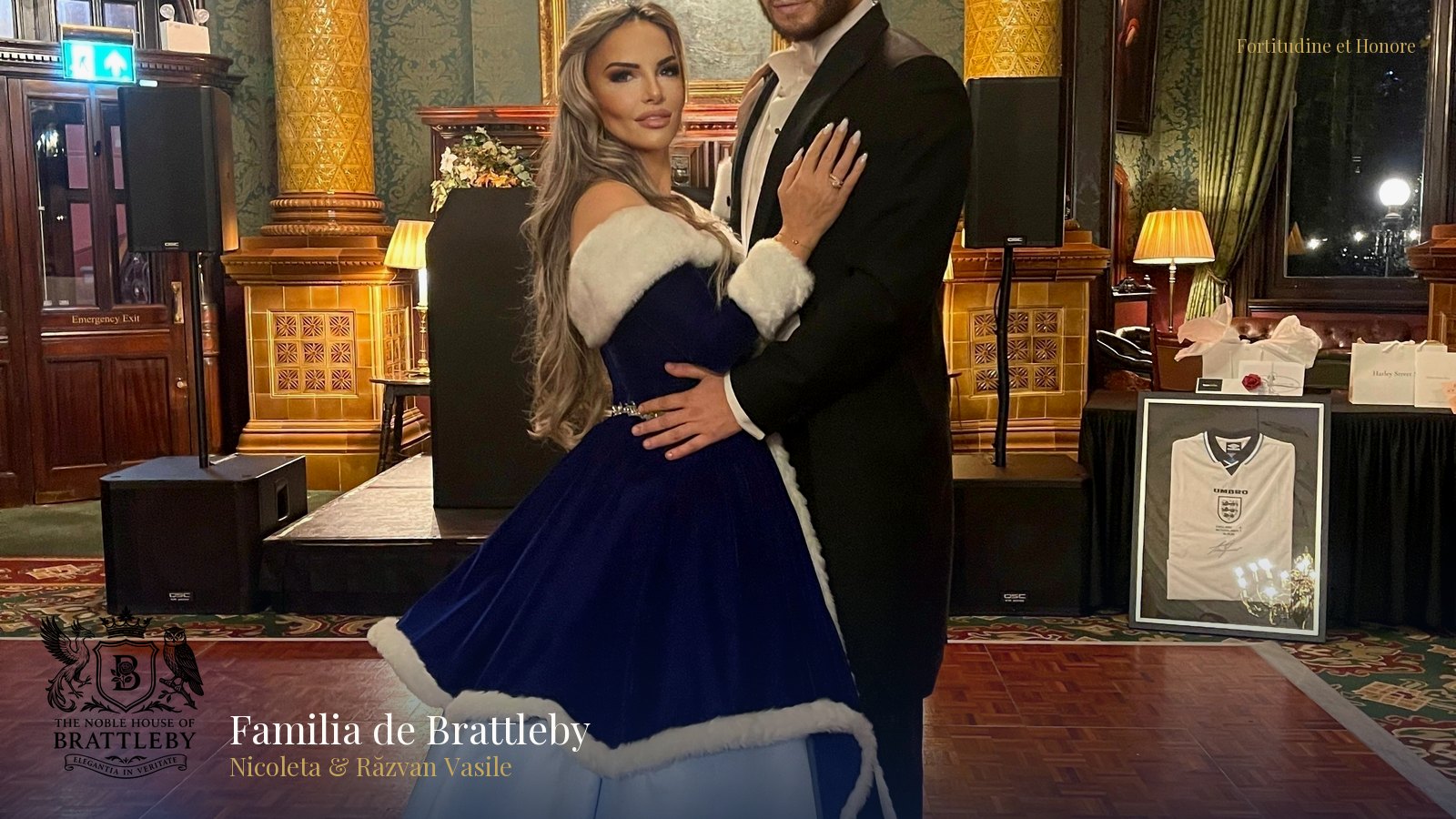
The Noble House of Brattleby, led by Lady Nicoleta Vasile, 12th Baroness of Brattleby, and her husband, Honorary Lord Răzvan Vasile, is dedicated to the stewardship of a unique nine-century English heritage. The House’s modern mission is focused on three core pillars: the preservation of its historical legacy, the advancement of cultural education, and a deep commitment to targeted philanthropy. Through key initiatives such as its annual Winter Banquet in aid of vulnerable children and the work of The Brattleby Club, the House translates its ancient motto, *Fortitudine et Honore* (‘With Fortitude and Honour’), into tangible actions that strengthen community and protect the defenceless. The House’s activities are guided by a profound sense of duty to its distinguished lineage and its contemporary social responsibilities.
**About the Barony of Brattleby**
The Barony of Brattleby is a feudal barony of Magnitude in Lincolnshire, England, established by King William the Conqueror in AD 1066. Its first holder, the Norman knight Colswein of Lincoln, is recorded in the *Domesday Book* of 1086 as holding 56 lordships directly from the Crown. Over the centuries, the Barony has a distinguished history, with its title and associated lands having passed through some of English history’s most notable figures, including Nichola de la Haye, the formidable defender of Lincoln Castle; Henry of Grosmont, 1st Duke of Lancaster; and John of Gaunt. As one of the few feudatories from the Norman Conquest to have a provable continuous existence, its historicity was formally acknowledged by The London Gazette on 9 September 2022 (Notice ID 4158083).
**Notes to Editors** - The Barony of Brattleby was established in AD 1066 and is recorded as a significant landholding in the *Domesday Book* of 1086. - The succession of the 12th Baroness, Lady Nicoleta Vasile, was formally recorded in *The London Gazette*, Notice ID 4158083, on 9 September 2022. - Notable predecessors associated with the Barony's history include Nichola de la Haye (5th Baroness *de jure uxoris*), Henry of Grosmont (10th Baron), and John of Gaunt (11th Baron). - The annual white-tie Winter Banquet held in London is the House's principal philanthropic event, with proceeds benefiting the charity Healing the Wounded Child.
**Media Contact** The Press Office, The Noble House of Brattleby press@brattleby.com