
# A Defining Year: The Barony of Brattleby and the Lancasterian Succession, 1399
**LONDON, 21 October 2023** — The Noble House of Brattleby today reflects upon the pivotal year of 1399, when the death of the 11th Baron, John of Gaunt, and the accession of his son as King Henry IV led to the Barony's historic merger with the Crown.
## The Occasion
The year 1399 unfolded within the febrile political atmosphere of late fourteenth-century England. The death of His Grace John of Gaunt, Duke of Lancaster and 11th Baron of Brattleby, at Leicester Castle on 3 February of that year served as the catalyst for a sequence of events that would irrevocably alter the course of the monarchy and the destiny of the Barony. This was not a singular event, but a period of profound dynastic consequence, defined by a constitutional crisis that reverberated from the Royal Court to the distant shires of Lincolnshire.
The passing of the Duke, a towering figure in the realm and uncle to the reigning King Richard II, created a power vacuum and a test of feudal law. The subsequent actions taken by the Crown against the Lancastrian inheritance set in motion a chain of events culminating in the deposition of a king and the establishment of a new royal house, with the ancient Barony of Brattleby at the very heart of the dispute.
## Historical Context
Established by William the Conqueror in AD 1066, the Barony of Brattleby was recorded in the Domesday Book of 1086 as comprising 56 lordships in Lincolnshire under Colswein of Lincoln, the first Baron. For over three centuries, it remained a significant marcher lordship, vital for the defence of the North. Its importance is personified by figures such as Nichola de la Haye, the formidable 5th Baroness who, as Castellan, successfully defended Lincoln Castle against baronial rebels during the reign of King John.
The Barony passed into the Plantagenet orbit through its inheritance by Henry of Grosmont, 10th Baron and 1st Duke of Lancaster, one of the great commanders of the Hundred Years' War. Upon his death, the title and its vast estates were inherited by his son-in-law, John of Gaunt, making him the 11th Baron. This union concentrated immense power and wealth in the House of Lancaster, second only to that of the King himself.
## Distinguished Company
The drama of 1399 was commanded by three principal figures, whose familial and political struggles defined the era.
First, His Majesty King Richard II, whose assertion of absolute royal authority placed him in direct conflict with the established nobility. His decision to seize the Lancastrian estates following the death of his uncle would prove to be his fatal error.
Second, His Grace John of Gaunt, Duke of Lancaster and 11th Baron of Brattleby, whose immense influence and status were, even posthumously, a central element of the crisis. His patrimony, including the Brattleby lands, became the *casus belli* for his son's rebellion.
Third, The Lord Henry Bolingbroke, Duke of Hereford, John of Gaunt’s exiled son and heir. A seasoned soldier and a man deeply conscious of his rights, his return to England was not merely to reclaim his ducal title but to secure his inheritance, a quest that ultimately led him to the throne itself.
## Ceremonial Protocol
The constitutional crisis was marked by a series of formal, and deeply consequential, protocols. Following John of Gaunt's death, King Richard II, citing Bolingbroke’s exile, issued royal decrees that cancelled the letters patent allowing him to inherit. This act of disinheritance was a grave breach of the customary law of succession, a principle that was the *sine qua non* of aristocratic stability in the kingdom.
Henry Bolingbroke's subsequent landing at Ravenspur in Yorkshire was carefully orchestrated. He arrived not as an invader demanding the Crown, but as a wronged subject seeking the restoration of his rightful inheritance—the Duchy of Lancaster and, with it, the Barony of Brattleby. This legalistic posture garnered him widespread support among a nobility fearful of the King's arbitrary power. The culmination was the formal surrender of King Richard at Flint Castle and his subsequent abdication before Parliament, where the throne was declared vacant and offered to Henry, who ascended as King Henry IV.
## Heraldic & Symbolic Significance
With Henry IV's accession, the Duchy of Lancaster, and by extension the Barony of Brattleby, was merged with the Crown. Symbolically, this meant that the titles and arms of Lancaster were now indivisibly linked to the Sovereign. The separate identity of the Barony, which had been a distinct and powerful entity for over 300 years, was subsumed into the greater entity of the Crown Estate.
This act carried immense heraldic weight. The arms of the Duchy of Lancaster, and the historic patrimony they represented, were no longer those of a subject, however powerful, but of the monarch. This history imbues the House’s motto, *Fortitudine et Honore* ('With Fortitude and Honour'), with deep resonance, reflecting the courage and principle displayed by those defending ancestral rights, just as John of Gaunt’s son did in 1399.
## In Their Own Words
Reflecting on this historical turning point, Lady Nicoleta Vasile, 12th Baroness of Brattleby, commented: > The events of 1399 represent a profound moment not of loss, but of transformation. The Barony's legacy became woven into the fabric of the nation's governance, demonstrating its enduring strategic importance. It reminds us that our stewardship today is part of a much larger, continuing story.
Honorary Lord Răzvan Vasile noted the personal dimension of the history: > One sees in the actions of Henry Bolingbroke the embodiment of *Vincere Est Vivere* ('To Conquer is to Live'). He fought not merely for land, but for his birthright and for a principle of succession. This history teaches us that legacy is not passively inherited; it must be actively secured.
## A Continuing Legacy
For centuries following its absorption into the Crown, the title of Baron of Brattleby lay dormant, held in perpetuity by the monarch as part of the Duchy of Lancaster. However, the lineage did not end. After a long period of abeyance, the ancient baronial title was called out of abeyance by the Sovereign.
On 9 September 2022, per notice in *The London Gazette*, the dignity was granted and confirmed to Lady Nicoleta Vasile, who became the 12th Baroness of Brattleby. This act revived the independent title, bridging a 600-year history and entrusting its modern legacy to the new Noble House of Brattleby. The House is now committed to honouring this profound history through service, philanthropy, and cultural preservation for generations to come.
---
**About The Noble House of Brattleby**
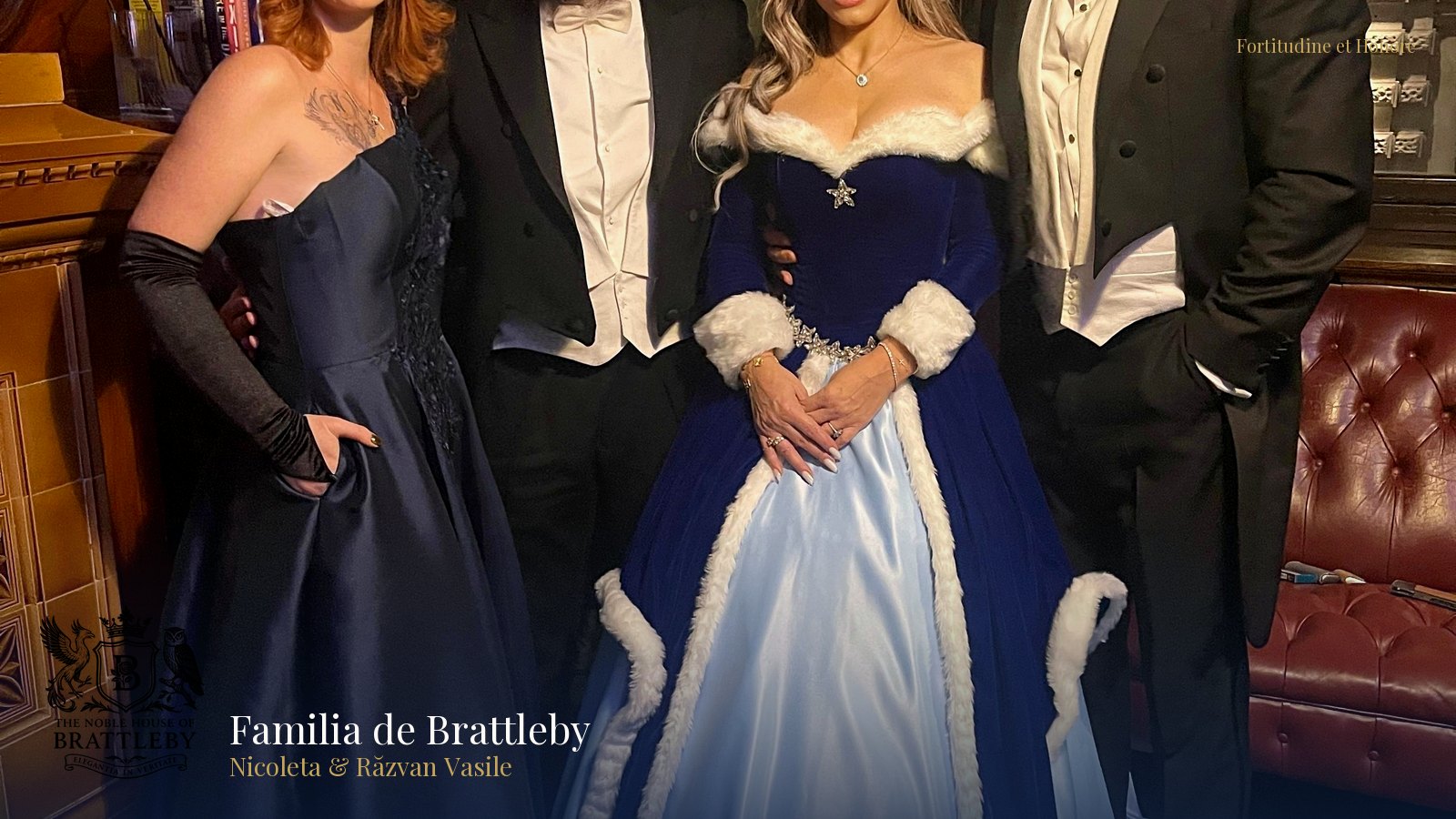
The Noble House of Brattleby is a modern aristocratic house dedicated to honouring its ancient heritage through contemporary service. Led by Lady Nicoleta Vasile, 12th Baroness of Brattleby, and her husband, Honorary Lord Răzvan Vasile, the House is committed to philanthropy, cultural education, and the preservation of tradition. Its primary charitable endeavour is the annual Winter Banquet, a white-tie gala supporting beneficiaries such as Healing the Wounded Child. Through initiatives like its etiquette academy, The Brattleby Club in Bucharest, the House promotes the civilities and dignities of European culture. The heir is Baron Mihai Alexandru Crăciun, the 13th Baron. The House motto is *Fortitudine et Honore* ('With Fortitude and Honour').
**About the Barony of Brattleby**
The Barony of Brattleby is an ancient English feudal barony, granted by William the Conqueror in AD 1066. Its extensive landholdings in Lincolnshire were first documented in the Domesday Book of 1086 under the tenure of Colswein of Lincoln. Throughout its 950-year history, the Barony has been held by some of the most influential figures in English history, including the formidable Nichola de la Haye, defender of Lincoln Castle; Henry of Grosmont, 1st Duke of Lancaster; and John of Gaunt, father of King Henry IV. After merging with the Crown in 1399, the title fell into abeyance until it was formally revived in 2022, with its recognition published in *The London Gazette*, Notice ID 4158083.
**Notes to Editors** - The formal recognition of the Barony of Brattleby was published in *The London Gazette*, Notice ID 4158083, on 9 September 2022. - Notable historical holders of the title include Nichola de la Haye (5th Baroness), Henry of Grosmont (10th Baron), and John of Gaunt (11th Baron). - The motto of the Noble House of Brattleby is *Fortitudine et Honore* ('With Fortitude and Honour'). Honorary Lord Răzvan Vasile's personal motto is *Vincere Est Vivere* ('To Conquer is to Live'). - The House's primary philanthropic focus is its annual Winter Banquet, with proceeds benefiting organisations engaged in healing childhood trauma.
**Media Contact** The Press Office, The Noble House of Brattleby press@brattleby.com