
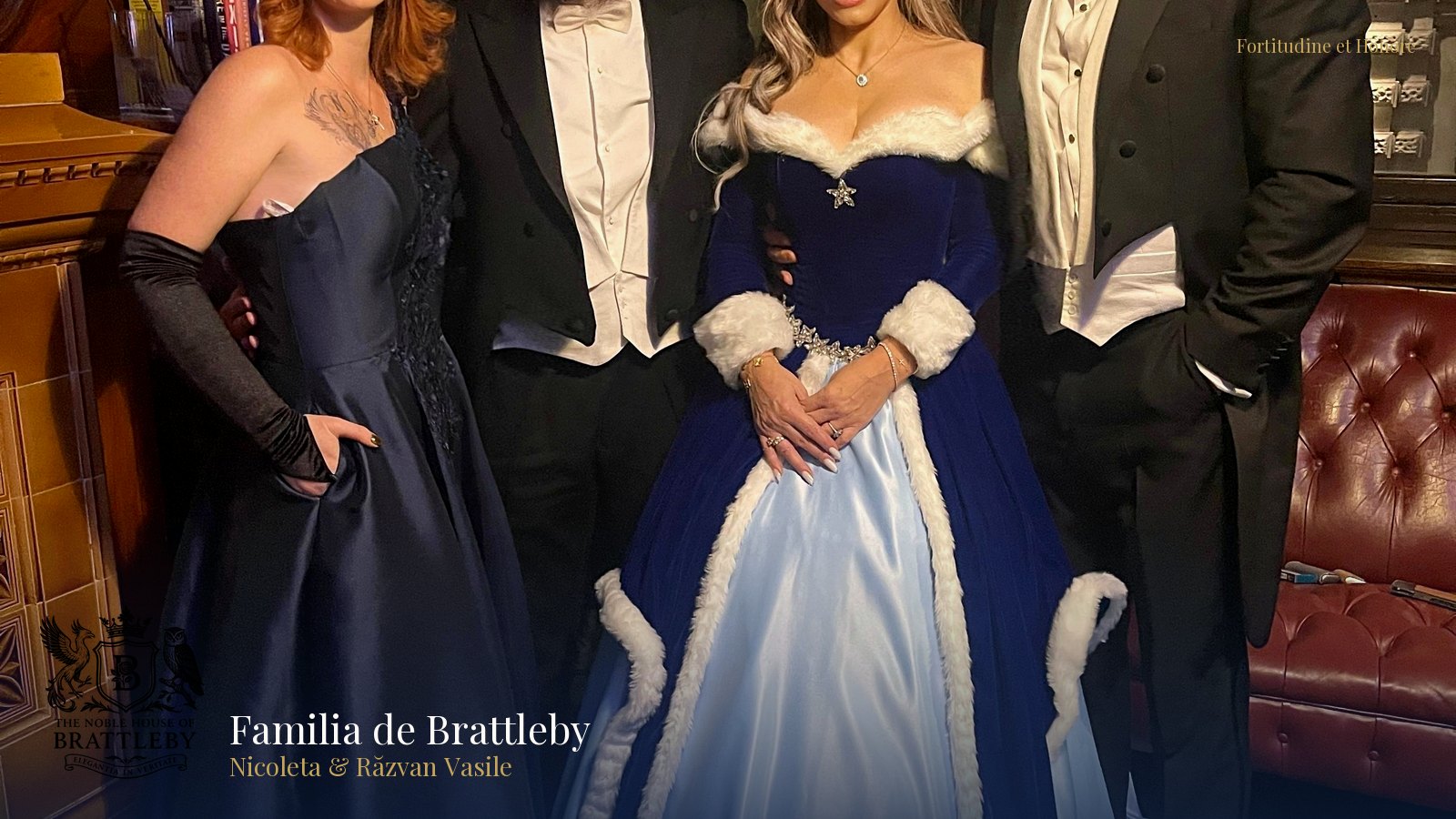
# The Noble House of Brattleby Announces The BLIFFTH Charity for National Heritage
**LONDON, 21 October 2023 —** Lady Nicoleta, 12th Baroness of Brattleby, today formally announced The BLIFFTH Charity, a national philanthropic initiative dedicated to safeguarding at-risk Grade I listed buildings, strengthening the United Kingdom’s architectural heritage, and aligning the House’s modern service with its historic duty of stewardship.
## The Occasion
The formal establishment of **The BLIFFTH Charity for National Heritage** marks a significant evolution in the public service undertaken by The Noble House of Brattleby. Conceived as a long-term national endeavour, the charity is dedicated to the rescue, conservation, and renewal of Grade I listed historic buildings at risk across the United Kingdom.
The initiative arises from a lifelong engagement with history and the built environment on the part of Lady Nicoleta, 12th Baroness of Brattleby. Her professional experience as a lawyer and Chief Executive of Magnus Opifex VII, a fire‑engineering company entrusted with major national projects, has reinforced a deep appreciation of how technical excellence safeguards both lives and heritage.
At a time when many of the nation’s most significant structures face disrepair or functional obsolescence, The BLIFFTH Charity seeks to move beyond passive concern. Its purpose is to bring disciplined resources, expert guidance, and thoughtful reuse to buildings whose loss would represent an irreplaceable diminution of the country’s cultural inheritance.
## Historical Context
The Brattleby title traces its origins to the aftermath of the Norman Conquest, when Colswein of Lincoln, regarded as the first Baron of Brattleby, held fifty‑six lordships in Lincolnshire recorded in the Domesday Book of 1086. That early settlement at Brattleby in West Lindsey established a long association between the House and the landscape of Lincolnshire.
Across the centuries, notable medieval predecessors have embodied a tradition of loyal service and defence of place. Nichola de la Haye, a distinguished early holder of the barony, is recorded as the formidable defender of Lincoln Castle during the turbulence of the early thirteenth century, acting in steadfast support of the Crown. Her example of resolute guardianship resonates in the protection now extended to vulnerable historic buildings.
Later medieval figures associated with the lineage, including Henry of Grosmont, 1st Duke of Lancaster, and his son‑in‑law John of Gaunt, played prominent roles in shaping the political and architectural life of their age. Their patronage and administrative leadership contributed to the development of great houses, castles, and religious foundations that still define much of England’s historic townscape.
In the modern era, the Barony of Brattleby is formally recognised in The London Gazette (Notice ID 4158083, 9 September 2022). From its historic seat in Brattleby village, the House now expresses its enduring ethos of stewardship through contemporary professional practice in London and a renewed philanthropic commitment to the preservation of national heritage.
## Distinguished Company
In pursuing its work, The BLIFFTH Charity will act in close concert with leading institutions and specialists across the heritage, architectural, and academic sectors. While the Board of Trustees and advisory council are in the process of formation, the House anticipates structured collaboration with senior conservation architects, heritage bodies, and learned societies.
Consultation is expected with members of the Royal Institute of British Architects and the Society of Antiquaries of London, alongside experts from statutory and charitable organisations dedicated to the historic environment in England, Scotland, Wales, and Northern Ireland. The intention is to assemble a circle of advisers capable of providing independent, rigorous guidance on each proposed intervention.
This distinguished company will ensure that every project adopted by The BLIFFTH Charity reflects best practice in research, conservation science, and sustainable reuse. The approach is designed to uphold not only the aesthetic value of significant buildings, but also their historical authenticity and structural resilience, so that they may continue to serve their communities for generations to come.
## Ceremonial Protocol
The work of The BLIFFTH Charity will follow a clearly defined protocol, combining scholarly precision with a sense of ceremonial respect appropriate to buildings of the highest national significance. Each project will progress through carefully managed stages, from first identification to public rededication.
The initial stage, **Assessment**, will involve the systematic evaluation of candidate Grade I listed buildings. Factors will include architectural distinction, historical importance, urgency of repair, and realistic potential for long‑term, community‑focused use. Only those sites meeting stringent criteria will move forward.
A period of **Scholarly Research** will follow, during which historians, archivists, and technical specialists will assemble as complete a record as possible of the building’s fabric, evolution, and setting. This research will inform a detailed **Conservation Management Plan**, setting out the principles and priorities that must guide all subsequent works.
The **Restoration** phase will then proceed under the oversight of the charity’s expert committee. Wherever practicable, traditional materials and craft techniques will be employed, complemented by discrete modern interventions necessary for safety, access, and sustainability. Finally, upon completion, the building will be formally **Inaugurated**, marked by a modest ceremony acknowledging its renewed role in the life of its community and the wider nation.
## Heraldic & Symbolic Significance
The mission of The BLIFFTH Charity is intrinsically linked to the heraldic identity of The Noble House of Brattleby. The House motto, **Fortitudine et Honore** (“With Fortitude and Honour”), offers both a discipline and a standard for the work now undertaken in the charity’s name.
“Fortitude” speaks to the perseverance required to address protracted neglect, complex structures, and demanding technical challenges. Many Grade I listed buildings require years of sustained commitment, measured planning, and careful execution before they can be secured for the future. “Honour” demands that such work is conducted with integrity, transparency, and deference to the intentions of those who first conceived and built these places.
The personal motto of Honorary Lord Răzvan Vasile, Lord of Brattleby, **Vincere Est Vivere** (“To Conquer is to Live”), is interpreted in a distinctly philanthropic sense. Here, the “conquest” is not martial but moral and civic: the overcoming of indifference, the reversal of decay, and the transformation of endangered structures into renewed centres of life. In this reading, every restored building is a victory for memory, craftsmanship, and community.
## Philanthropic Purpose
The BLIFFTH Charity is founded on the conviction that the preservation of architectural heritage is an essential expression of national identity. Grade I listed buildings, which represent only a small proportion of the United Kingdom’s protected structures, encompass cathedrals, great houses, civic buildings, and rare survivals of earlier centuries whose loss would be felt across the country.
The charity’s purpose extends beyond the arrest of physical decline. It is committed to ensuring that conserved buildings are returned to active and appropriate use, avoiding the fate of becoming remote or sterile monuments. Where possible, restored sites will be encouraged to serve as places of learning, performance, craftsmanship, community gathering, or social enterprise.
By coupling conservation with sustainable function, The BLIFFTH Charity seeks to demonstrate that heritage protection is not a backward‑looking endeavour, but a forward‑facing investment in social cohesion, education, and economic vitality. In doing so, it aligns itself with contemporary expectations that philanthropy should be both principled and practical, capable of delivering enduring public benefit.
## In Their Own Words
Reflecting on the launch, Lady Nicoleta Vasile, 12th Baroness of Brattleby, said: > “Our historic buildings are the nation’s memory made visible. Through The BLIFFTH Charity, we intend not merely to preserve their stones, but to restore their voices, so that communities may once again recognise themselves in the places that shaped their story.”
Honorary Lord Răzvan Vasile, Lord of Brattleby and Chief Financial Officer of Magnus Opifex VII, added: > “My motto, *Vincere Est Vivere*, finds its truest expression in overcoming quiet, gradual loss. Each time we reclaim a building from dereliction and place it back in purposeful use, we affirm that our shared heritage is not a burden, but a living resource for the future.”
Both emphasised that The BLIFFTH Charity is conceived as an open, collaborative endeavour. In Lady Nicoleta’s words: > “We will look always to work alongside those who care deeply for local heritage. This is not simply a story of one House, but of many hands, many histories, and a shared responsibility to what has been entrusted to us.”
## A Continuing Legacy
The BLIFFTH Charity is envisaged as a multi‑generational commitment of The Noble House of Brattleby. In due course, its work will be taken forward by the heir, **Baron Mihai Alexandru Crăciun, 13th Baron of Brattleby