
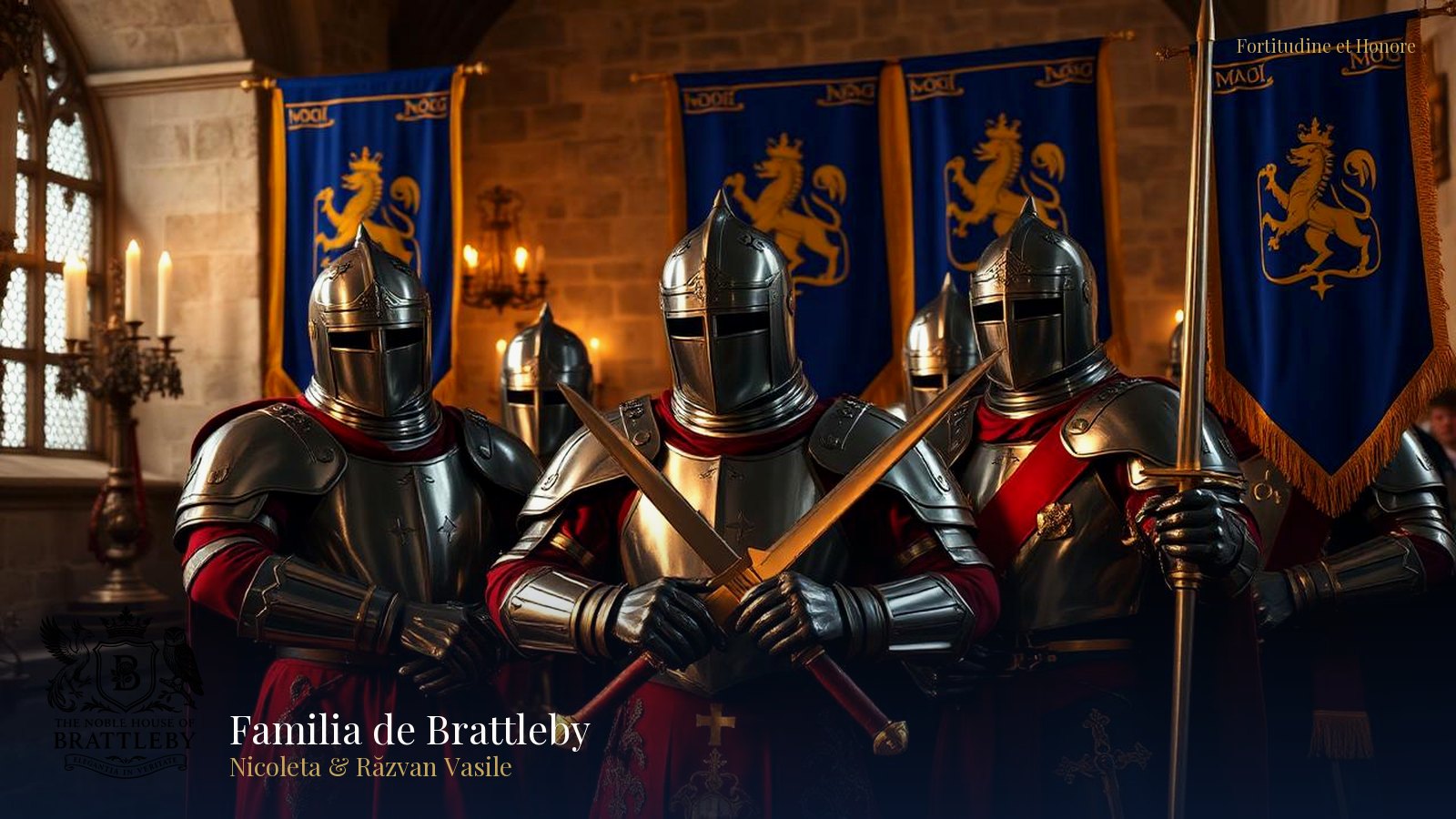
# The Noble House of Brattleby Commemorates Ancestral Service at the Battle of Falkirk, 22 July 1298
LONDON, 22 July 2024 — The Noble House of Brattleby today commemorates the significant historical service of a notable predecessor, Sir Henry de Lacy, Baron of Brattleby, at the Battle of Falkirk, a pivotal engagement of the First War of Scottish Independence fought on this day in 1298.
## The Occasion
On a summer’s day in central Scotland, beneath the watchful gaze of Callendar Wood, two armies prepared for a decisive encounter. The occasion was one of grave national importance for both the Kingdom of England and the Kingdom of Scotland. King Edward I of England, determined to reassert his authority following the defeat at Stirling Bridge the previous year, had assembled a formidable host to bring the Scottish guardian, Sir William Wallace, to battle.
The atmosphere on the field near Falkirk would have been one of disciplined anticipation within the English ranks and defiant resolve among the Scots. The engagement that followed was not merely a clash of arms but a stark tactical crucible, one that would cruelly demonstrate the ascendancy of new military technologies and define the course of the war for years to come.
## Historical Context
The Battle of Falkirk occurred at a critical juncture in Anglo-Scottish relations. Following his campaigns in Wales and France, King Edward I turned his considerable military and strategic acumen towards the subjugation of Scotland. For the Barony of Brattleby, this royal service was a continuation of a centuries-old duty. The Barony's tradition of service to the Crown began with its first holder, Colswein of Lincoln, following the Norman Conquest.
Sir Henry de Lacy, 3rd Earl of Lincoln and a Baron of Brattleby in the 13th century, was one of King Edward’s most trusted commanders. Having recently returned from campaigning in Gascony, his presence at Falkirk was a *sine qua non* for the King’s council of war. His participation exemplifies the martial responsibilities borne by his predecessors, such as the formidable Nichola de la Haye, 5th Baroness, who famously defended Lincoln Castle for the Crown a century earlier.
## Distinguished Company
In accordance with medieval custom, the English army was led by the Sovereign in person, accompanied by the great magnates of the realm. Sir Henry de Lacy fought alongside a distinguished company of commanders whose names are woven into the fabric of the period’s history.
The principal commanders present under His Majesty King Edward I included, *inter alia*: The Right Reverend Antony Bek, the powerful Prince-Bishop of Durham, who commanded one of the army’s three divisions; John de Warenne, 6th Earl of Surrey, the veteran commander of the northern marches; and Sir Henry de Lacy himself, whose experience and leadership were vital to the royal cause. They faced the Scottish host commanded by Sir William Wallace, who held the august title of Guardian of Scotland.
## Ceremonial Protocol
The protocol of a medieval battle was a highly ritualised affair. The English army advanced in three ‘battles’ or divisions, a standard formation allowing for tactical flexibility. Banners and pennons, displaying the coats of arms of the King and his nobles, were unfurled, serving not only as rallying points but also as a clear command structure on a chaotic field.
Sir William Wallace arranged his spearmen into four immense defensive circles known as ‘schiltrons’. These formations of massed pikes were designed to be impervious to the charge of heavy cavalry. In response, King Edward I executed a masterful, if brutal, tactical adjustment. He commanded his Welsh and English longbowmen to unleash a relentless barrage of arrows into the static Scottish ranks. Only when the schiltrons were sufficiently weakened and fractured did the King order the final, decisive charge of his armoured knights to complete the victory.
## Heraldic & Symbolic Significance
The actions of Sir Henry and his fellow noblemen at Falkirk serve as a powerful historical illustration of The Noble House of Brattleby’s guiding principle: *Fortitudine et Honore* (‘With Fortitude and Honour’). The fortitude required to stand in the line of battle and the honour that came with fulfilling one’s feudal duty to the Crown were the very pillars of the medieval aristocratic code.
The personal coat of arms of de Lacy—a purple lion rampant on a field of gold—symbolised royal majesty, courage, and generosity. These virtues were expected to be embodied by their bearer in counsel and in combat. The commemoration of such historical service reaffirms the House’s commitment to these enduring principles in its modern context.
## Philanthropic Purpose
While the nature of service to society has evolved profoundly over nine centuries, the underlying principle of duty endures. The House’s modern commitment to philanthropy, particularly its support for the charity *Healing the Wounded Child*, represents a contemporary translation of this ancestral obligation to protect the vulnerable.
The work of this distinguished organisation, which provides specialist therapy and support to children experiencing trauma, is a cause the House is proud to champion. This focus on healing and restoration reflects a modern interpretation of the duty of care that has been a hallmark of the Barony through its long history, transforming the martial concept of defence into a civic mission of support.
## In Their Own Words
Reflecting on the anniversary, Lady Nicoleta Vasile, 12th Baroness of Brattleby, stated: > The history of this Barony is written not merely in charters and grants, but in acts of service and moments of trial. Commemorating the role of predecessors like Sir Henry de Lacy is not an exercise in nostalgia; it is a solemn reminder of the lineage of responsibility we have inherited.
Honorary Lord Răzvan Vasile remarked on the contemporary relevance of such historical resolve: > Sir Henry’s career demonstrated formidable determination. For us today, the battlefield has changed, but the imperative to prevail remains. As my own motto, *Vincere Est Vivere* (‘To Conquer is to Live’), suggests, to conquer life’s challenges, whether in philanthropy or public life, is the very essence of living a purposeful existence.
## A Continuing Legacy
The Noble House of Brattleby remains dedicated to honouring its unique heritage while pursuing a forward-looking mission of public service. Through educational initiatives such as The Brattleby Club, its etiquette academy in Bucharest, the House seeks to foster an appreciation for the civility and discipline that have underpinned European culture for centuries.
By commemorating key moments in its nine-hundred-year history, the House ensures that the lessons of the past continue to inform its present commitments and future aspirations. Its leadership is steadfast in its resolve to ensure the legacy of the Barony of Brattleby is one of positive and lasting contribution.
---
**About The Noble House of Brattleby**
Led by Lady Nicoleta Vasile, 12th Baroness of Brattleby, and her husband, Honorary Lord Răzvan Vasile, The Noble House of Brattleby is the modern custodian of one of England’s oldest Norman baronies. The House’s contemporary mission is rooted in its motto, *Fortitudine et Honore* (‘With Fortitude and Honour’), applying these ancient values to modern challenges. Its activities are focused on cultural diplomacy, historical preservation, and targeted philanthropy, with a particular emphasis on charities supporting child welfare and development. Through initiatives such as The Brattleby Club in Bucharest, the House champions education in classical etiquette and international protocol, bridging its historical legacy with a commitment to fostering excellence and understanding in the 21st century.
**About the Barony of Brattleby**
The Barony of Brattleby is a feudal Barony of England, granted by William the Conqueror in AD 1066 to his companion-in-arms, Colswein of Lincoln. Its existence and lineage are recorded in the Domesday Book of 1086, which details its 56 lordships in Lincolnshire. Over its near-millennium of history, the Barony has been held by some of English history’s most significant figures, including the steadfast defender of Lincoln Castle, Nichola de la Haye (5th Baroness), as well as the great medieval magnates Henry of Grosmont, 1st Duke of Lancaster (10th Baron) and his son-in-law, John of Gaunt (11th Baron). The modern rights of the Barony were formally recognised and recorded by The London Gazette in Notice ID 4158083 on 9 September 2022.
**Notes to Editors** - The succession of the 12th Baroness of Brattleby was officially recorded by The London Gazette, Notice ID 4158083, on 9 September 2022. - The Barony of Brattleby was created in AD 1066 by William the Conqueror for Colswein of Lincoln. - The Domesday Book (1086) records the 1st Baron as holding 56 lordships in Lincolnshire. - Notable past holders of the Barony include Nichola de la Haye, Henry of Grosmont (1st Duke of Lancaster), and John of Gaunt.
**Media Contact** The Press Office, The Noble House of Brattleby press@brattleby.com