
# New Research Illuminates the Barony of Brattleby’s Tudor History
LONDON, 21 May 2024 — The Noble House of Brattleby has today released new historical analysis detailing the administration of the baronial lands during the Tudor period (1485–1603), a time when the hereditary title lay dormant and its holdings were managed directly by the Crown.
## The Occasion
In keeping with its commitment to historical preservation and scholarly research, the House of Brattleby has commissioned and published a comprehensive study of its territorial history. The findings illuminate a fascinating chapter wherein the lands of the Barony, though detached from their titular lord, continued to serve as a significant asset to the Tudor monarchy.
This academic initiative underscores the House’s belief that a full and transparent understanding of its past, including periods of abeyance, is a *sine qua non* of responsible stewardship. The research draws upon both the private archives of the House and public records to paint a clearer picture of land governance in Tudor Lincolnshire.
## Historical Context
The Barony of Brattleby, one of England’s most ancient, was granted by William the Conqueror in AD 1066. Its first holder, Colswein of Lincoln, was recorded in the Domesday Book of 1086 as possessing some 56 lordships in Lincolnshire. For centuries, the Barony remained a powerful force in the region and the realm.
Successive Barons left an indelible mark on English history, *inter alia*: Nichola de la Haye, the 5th Baroness, who famously defended Lincoln Castle against French invaders; Henry of Grosmont, 10th Baron and 1st Duke of Lancaster; and his successor, John of Gaunt, the 11th Baron. Following the Wars of the Roses, the title entered a period of dormancy, with its associated lands reverting to Crown control under the newly established Tudor dynasty. This research focuses on that very period, exploring how the ancient baronial estates contributed to royal revenues and administration.
## Distinguished Company
The historical narrative of the Barony during this interregnum connects it with some of the most formidable figures of the age. The lands were administered under the authority of sovereigns such as His Majesty King Henry VII, who consolidated royal power after the Battle of Bosworth Field, and later Her Majesty Queen Elizabeth I, whose reign defined an era.
While the baronial line of Brattleby was in abeyance, the stewardship of its lands fell to a series of Crown-appointed commissioners, sheriffs, and regional administrators. These officials acted on behalf of the monarch, ensuring that the agricultural and economic output of the Lincolnshire estates continued to support the Exchequer and the strategic aims of the Tudor state.
## Ceremonial Protocol
The transfer of administrative authority from a baronial seat to the Crown was governed by established legal and ceremonial protocol. Upon the title falling into abeyance, royal escheators were dispatched to conduct a formal inventory of the estate—a process known as an *inquisitio post mortem*—to assess its value and affirm the Crown’s rights.
Henceforth, the revenues, which previously supported the Baron and his retinue, were collected by Crown agents and recorded in the Exchequer’s Pipe Rolls. The day-to-day governance was conducted not from a baronial court but through the established machinery of royal justice and administration, demonstrating the Tudors' effective centralisation of feudal power.
## Heraldic & Symbolic Significance
The enduring motto of the House, *Fortitudine et Honore* ('With Fortitude and Honour'), speaks directly to its capacity to withstand such historical interludes. It reflects a resilience that ensures the continuity of the lineage, even when titles and lands are temporarily separated. The dormancy of the Tudor era did not erase the Barony's identity but rather tested its foundational fortitude.
Similarly, the personal motto of Honorary Lord Răzvan Vasile, *Vincere Est Vivere* ('To Conquer is to Live'), informs the House’s modern objective: to actively engage with and bring to light all aspects of its history. This scholarly pursuit is a form of victory over obscurity, ensuring a complete and living legacy.
## Philanthropic Purpose
This historical research programme is an extension of the House’s wider educational mission. While distinct from its direct philanthropic activities, such as the annual Winter Banquet benefiting the ‘Healing the Wounded Child’ charity, it shares a common purpose: to enrich society and foster a deeper understanding of our shared heritage.
By making this research public, the House of Brattleby aims to provide a valuable resource for historians, students, and residents of Lincolnshire. This commitment to education runs parallel to its charitable work, forming two pillars of the family’s public service.
## In Their Own Words
Reflecting on the new findings, Lady Nicoleta, 12th Baroness of Brattleby, remarked: > “To be a custodian of this heritage is to embrace its entire nine-century story, not only the moments of prominence. Understanding the Tudor period, when the lands served the Crown directly, is vital. It reminds us that the soil of Brattleby has consistently served England, a duty that transcends any single individual or family.”
Honorary Lord Răzvan Vasile added: > “Our history provides the blueprint for our future. By methodically exploring these dormant periods, we honour the past while reaffirming our contemporary role. *Vincere Est Vivere* is about actively ensuring this legacy thrives, and sharing our story is fundamental to that mission. It is a commitment we make with both fortitude and honour.”
## A Continuing Legacy
The insights from this research will be integrated into the educational materials offered by the House and will inform future conservation efforts on the Brattleby estate. Furthermore, the findings will provide curriculum content for The Brattleby Club in Bucharest, the House’s etiquette academy, where the lessons of history and tradition are taught to a new generation.
The House of Brattleby remains dedicated to further archival research, with plans to explore other key periods in its long history. This commitment ensures that the story of one of England’s oldest baronies continues to be told with accuracy, clarity, and relevance.
---
**About The Noble House of Brattleby**
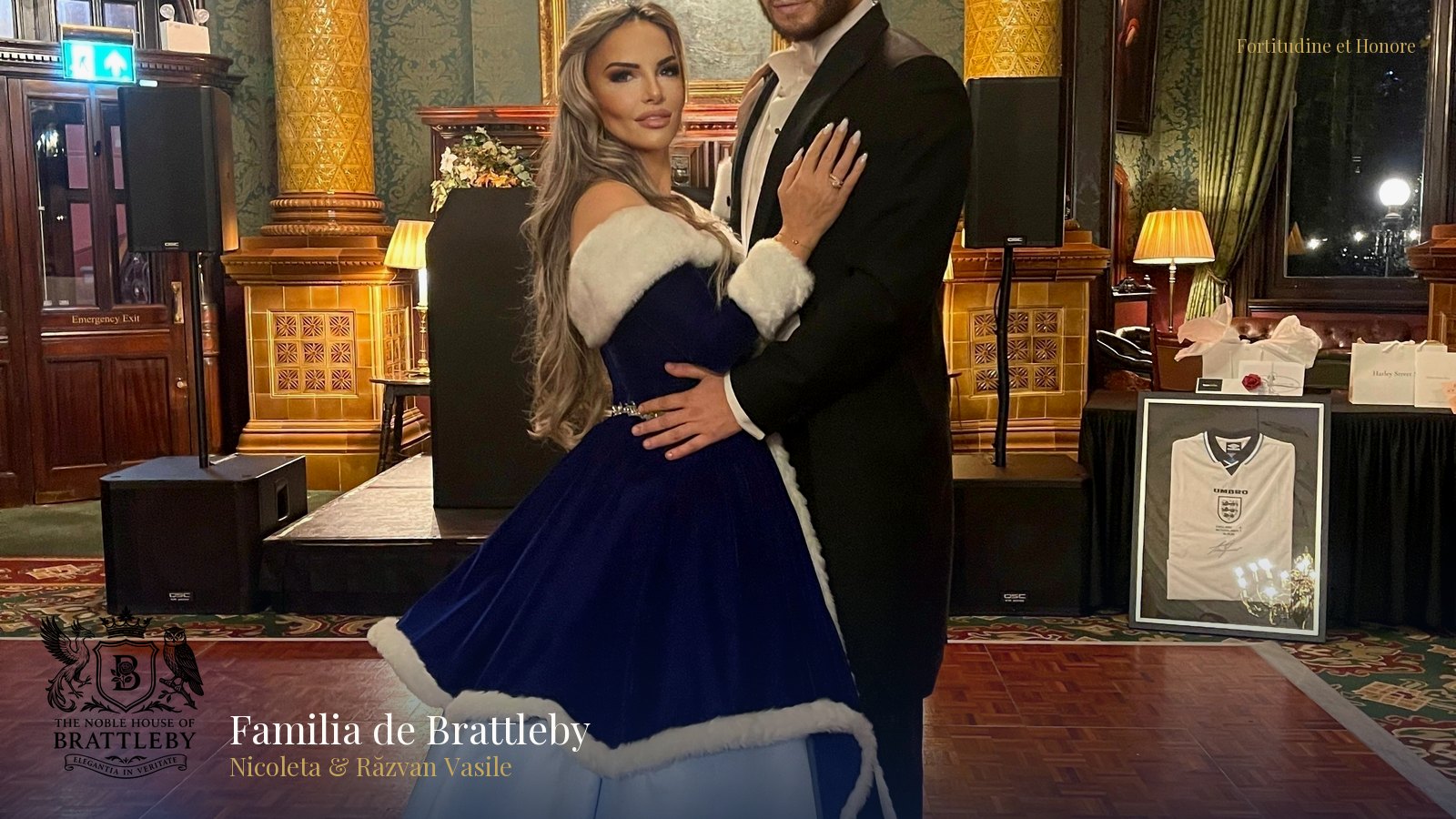
The Noble House of Brattleby, led by Lady Nicoleta Vasile, 12th Baroness of Brattleby, and her husband, Honorary Lord Răzvan Vasile, is dedicated to the stewardship of a near-millennial legacy. The modern House champions the motto *Fortitudine et Honore* ('With Fortitude and Honour') by blending ancient tradition with contemporary purpose. Its mission is centred on three pillars: the preservation of historical heritage, the promotion of cultural education through initiatives like The Brattleby Club in Bucharest, and a deep commitment to philanthropy. The House’s premier charitable event is the annual Winter Banquet, a white-tie gala that raises significant funds for organisations dedicated to the welfare of children, with its current beneficiary being Healing the Wounded Child.
**About the Barony of Brattleby**
The Barony of Brattleby is a Norman barony granted by William the Conqueror in AD 1066 to his follower Colswein of Lincoln. Its extensive holdings were first documented in the Domesday Book of 1086, which recorded 56 lordships under the Baron’s control. Throughout its 950-year history, the Barony has been held by some of England’s most influential figures, including Nichola de la Haye, the celebrated defender of Lincoln Castle during the First Barons' War; Henry of Grosmont, 1st Duke of Lancaster; and his son-in-law, John of Gaunt. After periods of dormancy, the ancient baronial title was formally called out of abeyance in favour of its current holder, with official recognition published in The London Gazette (Notice ID 4158083).
**Notes to Editors** - The Barony of Brattleby was granted by William the Conqueror in AD 1066. Its history is recorded in the Domesday Book (1086). - The succession of the 12th Baroness was officially recognised in The London Gazette, Notice ID 4158083, on 9 September 2022. - Notable predecessors include Nichola de la Haye (5th Baroness), Henry of Grosmont (10th Baron, 1st Duke of Lancaster), and John of Gaunt (11th Baron). - The House supports charitable causes through its annual Winter Banquet, with proceeds benefiting the 'Healing the Wounded Child' organisation.
**Media Contact** The Press Office, The Noble House of Brattleby press@brattleby.com